China's Semiconductor Front-Runner CXMT Emerges as a DRAM Powerhouse Threatening Samsung and SK hynix [China's Semiconductor Challenge]
- Input
- 2026-07-27 18:16:13
- Updated
- 2026-07-27 18:16:13
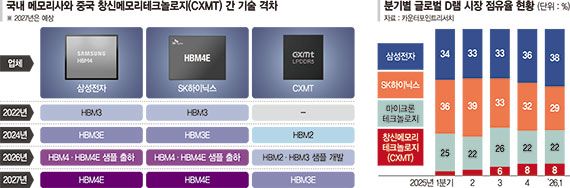
Although CXMT is widely seen as trailing Samsung Electronics and SK hynix by several generations in HBM technology, analysts say it could grow into a key rival to Korea's memory industry over the medium to long term if Chinese government support, massive domestic demand and large-scale capital investment continue to align.
■ 'Accelerating growth'... still a gap in HBM
According to the semiconductor industry on the 27th, CXMT is expanding its footprint in the global DRAM market by growing through commodity DRAM. Data from Counterpoint Research showed that in the first quarter of this year, Samsung Electronics held 38% of the global DRAM market by revenue, followed by SK hynix with 29%, Micron with 22%, and CXMT with 8%. CXMT, which had only 3% in the same period last year, more than doubled its share in just one year.
The gains came as the three major memory chipmakers increased production of HBM and other high-value products for AI, while CXMT quickly absorbed demand for commodity DRAM in China's domestic market. Nomura Securities also projected that CXMT's memory shipments will grow by 40% to 45% annually through 2030, and that its global DRAM market share will rise from about 10% now to 18% by the end of 2028.
However, most observers say the technology gap in HBM remains clear. CXMT has been expanding mass production of advanced-node DRAM, while reportedly supplying Huawei with samples of HBM3, its fourth-generation product based on DDR5, last year. The current mainstream product in the HBM market is HBM3E, or fifth generation, but industry watchers believe CXMT will not be able to begin full-scale mass production of HBM3E until next year or later. By contrast, Samsung Electronics and SK hynix have supplied sixth-generation HBM4 to major customers such as NVIDIA and have already shipped samples of the next product, HBM4E, or seventh generation. In terms of product roadmaps alone, domestic chipmakers are now competing in HBM4E while CXMT is still chasing HBM3. The gap is seen as at least two generations.
■ Can it catch Samsung and SK?
Still, experts say the possibility of China's catch-up should not be underestimated simply because of the current technology gap.
Kim Yang-paeng, a senior research fellow at the Korea Institute for Industrial Economics and Trade, said, "A technology gap in advanced memory will inevitably remain for some time. That is because China has difficulty bringing in advanced semiconductor equipment." He added, "The biggest constraint is that U.S. export controls make it hard to secure extreme ultraviolet (EUV) lithography equipment." He went on to say, "Even in this environment, the fact that China has raised its technology to the current level means its own capabilities have reached a considerable stage." He also noted, "Once equipment access improves, the technology gap could narrow faster than expected."
Another concern is that the listing has given CXMT a foundation to expand production capacity and market reach at the same time.
CXMT is expected to use the funds raised through the IPO for production line upgrades, next-generation DRAM processes, HBM research and development, and construction of a new plant in Shanghai. Its production facilities in Hefei and Beijing are already said to be running at more than 90% utilization, and capacity will expand further once the ramp-up begins in earnest. Just as Samsung Electronics, SK hynix and Micron are expanding HBM lines to meet AI memory demand, CXMT is also accelerating its catch-up through aggressive capital spending, analysts said.
Jonghwan Lee, professor of system semiconductor engineering at Sangmyung University, said, "As investment capacity grows, spending on production facilities will increase, and DRAM output will inevitably rise." He added, "There is also a growing possibility that HBM supply will expand gradually, not just commodity DRAM." He emphasized, "If the supply shortage eases as CXMT expands capacity, it could also affect the profitability of Korean chipmakers. It is important to keep investing in the latest processes and production lines to widen the technology gap further."
[email protected] Reporter Im Su-bin and Lee Dong-hyeok Reporter