Monthly Monitoring Promised... On-site Face Double Burden of 'Relocation Costs and Rent Shortages' [From "The Light and Shadow of Urban Redevelopment Projects"]
- Input
- 2026-07-27 18:15:02
- Updated
- 2026-07-27 18:15:02
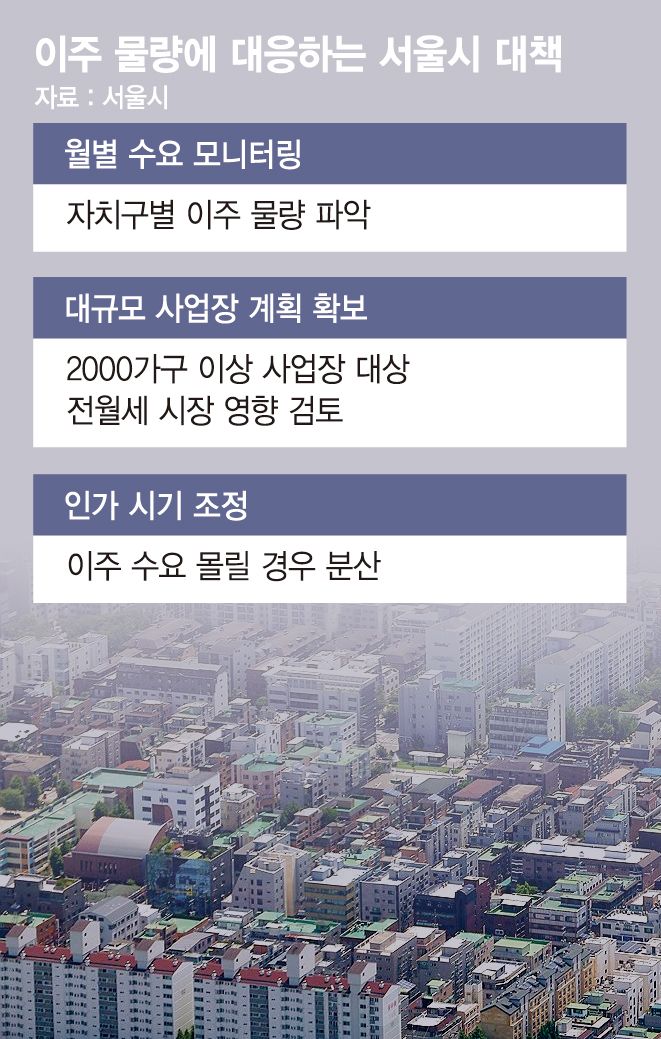
However, on the ground, critics point out that these policies are not having a major effect. With a decrease in rental listings coinciding with the rapid push for redevelopment and reconstruction, it appears that the burden of the damage is being passed on entirely to the displaced residents. ■ From Monitoring to Adjusting Approval Timing According to a comprehensive report by the Financial News on the 27th, the Seoul Metropolitan Government is currently responding to the surging relocation volume through methods such as monitoring monthly relocation demand, securing relocation plans in advance for large-scale projects, and adjusting approval timing when relocation demand spikes.
A regular task is monitoring each project site. The Seoul Metropolitan Government receives monthly relocation demand for urban renewal projects from all 25 autonomous districts every month. They explain that this allows them to determine which districts are experiencing a concentration of relocation volume and to what extent.
For large-scale projects with over 2,000 households, plans are secured from the association prior to relocation. An official from the Seoul Metropolitan Government's Real Estate Policy Team stated, "We review the impact of relocation due to redevelopment projects on the rental market by considering the supply and demolition volumes of the relevant district and adjacent districts. " There are 18 complexes in Seoul where the relocation of more than 2,000 households is scheduled from this year until 2030, including 'Noryangjin 1' in Dongjak-gu (3,897 households), 'Bukahyeon 2' in Seodaemun-gu (2,862 households), and 'Sinjeong 4' in Yangcheon-gu (2,127 households).
The initiative also aims to disperse relocation demand. In fact, according to the Seoul Metropolitan Government, during the relocation crisis in the Banpo area in 2021, the timing of approvals for each complex was adjusted to create a time lag.
At the time, over 3,600 households from Banpo Jugong Complex 1, including Zones 1, 2, 4, and Zone 3, experienced a surge in relocation volume in a short period in Seocho-gu, Seoul. ■ Effectiveness is 'Questionable'.
"Practical Assistance Needed" However, those on the ground do not feel the policy is very effective. According to members of associations involved in multiple redevelopment projects in Seoul who have recently completed or are currently relocating, what is needed during the relocation phase is not monitoring, but practical assistance such as "rental supply" and "loans.
" The most urgent need is relocation loan support. Earlier this year in February, the Seoul Metropolitan Government promised to provide relocation loans, but caused a stir once by reversing its decision to support some association members.
Member A, who completed relocation for a redevelopment project this year, said, "Redevelopment sites are broadly divided into two categories: those with many original residents and those with many investors," adding, "The latter have fewer problems, but in the former, it often takes a longer time to complete the relocation. " He continued, "There are people who cannot move even after the voluntary relocation period has passed because they lack even 300,000 won," adding, "While pushing forward with urban renewal projects quickly is good, a fundamental solution is needed to minimize the number of victims.
" The relocation crisis is not something the Seoul Metropolitan Government should be held responsible for alone. Although there have been signs of easing following the recent grand debate on real estate, it was the government that significantly tightened loan regulations in last year's "June 27 Measures" and "October 15 Measures.
" Some point out that the decrease in rental listings resulting from the government's tightening of regulations on multi-home owners and loan restrictions, combined with the Seoul Metropolitan Government's stance on rapid urban renewal projects, is exacerbating the problem. An official involved in urban renewal projects stated, "If (the relocation crisis) is not improved, the issue will become even more serious starting as early as 2028," adding, "This is a time when cooperation between the Seoul Metropolitan Government and the Ministry of Land, Infrastructure and Transport is absolutely necessary.
"
[email protected] Kwon Jun-ho Reporter