[Editorial] To Make Mega Special Zones a Success, Work Hour Flexibility Must Come First
- Input
- 2026-07-27 18:12:42
- Updated
- 2026-07-27 18:12:42
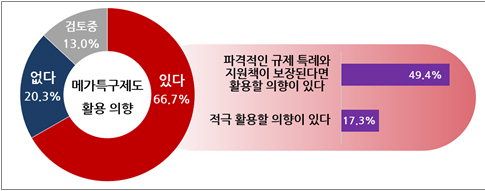
On the 26th, the Korea Enterprises Federation (KEF) released the results of a survey on corporate views of the mega special zone system, conducted among 468 companies in national advanced strategic technology sectors with 50 or more employees nationwide. Of the respondents, 66.7% said they were willing to use the mega special zones. More than half of the companies surveyed identified "flexibility in working hours for R&D personnel" as the most necessary labor-related regulatory exemption. This includes introducing a white-collar exemption that would exclude certain professionals meeting specific requirements from work hour regulations, such as exemptions from the 52-hour maximum workweek regulation, as well as expanding the periods for flexible work arrangements and the selective work system.
Since the 52-hour maximum workweek regulation took effect in 2018, the business community has repeatedly argued that "global companies keep the lights on in their labs around the clock and devote themselves to technological development, while our companies are falling behind because they are bound by uniform work hour rules." Their point is that R&D depends on concentration and continuity, yet only domestic companies are being forced to run with their hands and feet tied. In 2024, the People Power Party, then the ruling party, tried to include a clause exempting R&D positions from the 52-hour rule in the Semiconductor Special Act to reflect these demands. But the effort collapsed amid opposition from the Democratic Party of Korea (DPK), then the main opposition party, and labor groups. The Semiconductor Special Act finally passed the National Assembly in January this year, but the relevant clause was ultimately left out.
The atmosphere has changed under the Lee Jae Myung administration. The government is recently pushing a plan to exempt some specialized workers in mega special zones, including those in the Honam region, from the 52-hour workweek regulation. The government and the ruling party have, belatedly, shifted toward allowing exceptions. As the business community has argued, this is a necessary step from the standpoint of corporate and national competitiveness, and ultimately survival strategy. Of course, safeguards to protect workers' health, such as performance-based pay that rewards work done and guaranteed consecutive rest periods, must also be put in place.
The government should not stop at allowing exemptions from the 52-hour rule only in some mega special zones. It should also consider a broader approach. If exceptions are recognized only in certain regions, it could trigger fairness disputes and political misunderstandings. A forward-looking review is needed on whether the policy should also apply to the Yongin Semiconductor Cluster and, more broadly, to the semiconductor sector as well as future advanced strategic industries.
It would also be worth examining requests from companies for a delay in the application of the Serious Accidents Punishment Act and for eased restrictions on hiring foreign workers. If mega special zones are to become new growth hubs, regulations that constrain business activity, including labor and safety rules, must be boldly revised from the perspective of industrial competitiveness. Strong regulatory innovation and support measures, substantial enough to be felt as more competitive than the Capital Region, must follow. Only then can mega special zones become not just special districts in name, but a new growth engine for the Korean economy.