Ruling Party Prepares for Legislative Push...Moves Quickly to Revise Filibuster and Fast-Track Rules
- Input
- 2026-07-27 14:53:00
- Updated
- 2026-07-27 14:53:00
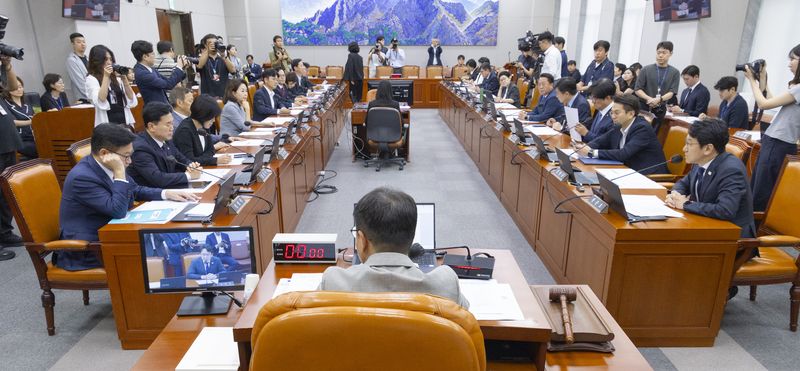
On the 27th, the House Steering Committee held a plenary session and referred 63 bills to the Subcommittee on Operational Improvements. Among the bills sent to the subcommittee, the most notable is a revision to the National Assembly Act proposed by DPK lawmaker Kim Tae-nyeon. It is known as the so-called "Working National Assembly Act."
The revision bill is designed to completely block boycotts of standing committees. Its core provision would create a legal basis for replacing the chair of a committee or subcommittee if the chair fails to convene a meeting for the purpose of preventing bill review. It also requires a meeting to be held within a set period if a request is made. The DPK introduced the measure as a response to the People Power Party's use of committee control to delay legislation during the first half of the 22nd National Assembly.
A separate National Assembly Act revision proposed by DPK lawmaker Kim Jun-hyeok, which would tighten the requirements for filibusters, was also referred to the subcommittee. The key point is to give the Speaker the authority to end debate if the number of lawmakers needed for a quorum, or one-fifth of all members, does not remain in the plenary chamber during a filibuster.
A similar revision had also been pushed by the DPK during the first half of the 22nd National Assembly. However, after negotiations between the floor leadership of the ruling and opposition parties, they agreed to drop that provision. As a result, only the part expanding plenary floor-management authority from the leadership to standing committee chairs was passed by the full chamber.
The DPK is now reviving the previously dropped filibuster-tightening measure, signaling a strategy to block the People Power Party's legislative delay tactics. Such tactics are expected to surface again when contentious bills are handled in the future. In fact, when a revision bill to extend the investigation period for the second special counsel probe was introduced to the plenary session at the start of the 22nd National Assembly, the People Power Party responded with a filibuster.
At the plenary session, Han Byung-do, the DPK's acting party leader and floor leader as well as chair of the House Steering Committee, stressed, "We need to improve the system so that the clock of the National Assembly never stops," adding, "We must complete the 'working National Assembly' through institutional reform."
Han has also argued repeatedly that, in addition to revising the filibuster system, the fast-track process, which can take up to 330 days, should be shortened to no more than 75 days.
A National Assembly Act revision proposed on the 21st by Nam In-soon, vice speaker of the National Assembly of the Republic of Korea, would automatically place bills that pass standing committees and the Legislation and Judiciary Committee on the plenary agenda. It was not submitted to the House Steering Committee's plenary session on the day because the 15-day review period required under the law had not yet passed. Han, however, has emphasized the need for the bill and signaled his intention to push for its passage.
[email protected] Kim Hyeong-gu Reporter