Heat Wave Crisis Alert Raised to "Severe"... CDSCHQ Activated (Roundup)
- Input
- 2026-07-27 14:32:38
- Updated
- 2026-07-27 14:32:38
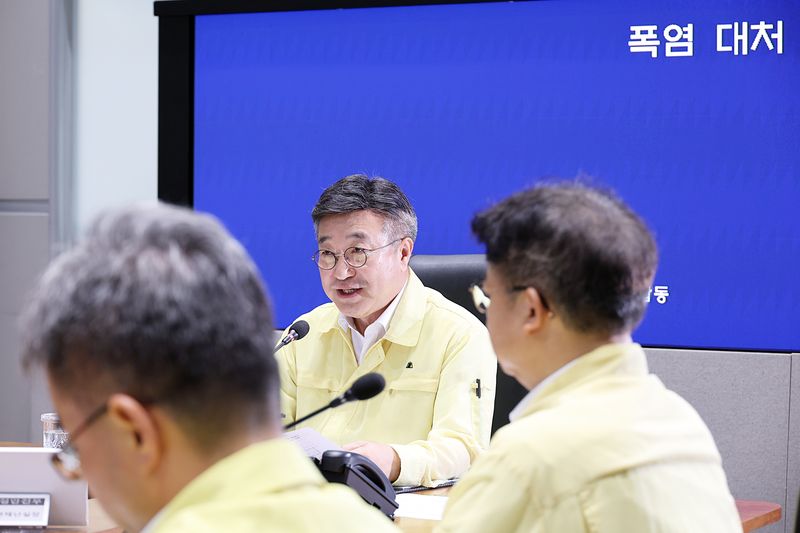
The Ministry of the Interior and Safety raised the heat wave crisis alert to "Severe" at 3 p.m. on the 27th and activated CDSCHQ, with Minister Yoon Ho-jung serving as head of the headquarters.
At a meeting on heat wave response measures held at Government Complex Seoul that day, Minister Yoon said, "As soon as the rainy season ended, intense heat has swept across the country," and added, "We will launch an all-out, whole-of-government response."
As of 1 p.m. on the 27th, heat wave advisories were in effect in Gwangyang, South Jeolla Province; Daegu, excluding Gunwi; Gyeongsan, Cheongdo County, Goryeong County, Pohang, and northern and southern Gyeongju in North Gyeongsang Province; and Yangsan, Changwon, Gimhae, Miryang, Uiryeong County, Haman County, Changnyeong County, Jinju, and central Hapcheon County in South Gyeongsang Province. Advisories were also in place for most other parts of the country.
The nationwide maximum perceived temperature ranged from 28 to 38 degrees Celsius. Yangsan posted the highest reading at 37.4 degrees, followed by Gwangyang-eup at 37.3 degrees, Geumjeong District in Busan at 37.0 degrees, Sinpo in Uiryeong County, South Gyeongsang Province, at 36.9 degrees, and Buk District, Daegu, at 36.6 degrees. In the Seoul metropolitan area, Gimpo and Geumsa in Yeoju each reached 34.9 degrees, while in Jeju, Seogwipo and Jeju Namwon rose to 35.0 degrees.
For the time being, the maximum perceived temperature is expected to stay above 33 degrees Celsius in most parts of the country and above 35 degrees in the southern regions.
The government plans to intensify welfare checks on residents of cramped housing districts, vulnerable seniors and the homeless, while also reviewing the distribution of cooling supplies. Village heads, neighborhood heads and volunteer disaster prevention teams will visit elderly farmers in person to check their health and advise them to avoid outdoor activities.
It will also inspect whether safety rules, including guaranteed rest breaks, are being followed for outdoor workers and workplaces vulnerable to heat waves. Nonessential outdoor work and activities will be suspended or postponed.
The government will again check cooling equipment and accessibility at cooling shelters and shade structures. In areas where tropical nights keep the heat lingering late into the night, it will extend the operating hours of cooling shelters so residents can use them after dark.
In areas under a Severe Heat Wave Alert, officials in charge of situation management will be dispatched. The government will also implement measures under the "Severe Heat Wave Alert response guide," including shortening the interval between welfare checks on vulnerable groups and adjusting the schedules of outdoor events and festivals.
It will also conduct preemptive checks on power supply conditions at social infrastructure facilities such as roads and railways, and support the distribution of heat wave prevention equipment to livestock farms and aquaculture businesses.
Minister Yoon urged the public to "refrain from outdoor activities during the daytime as much as possible and follow heat safety guidelines such as drinking enough water and taking adequate rest," adding, "Please also make a point of checking in on your family members and elderly relatives from time to time."
[email protected] Lee Bo-mi Reporter