"A 28% plunge in KOSPI makes a COVID-era V-shaped rebound unlikely"; 'leveraged ETF aftereffects' highlighted
- Input
- 2026-07-27 15:36:35
- Updated
- 2026-07-27 15:36:35
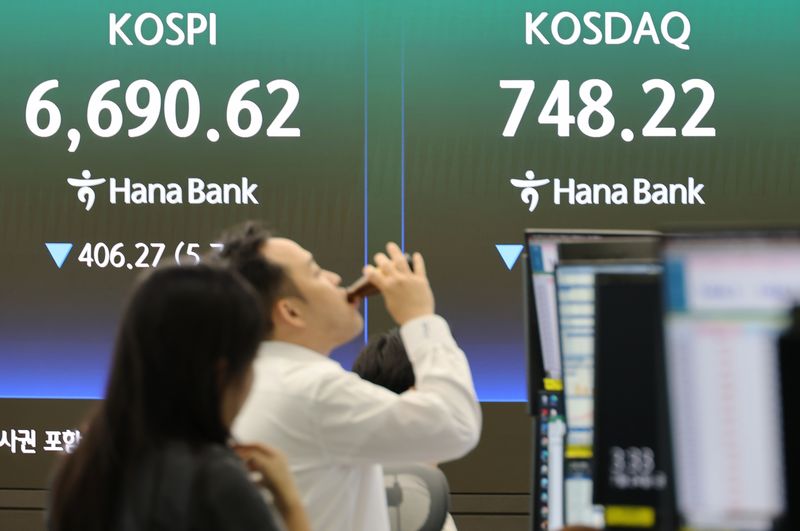
[Financial News] As the KOSPI Index has fallen more than 28% over the past month, securities analysts say it will be difficult to expect a sharp, short-term rebound like the one seen during the COVID-19 crisis. They added that the possibility of another rate hike by the Bank of Korea and weakening cash flow at global big tech companies are acting as major constraints on a recovery in the domestic stock market.
Eugene Investment & Securities: "Potential rate hikes by the Bank of Korea and weakening cash flow at big tech are key factors"
According to the Korea Exchange on the 27th, KOSPI fell 28.5% from an intraday high of 9,114 points on June 21 to 6,516 points on July 20. That decline is comparable to the drop during COVID-19 (-36%) and the U.S. rate-hike cycle in 2022 (-31%), and it ranks among the steepest since the Global Financial Crisis (GFC) in 2008 (-54%). SK hynix, a bellwether stock, also led the index lower, falling 39.6% from its closing high.
In a report released that day, Heo Jae-hwan, a researcher at Eugene Investment & Securities, forecast that it would take about a month to recover the stock market losses. He cited two patterns seen after past market crashes.
One is a sharp rebound immediately after a plunge, as seen during COVID-19. The other is a prolonged bottoming-out phase, as in 2022, when the market fell 35% over 14 months.
Heo said, "In terms of the short-term plunge, the domestic market looks more similar to the COVID-19 period than to 2022," but added, "This time, however, a V-shaped recovery will be difficult to expect."
He explained that the reason is that expectations for another rate hike by the Bank of Korea are stronger than those for the Federal Reserve System (Fed), making the monetary policy backdrop markedly different from the past.
He also pointed to added pressure from slowing first-quarter operating margins at major big tech firms such as Alphabet Inc. (from 36.6% to 34.2%) and a shift to negative free cash flow, which has intensified concerns over domestic semiconductor demand.
Heo said, "Alphabet's free cash flow turned negative for the first time," adding, "Questions about the sustainability of capital spending continue."
He also addressed the aftereffects of Leveraged Exchange-Traded Funds (Leveraged ETFs). He said, "Trading volume in Samsung Electronics single-stock Leveraged ETFs has fallen back to pre-launch levels before May 27, while trading volume in SK hynix Leveraged ETFs has not declined. Trading volume in SK hynix Leveraged ETFs even exceeded that of the underlying stock. The aftereffects of Leveraged ETFs are easing, but they have not fully disappeared."
He ruled out another crash, saying, "The downward pressure on the stock market is easing."
He added, "Given the unusually steep short-term decline, downward pressure on the domestic market is expected to gradually ease. The KOSPI's 12-month forward PER, excluding semiconductors, is around 7 to 8 times, the lowest since April last year. However, compared with the recent losses, it still appears to need more time before prices recover clearly."
He said the recovery would not be limited to semiconductors. "Looking at the decline from this year's peak, interest should also extend to industrial sectors such as machinery, shipbuilding, and construction, along with semiconductors and IT hardware, which have seen particularly large losses," he said, recommending a diversified approach.
[email protected] Reporter Seong Min-seo Reporter