Risky Drinking Declines Among Men, Rises Among Women... Increase Seen Among Women in Their 30s and Older
- Input
- 2026-07-27 12:00:00
- Updated
- 2026-07-27 12:00:00
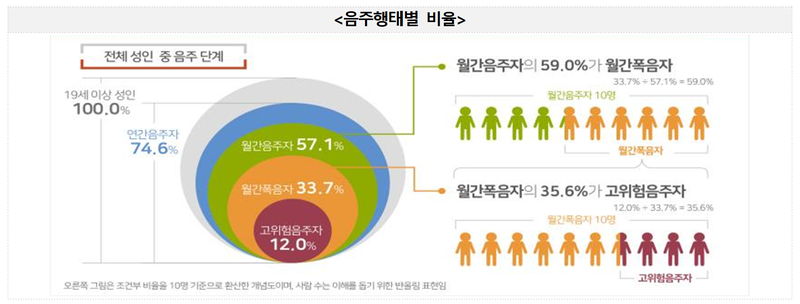
On the 27th, the Korea Disease Control and Prevention Agency (KDCA) announced the results of an analysis of drinking behavior among about 230,000 Korean adults based on the 2025 Community Health Survey.
The survey found that this year's monthly drinking rate among adults stood at 57.1%, meaning six out of 10 people drank at least once a month. The monthly binge drinking rate was 33.7%, while the high-risk drinking rate, defined as binge drinking at least twice a week, was 12.0%. Overall drinking rates have risen again since the COVID-19 pandemic, but they remain below pre-pandemic levels. Still, 59% of monthly drinkers reported binge drinking, and 35.6% of them fell into the high-risk drinking category, showing that health risks increase as drinking becomes more frequent.
The gender gap was clear. Men's high-risk drinking rate declined in every age group, with the sharpest drop of 41.6% among those in their 20s. By contrast, women's rate rose in every age group from their 30s and older, except for those in their 20s. The increase was most pronounced among women in their 40s, where it rose by 31.0%, and the upward trend continued among those in their 30s and in their 50s to 70s and older.
The absolute level remained higher among men. Among men in their 30s to 50s, one in two binge drank, and more than one in five men in their 40s to 50s met the criteria for high-risk drinking. The KDCA said that, despite recent changes in drinking culture, preventive management tailored to gender is needed as risky drinking among women is increasing.
Smoking was the factor most strongly associated with high-risk drinking. Smokers were 2.6 times more likely to engage in high-risk drinking than non-smokers. Those with a history of hypertension or diabetes were 1.3 times more likely, and people with depressive symptoms were 1.2 times more likely. The analysis found that high-risk drinking is closely linked not only to drinking habits but also to other health risk factors.
By region, Gangwon Province had the highest high-risk drinking rate at 15.7%, followed by North Chungcheong Province at 14.4% and Ulsan at 13.3%. In contrast, Sejong City at 7.0%, Daejeon at 9.5%, and Seoul and Gwangju at 10.1% were relatively low. Regions with higher high-risk drinking rates were also found to have higher smoking and obesity rates, while walking participation rates were lower.
Korea's drinking level is also high by international standards. According to OECD's "Health at a Glance 2025," Korea's monthly binge drinking rate exceeded the OECD average and ranked fifth among 27 comparable member countries.
KDCA Commissioner Lim Seung-kwan said, "Overall drinking behavior is improving, but high-risk drinking rates remain high among men in their 30s to 50s, and an upward trend is appearing among women in their 30s and older." He added, "We need tailored alcohol prevention and management policies that reflect gender, age, and regional characteristics."
[email protected] Jung Sang-hee Reporter