"My spouse fell in love with AI"... Could emotional infidelity also be grounds for divorce?
- Input
- 2026-07-29 06:30:00
- Updated
- 2026-07-29 06:30:00
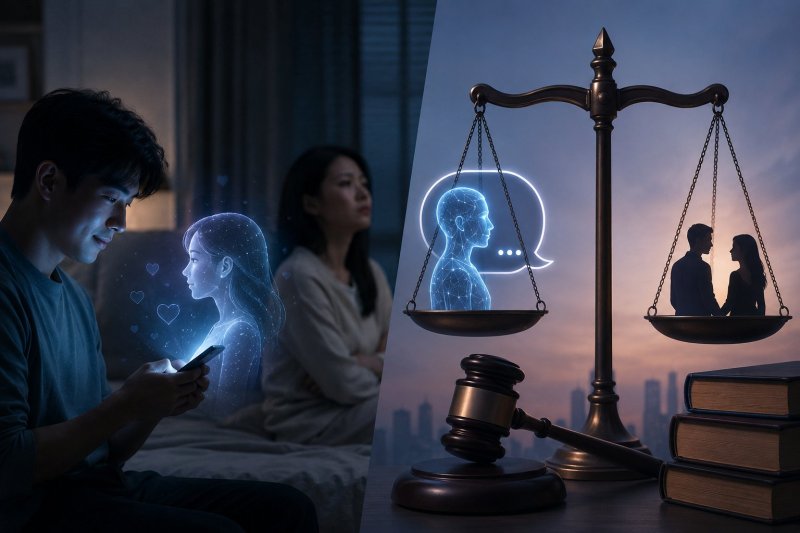
[Financial News] As cases emerge in which a spouse chats with generative artificial intelligence (AI) as if it were a lover and neglects real-life married life, debate over so-called "AI infidelity" is spreading. Under current law, it is difficult to recognize a spouse's adultery based solely on emotional interaction with AI. However, legal experts say it could still be grounds for divorce if excessive immersion leads to the breakdown of the marriage or causes emotional abuse.
According to Financial News' review of the issue on the 29th, interest in the legal implications is growing as more disputes between couples and lovers involving generative AI are coming to light. Recently, a post on an online community sparked controversy after it claimed that a husband had been talking with generative AI as if it were his girlfriend. The poster alleged that the husband gave the AI a nickname and exchanged messages such as, "I like you more than my wife" and "I want to create a physical form for the AI and spend my life with it." The husband is said to have explained that the conversation with the AI was a kind of role-play.
Since then, people have been split between those who say conversations with AI cannot be considered infidelity because they are not with a real person, and those who argue that if someone secretly expresses love to AI and becomes emotionally dependent on it more than on their spouse, it amounts to "emotional infidelity."
The current Civil Act does not contain any provision that directly regulates emotional relationships with AI, nor is there a Supreme Court of Korea precedent that defines such conduct as grounds for divorce. Article 840 of the Civil Act lists a spouse's adultery, malicious refusal of divorce, and abusive treatment as legal grounds for divorce.
However, the existing concept of "adultery" has generally been applied on the premise that a spouse engaged in conduct such as an affair with a third person, thereby violating the duty of marital fidelity. Since AI is not a legal subject with rights and obligations, it is difficult to treat it as a third party in an affair or hold it responsible.
Instead, there is room to argue whether the degree of immersion in AI, and the extent to which it damaged the couple's shared life, falls under the "other serious reasons making it difficult to continue the marriage" clause in Article 840, Paragraph 6 of the Civil Act. Some interpret this as similar to cases in which excessive dependence on religion, shamanism, pornography, or games leads to neglect of family life.
In addition, if a person becomes so absorbed in AI that they repeatedly belittle their spouse or refuse to talk, that conduct could also be viewed as verbal abuse or emotional abuse, and may be examined under Paragraph 3 of the same article as "severe mistreatment of a spouse."
Kim Tae-yeon, managing attorney at Taeyeon Law Office, said, "If excessive dependence on AI destroys trust between spouses and leads to the breakdown of the marriage, it can be grounds for divorce." She added, "At present, it is difficult to judge an emotional relationship with AI as adultery, but if AI develops to the point where it is hard to distinguish from a human and related precedents accumulate, the courts' interpretation could also change."
Meanwhile, overseas there are moves to view relationships with AI through the lens of institutions and regulation. In the United States, there have been inquiries about whether a relationship with AI can be included in an infidelity clause in a prenuptial agreement. China is also pushing regulations that would restrict AI chatbots from encouraging users' excessive emotional dependence or forming virtual romantic relationships with minors.
As a result, some say South Korea should also begin social discussions to prevent side effects caused by overdependence on AI and to protect vulnerable groups. Yeom Heung-yeol, professor emeritus in the Department of Information Security at Soonchunhyang University, said, "There is no need to treat the use of AI as a companion as a problem in itself, but we should be cautious when users lose their independence and become emotionally dependent." He added, "In particular, safety measures and institutional discussions are needed to protect teenagers and mentally vulnerable users."
[email protected] Kim Ye-ji Reporter