AI Reshapes the Semiconductor Export Map: "Dependence on China Falls, Taiwan Rises"
- Input
- 2026-07-27 12:00:00
- Updated
- 2026-07-27 12:00:00
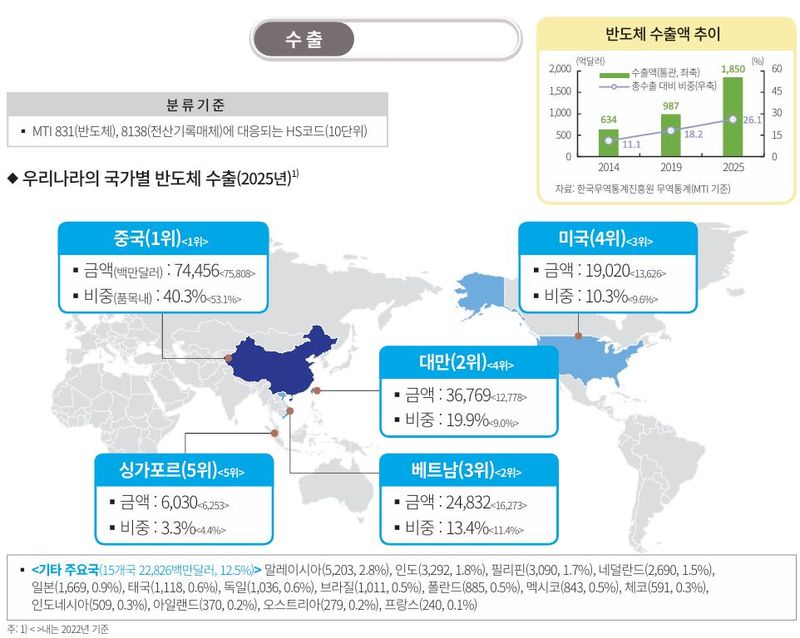
That was up 10.9 percentage points from 2022, when Taiwan ranked fourth with 9.0%. The figure was 8.5 percentage points higher than Vietnam, which ranked third at 11.4%. The United States also increased its share from 9.6% to 10.3% over the same period, ranking fourth. By contrast, China's share fell by more than 10 percentage points, from 53.1% to 40.3%, breaking the structure in which China had accounted for more than half of exports.
By product, China and Taiwan accounted for 50.1% and 28.6% of memory chip exports, respectively. The gap narrowed significantly from 2022, when the figures were 71.5% and 28.6%. In System Semiconductor, China's share fell from 45.7% to 31.5%, while Vietnam's rose from 15.6% to 26.5% and Taiwan's from 10.2% to 12.9%.
The Bank of Korea said the turning point came with the emergence of generative AI, represented by ChatGPT, in late 2022. Since then, the buildout of AI infrastructure such as data centers has accelerated, and demand that had centered on central processing units (CPU) and general-purpose dynamic random access memory (DRAM) has shifted to graphics processing units (GPU) and high bandwidth memory, which are specialized for AI computing.
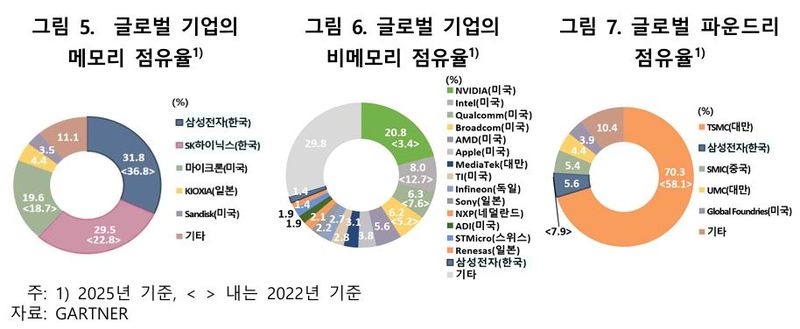
In the memory market last year, Samsung Electronics and SK hynix ranked first and second, with shares of 31.8% and 29.5%, respectively. In non-memory semiconductors, NVIDIA led by a wide margin with 20.8%, 2.5 times the share of second-place Intel at 8.0%. In foundry services, TSMC held 70.3% of the global market. The semiconductor market, in other words, is structured around a few companies with exclusive leadership.
Dependence on specific countries was also high in imports. Jeong interpreted this as evidence that the global semiconductor industry is becoming vertically integrated through specialization by value chain segment. For semiconductor manufacturing equipment imports, the Netherlands accounted for 26.0%, largely due to the influence of ASML. Japan followed with 23.7%, and the United States with 16.9%. In materials and components, China, Japan and the United States together accounted for about 60%, with shares of 22.5%, 20.4% and 16.3%, respectively.
The defining feature of semiconductor production by region in South Korea is concentration in the Capital Region. As of 2024, the Capital Region accounted for 82.3% of total national production value. It is home to Samsung Electronics' Hwaseong, Pyeongtaek and Giheung plants, as well as SK hynix's Icheon plant. The Chungcheong Region, where SK hynix's Cheongju plant and Samsung Electronics' Onyang and Cheonan plants are located, followed with 14.7%. Jeong said, "For the semiconductor industry to operate smoothly, many factors such as factories, technology and labor must align. In particular, location matters when products are exported overseas, and that appears to have worked in favor of the Capital Region."
[email protected] Kim Tae-il Reporter