"It Looked Like My Brain Was Exposed"... The Rare Condition That Tormented a Man in His 20s [Health Talk]
- Input
- 2026-07-27 08:59:29
- Updated
- 2026-07-27 08:59:29
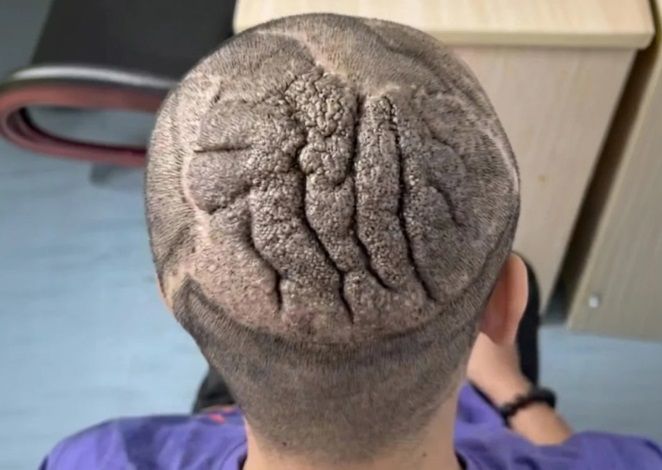
[Financial News] A man in his 20s in China who suffered from a rare disorder that caused his scalp to thicken and take on a brain-like, wrinkled appearance has reportedly regained a normal appearance after surgery.
According to the South China Morning Post (SCMP) on the 27th, Li, a 23-year-old living in Hunan Province, had been experiencing a gradually hardening scalp for years.
As Li's condition progressed, the soft tissue in his scalp thickened and proliferated, forming large, irregular folds that resembled brain tissue. By the time he was 14, about half of his scalp was already covered with abnormally overgrown skin, causing a severe change in appearance and leading to intense psychological distress that was difficult to bear at such a young age.
Doctors at a local hospital once attempted skin expansion surgery, but the operation failed. The procedure left scars on his scalp, and most hospitals refused further surgery, saying there was not enough normal skin available for grafting or replacement.
After visiting several hospitals in despair, Li finally found a path to treatment when he met the team led by Professor Zhou Wei of the Plastic Surgery Department at Wuhan University Zhongnan Hospital.
What is cylindrical scalp?
Professor Zhou diagnosed Li with cylindrical scalp (CVG). It is an extremely rare endocrine and skin disorder in which the subcutaneous soft tissue of the scalp becomes excessively thick, creating wavy folds that resemble the gyri and sulci of the brain.
It can be present at birth, but in acquired cases, the exact cause is often unclear. When there are no underlying diseases or other systemic health problems, the main impact is usually cosmetic deformity. However, sweat and debris can accumulate between the folds, leading to inflammation, odor, and secondary bacterial infections, which makes hygiene difficult to manage.
Because scarring from the failed previous surgery made it difficult to secure enough normal skin, Professor Zhou's team drew up a detailed reconstruction plan.
In July last year, the medical team inserted tissue expanders into two areas of the scalp by using the existing scar lines. They then regularly injected saline to slowly stretch the normal scalp skin.
It took a total of 11 months to secure enough normal skin. Using the expanded skin, the medical team successfully completed a second surgery that lasted about three hours, fully removing the deformed lesion tissue and covering the wound.
The surgery was a success. Li's scalp regained a normal shape, and his hair was also restored to a condition in which it could grow normally.
After hearing the story, local internet users praised the medical team, saying, "The true essence of plastic surgery is not simply to make people prettier, but to heal the hearts of patients suffering from disease as well."
[email protected] Moon Young-jin Reporter