[Editorial] U.S. AI Summit Showcases South Korea’s Semiconductor Standing
- Input
- 2026-07-26 18:30:38
- Updated
- 2026-07-26 18:30:38
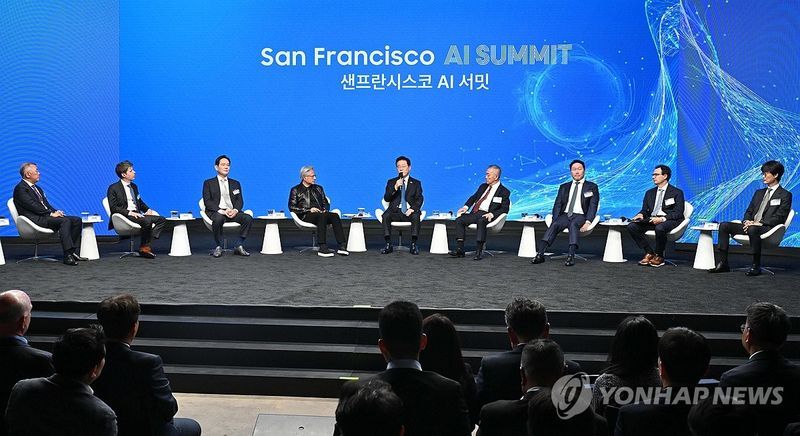
In fact, global big tech companies are reaching out to South Korean chipmakers such as Samsung Electronics and SK hynix to secure memory supplies, the biggest bottleneck in AI industry expansion. Chey Tae-won, chairman of SK Group, recently said, "Even if we limit it to AI, demand next year is expected to rise by 60% to 100%. I do not know whether I should even use the word chaos, but we are facing enormous lobbying and pressure." This reflects the changed status of South Korea’s memory industry. Memory semiconductors, once seen as mere component suppliers, have now emerged as a core industry in the AI era. The production and technological capabilities of South Korean chipmakers in high-bandwidth memory (HBM) are now influencing the pace of global AI expansion.
Above all, the event brought together the heads of major companies leading the global AI industry. Jensen Huang of NVIDIA, Hock Tan of Broadcom Inc., Sam Altman of OpenAI, and Dario Amodei of Anthropic all shared the same stage. After leaving OpenAI to found Anthropic, Amodei has remained in conflict with Altman over AI model competition and safety regulations. The mere fact that leaders of rival global AI companies gathered in one place underscores the stature of this summit.
At the event, President Lee also unveiled the "San Francisco AI Declaration," outlining South Korea’s vision for the AI era. He declared, "The Republic of Korea will leap forward as an indispensable core nation in the global AI supply chain." Cooperation results followed to support that declaration. At the summit, South Korean chipmakers secured large-scale AI infrastructure and memory partnerships with major big tech firms, proving themselves to be key partners in the global AI ecosystem. The Blue House said domestic companies and global big tech firms agreed to pursue semiconductor cooperation worth a total of $950 billion, or about 1,375 trillion won. Samsung Electronics will work with Broadcom Inc. over the next five years on advanced memory semiconductor supply and foundry cooperation, while SK Group plans to expand long-term memory supply partnerships with NVIDIA and others.
South Korean companies must now move beyond memory supply and actively help build a physical AI ecosystem that extends to data centers, autonomous driving, and robotics. It is also important to create a virtuous cycle that links overseas big tech investment and demand to major semiconductor clusters at home. Beyond technological competition, South Korea should also strengthen its voice in discussions on AI safety and international norms, taking a leading role in shaping the global AI order.
The government also faces a long list of tasks. As cooperation with global big tech expands, pressure on South Korean semiconductors will inevitably grow amid the U.S.-China rivalry for technological supremacy. That is why careful trade diplomacy is needed. To become a global AI production hub, stable power and water supplies are essential as well. The country must speed up the building of national advanced industry infrastructure and boldly remove obstacles to expanding basic facilities such as electricity and water. The San Francisco Declaration is not the end but the beginning. For President Lee’s words that "the world’s AI industry cannot function without South Korean semiconductor plants" to ring true, they must be followed by a sober grasp of reality and meticulous execution.