Even as gold prices fall, investors are staying away... Trading volume and value cut in half in a month
- Input
- 2026-07-26 18:07:15
- Updated
- 2026-07-26 18:07:15
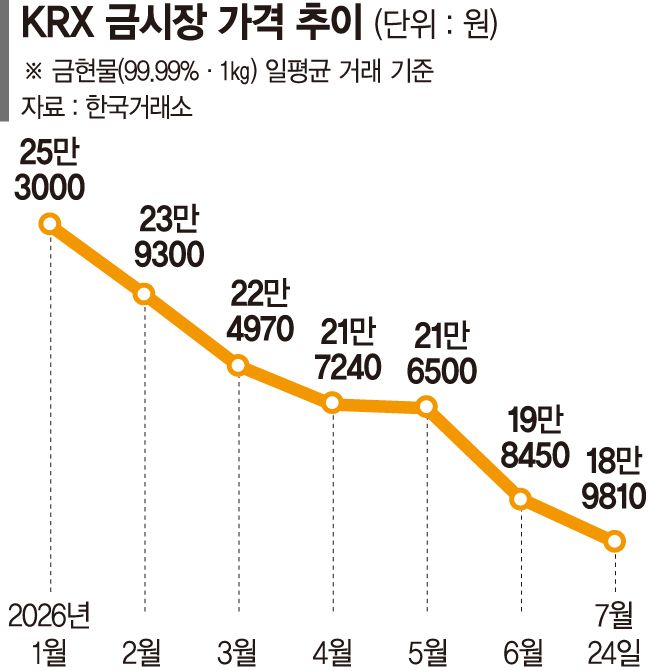
According to the Korea Exchange on the 26th, the average daily trading volume of physical gold (99.99%, 1 kg) in the KRX gold market this month stood at 239,116 grams, down 49.0% from last month’s 469,019 grams. Average daily trading value also fell 51.5%, from 97.012 billion won to 47.009 billion won. Compared with January, trading volume has plunged 77.1%, while trading value has dropped 80.6%.
The price of physical gold (99.99%, 1 kg) in the KRX gold market closed at 189,810 won on the 24th, extending its weakness after hitting a year-to-date high of 269,810 won on Jan. 29. That marks a 29.7% decline from the peak.
Exchange-traded notes (ETNs) tracking the KRX Gold Spot Index have also fallen 30.0% from their yearly high. The sharp drop in gold trading appears to reflect weakening investor sentiment more than a simple price correction. In general, a steep decline in prices can attract bargain hunters, but recently both prices and trading activity have fallen together, suggesting a stronger wait-and-see mood.
Brokerages say gold’s appeal has weakened as the U.S. continues its tightening stance and market interest rates remain high. As a representative liquidity hedge asset, gold is relatively vulnerable to shrinking liquidity and a high-rate environment, and this year’s decline in gold prices is also being seen as a reflection of that macro backdrop.
Another drag is the slowdown in buying by Chinese retail investors, who helped drive gold prices higher last year. Purchases by China's central bank continue as part of efforts to diversify foreign reserves, but analysts say the demand is not strong enough to push prices higher. Meanwhile, outflows have been seen from Chinese gold exchange-traded funds, and retail buying enthusiasm has also faded, weakening the momentum for further gains.
Choi Jin-young, an analyst at Daishin Securities, said, "The People's Bank of China's gold holdings in June reached 2,321.6 tons, up 27 tons from a year earlier, but that is a marked slowdown compared with the 266-ton increase in 2023." He added, "As the Chinese government’s room for economic stimulus remains limited, there is a strong chance that buying by Chinese retail investors, which helped lift gold prices last year, will also slow."
Still, some expect investor sentiment to recover later in the second half of the year. The reasoning is that if falling oil prices ease inflationary pressure, the market’s excessive concerns over tightening could gradually subside.
Brokerages expect strong U.S. growth, a firm dollar and a hawkish monetary policy stance to weigh on gold prices through the third quarter. After that, if inflation stability is confirmed and tightening fears ease, sentiment toward precious metals is expected to improve gradually.
Park Joo-ran, a senior analyst at Samsung Securities, said, "A cautious approach is needed through the third quarter, given concerns over hawkish policy and outflows from gold ETFs." She added, "However, if easing inflation is confirmed in the fourth quarter and tightening fears fade, gold is likely to post a modest rebound through year-end."
[email protected] Bae Han-geul Reporter