Samsung’s unmatched strength in memory, foundry and packaging keeps winning new orders [President Lee’s U.S. trip]
- Input
- 2026-07-26 18:01:30
- Updated
- 2026-07-26 18:01:30
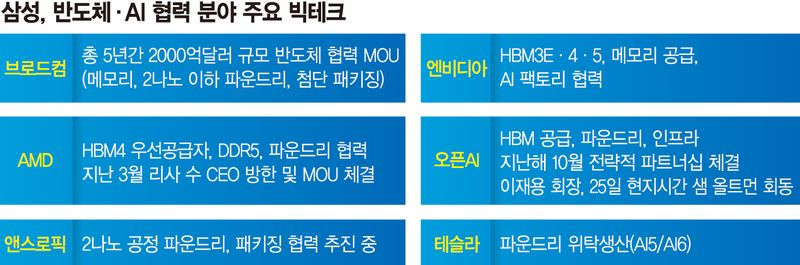
Samsung is expanding its presence as a key supplier of AI semiconductors to NVIDIA, Advanced Micro Devices, Inc. (AMD), OpenAI, Tesla, Broadcom, and Apple, which are driving the AI era with so-called semiconductor turnkey competitiveness that spans advanced memory chips, foundry manufacturing, and advanced packaging. Inside Samsung Electronics, some say the recent string of major semiconductor orders is "only the beginning."
■ Unrivaled competitiveness across memory, foundry and packaging
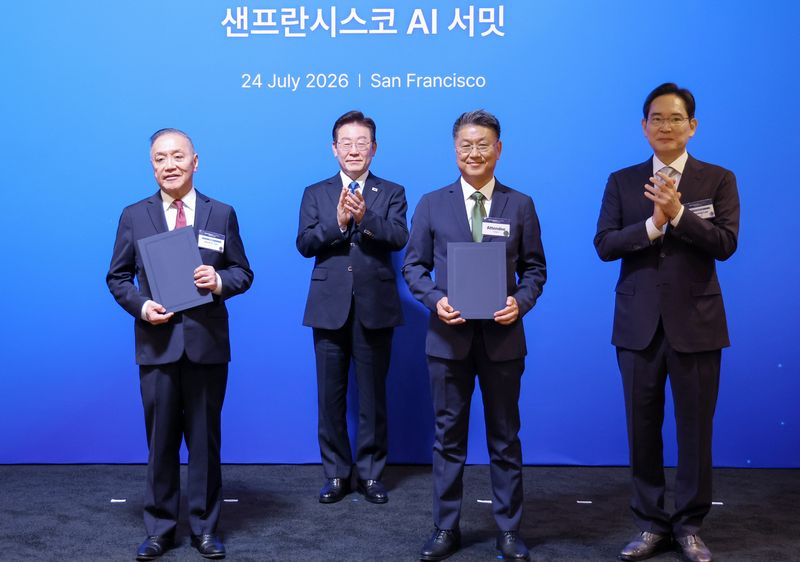
On July 24 local time in San Francisco, Samsung Electronics signed a strategic memorandum of understanding with Broadcom for a five-year semiconductor and foundry partnership worth a total of $200 billion, or about 290 trillion won, on the occasion of the AI Summit held during President Lee Jae-myung's U.S. visit. In the semiconductor industry, there is speculation that a large-scale order covering memory chips and foundry services between Samsung Electronics and Broadcom is imminent. Memory chip supply is reportedly set to begin soon. Unlike rivals that focus only on memory, Samsung's all-around competitiveness in memory, foundry and packaging is now seen as having reached full stride.
Jun Young-hyun, vice chairman and head of Samsung Electronics' Device Solutions Division, stressed that "in the AI era, semiconductor solutions that tightly integrate memory, logic and advanced packaging are the core of competitiveness" and added that Samsung will "accelerate the development of future AI infrastructure."
Broadcom is a leading fabless company that designs custom AI semiconductors, or ASICs, for global big tech firms such as Google. It also participates in the development of Google's AI chip, TPU, which uses High Bandwidth Memory. Global big tech companies have recently been expanding the adoption of their own AI accelerators, or ASICs, at a rapid pace. Samsung Electronics emphasized that the two companies will cooperate not only on supplying advanced memory chips, but also on foundry manufacturing and advanced packaging for AI ASIC production.
Samsung Electronics said the partnership will involve supplying next-generation HBM, including HBM4 and HBM4E, while also using advanced foundry processes below 2 nanometers and advanced packaging technology to strengthen Broadcom's competitiveness in next-generation AI semiconductors. Production of Broadcom's next-generation AI chips is likely to take place at Samsung Electronics' Pyeongtaek Campus, its most advanced semiconductor manufacturing base.
Samsung Electronics has recently been aggressively pursuing foundry orders for 2-nanometer processes. After winning a foundry deal for Tesla's next-generation AI6 chip, it is also negotiating with Anthropic for a next-generation AI chip order based on the 2-nanometer process. The company has already proven its technological strength in 4-nanometer processes. Samsung Foundry processes are being used for NVIDIA's Grok 3rd-generation LPU as well as for the NPU of domestic AI chip company Rebellions.
■ Chairman Lee Jae-yong's close Silicon Valley engagement
On July 24, Chairman Lee Jae-yong met with NVIDIA CEO Jensen Huang at NVIDIA's headquarters in Santa Clara, California, to discuss AI cooperation. The following day, he held a separate meeting with OpenAI CEO Sam Altman at OpenAI's headquarters in San Francisco.
At the AI Summit in San Francisco, Lee said, "If the strengths of South Korea and the United States are combined, we can innovate faster, grow bigger and solve more difficult challenges," adding that "South Korea has unrivaled competitiveness in semiconductors and advanced device manufacturing."
Over the past year, Lee has focused heavily on Silicon Valley. He began by attending the Sun Valley Conference, often called the "summer camp for billionaires," for the first time in about nine years last July. Since then, he has met successively with NVIDIA CEO Jensen Huang, AMD CEO Lisa Su and Google DeepMind CEO Demis Hassabis. He also visited Silicon Valley almost every month in late April to early May, in June and in July this year. In particular, he attended this year's Sun Valley Conference with Han Jin-man, head of the Foundry Division, and has been devoting all-out efforts to turning around Samsung Foundry, which has long suffered losses. A Samsung official said, "In addition to the partnership with Broadcom, we are currently holding close discussions with other global big tech companies in the AI semiconductor field."
[email protected] Jo Eun-hyo Reporter