"How Could It Go Without a Break?" ... The Daily Sidecar Alerts, Will Next Week Be Any Better?
- Input
- 2026-07-25 07:38:57
- Updated
- 2026-07-25 07:38:57
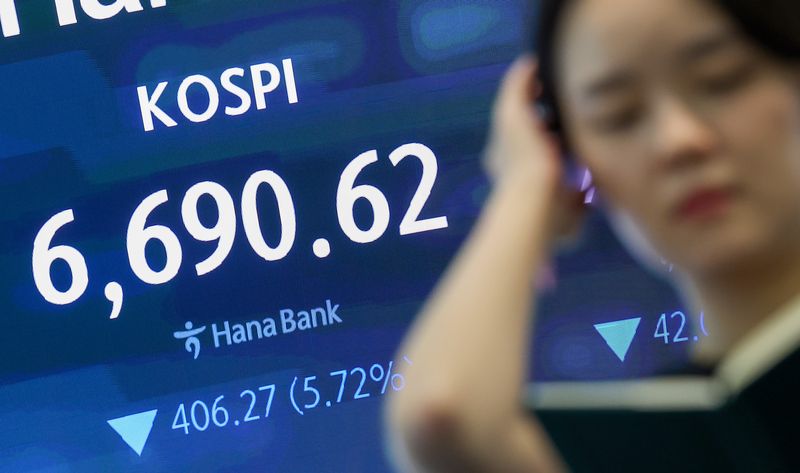
[Financial News] The domestic stock market saw an unusual stretch of volatility this week, with sidecar mechanisms triggered on all five trading days. Not only did sell-side sidecars activate to curb sharp declines, but buy-side sidecars also kicked in during rallies, leaving the market swinging wildly without finding a clear direction.
According to the financial investment industry on the 25th, sell-side sidecars were triggered in both KOSPI and KOSDAQ on the 20th, followed by back-to-back buy-side sidecars in KOSPI on the 21st and 22nd. On the 23rd, a buy-side sidecar was triggered in KOSDAQ, and on the 24th, sell-side sidecars were activated again in both KOSPI and KOSDAQ. In other words, every trading day of the week saw either a buy-side or sell-side sidecar.
What stood out in particular was that the market did not simply move in one direction; sharp drops and rebounds alternated. After the sell-side sidecar was triggered early in the week, KOSPI saw buy-side sidecars for two straight days. Later in the week, a buy-side sidecar in KOSDAQ was followed by sell-side sidecars in both markets. The index kept swinging sharply from day to day, driven more by supply and demand than by any clear market direction.
On the 24th, the final trading day of the week, KOSPI plunged 5.72% and KOSDAQ fell 5.32%. Yuanta Securities Korea Co., Ltd. analyzed the day's slump as being driven mainly by foreign investors' risk-off sentiment, sparked by surging international oil prices amid tensions in the Middle East and rising U.S. Treasury yields. WTI climbed above $90 per barrel, while Brent Crude Oil also broke through $100. Yields on 2-year and 10-year U.S. Treasuries rose to around 4.36% and 4.71%, respectively, adding downward pressure on the domestic market.
Volatility in major semiconductor stocks also rattled the market. On the 24th, Samsung Electronics fell 7.59%, SK hynix dropped 8.34%, and SK Square declined 9.17%. Although Intel reported strong second-quarter earnings and said data center revenue jumped 59% from a year earlier, investors were hit by concerns over the heavy cost of AI investment and fears that the memory chip cycle may have already peaked, prompting a wave of profit-taking that erased the previous day's gains.
Attention is now turning to whether tighter regulation of single-stock leveraged exchange-traded products, or ETF and ETN products, can calm the extreme concentration of funds. The FSC plans to raise the minimum deposit requirement for single-stock leveraged products to 30 million won starting on the 31st.
Lee Kyung-min, a researcher at Daishin Securities, said, "Buy-side and sell-side sidecars were triggered one after another this week, and the market remained in a state of extreme volatility." He added, "After the higher deposit requirement takes effect, we need to see whether the concentration of funds and volatility actually ease."
Some analysts say the sharp selloff has already eased valuation pressure considerably. Lee Jae-won, a researcher at Yuanta Securities Korea Co., Ltd., said, "KOSPI's forward price-earnings ratio has fallen below levels seen during the financial crisis, and even on a relative valuation basis that takes return on equity into account, it has entered an extremely undervalued range."
He also said, "At this level, investors should focus more on stocks that have fallen too far rather than on further selling." He added, "Next week, the Federal Open Market Committee (FOMC), earnings from hyperscalers such as Microsoft and Meta Platforms, and SK hynix's results will be key factors that determine the market's direction."
[email protected] Choi Du-seon Reporter