RE100 Industrial Complexes and the Conceptual Clash Over Nuclear Power [Lee Yoo-beom's Eco & Energy]
- Input
- 2026-07-25 06:00:00
- Updated
- 2026-07-25 06:00:00
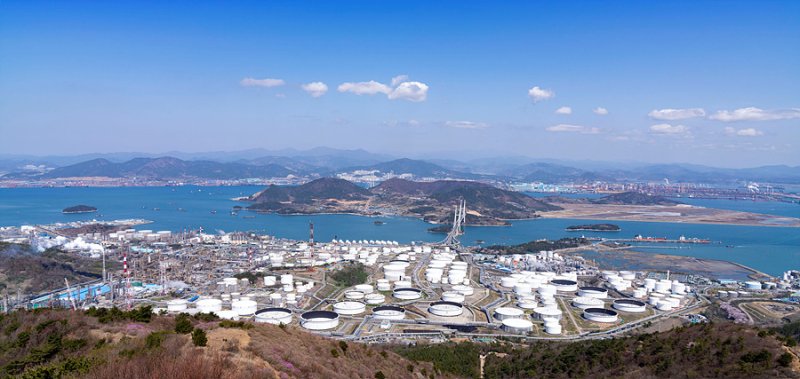
[Financial News] In May, environmental groups in the Yeosu area raised objections to an election pledge by candidates for mayor of Yeosu and the integrated mayor of Gwangju and South Jeolla Province. The pledge called for creating an 'RE100 industrial complex' that would incorporate Small Modular Reactors (SMRs). The Korean Federation for Environmental Movement (KFEM) pointed out that RE100 is a concept in which companies source 100% of the electricity they use from renewable energy, and that renewable energy refers only to naturally replenished sources such as solar power and wind power, excluding nuclear power from the outset. In other words, the policy agreement itself was conceptually unsound. What may have looked like a local political episode actually highlights the fundamental confusion built into the 'RE100 industrial complex' policy being promoted across the country.
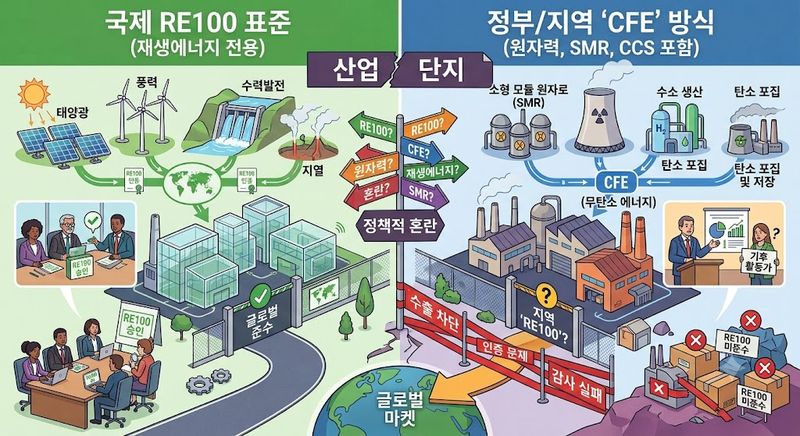
Nuclear power is not RE100
According to industry sources on the 25th, RE100 is a private campaign run by the international nonprofit Climate Group. It is a voluntary initiative in which companies pledge to source 100% of their electricity from renewable energy. In this context, renewable energy is limited to solar power, wind power, hydropower, and geothermal energy. Nuclear power generation does not emit greenhouse gases, but it is not a 'renewable' energy source, so it is fundamentally excluded from RE100 recognition. Separately from that distinction, the government and some in the industrial sector are also using the broader concept of 'carbon-free energy (CFE),' which includes nuclear power, clean hydrogen, and carbon capture and storage (CCS). If RE100 is a concept that defines the means as renewable energy, CFE is a broader framework that centers on the goal of reducing carbon emissions and includes nuclear power among the available means. The problem is that these two concepts are often mixed together in policy discussions. On paper, nuclear power and renewable energy may seem to be on the same side if the only focus is the end result of being 'carbon-free.' But overseas parent companies and international initiatives that require RE100 do not recognize nuclear power. As in the Yeosu case, once a local government inserts SMRs into an 'RE100 industrial complex,' a contradiction emerges: even if companies move into the complex, they still may not meet the RE100 certification requirements needed by exporters. The international RE100 initiative is also moving toward stricter recognition standards. Last April, it even excluded ammonia-coal co-firing from its technical criteria, narrowing the space for green ammonia, which had at least been considered closer to carbon-free energy. Nuclear power, by contrast, is not even considered in that debate.
Why are local governments trying to bring in nuclear power? 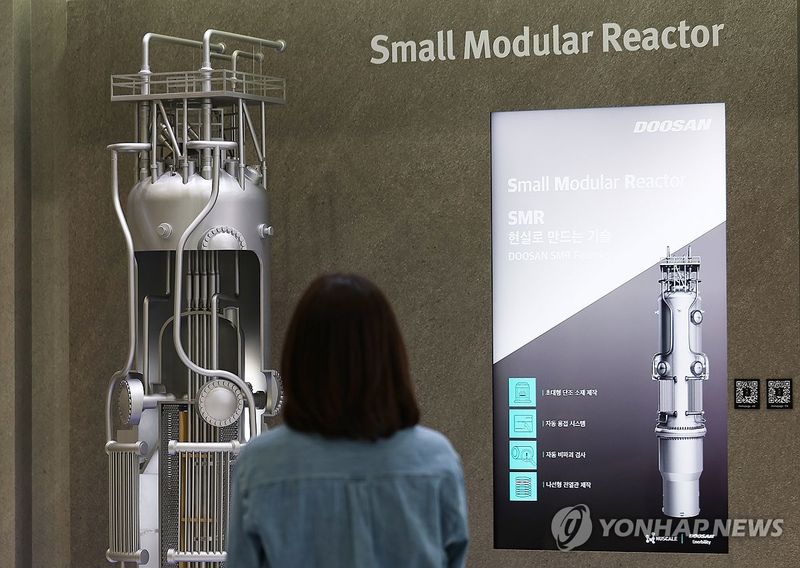
SMR model. Yonhap News
Even so, the incentive for local governments and politicians to bring in nuclear power is clear. It is simply difficult in practice to meet the electricity demand of advanced industrial complexes such as semiconductor and rechargeable battery clusters using only renewable energy like solar power and wind power. Industries such as semiconductors and displays are known to depend on electricity at up to eight times the level of traditional sectors such as mining and nonferrous metals. On top of that, the intermittency of renewable energy, relatively high generation costs, and delays in grid connection make it tempting for local governments seeking stable, high-density power to include nearby nuclear plants or SMRs in the power supply mix for industrial complexes. The pledge that became controversial in Yeosu was made against this backdrop. But this approach runs counter to the actual purpose of the industrial complex: to protect export competitiveness by meeting overseas buyers' RE100 requirements. An industrial complex that mixes in nuclear power may help Korea meet its domestic carbon-neutrality goals, but it risks becoming an 'RE100 in name only' complex that fails to satisfy the international standard. In fact, the approaches taken by candidate sites for RE100 industrial complexes now under discussion vary widely. Saemangeum is pursuing a model focused on expanding infrastructure for pure renewable energy such as solar power and offshore wind, while Suncheon, which is promoting itself as a site for an RE100 semiconductor cluster, does not fully rule out the possibility of being located near a nuclear plant in the region. If each region under the same 'RE100 industrial complex' label adopts a different energy mix policy, companies that move in may later have to check, on a site-by-site basis, whether each complex can actually qualify for RE100 certification.
What the changing name of the special law says
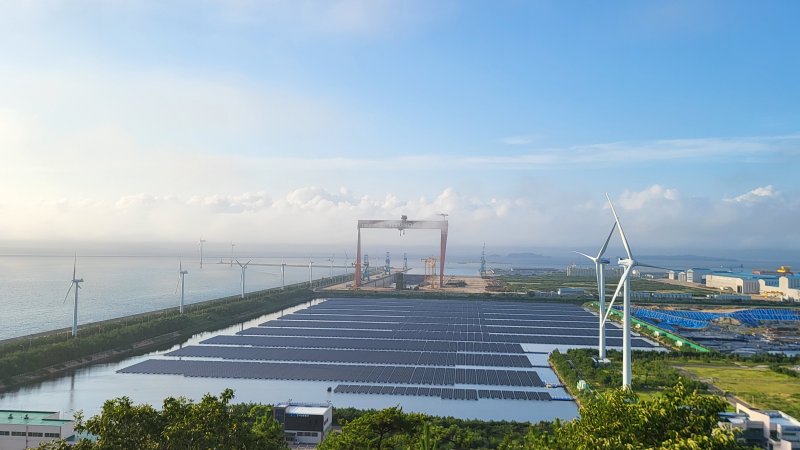
Apparently aware of this conceptual confusion, the government is also changing the name of the special law it is preparing. When the joint task force of the Ministry of Trade, Industry and Energy (MOTIE) and the Ministry of Land, Infrastructure and Transport (MOLIT) first began discussions, the law was commonly referred to as the 'RE100 Industrial Complex Special Act' or the 'Special Act on the Creation of RE100 Industrial Complexes.' More recently, however, it has been promoted under the name 'Special Act on Renewable Energy Self-Sufficient Cities.' Aiming for enactment in March next year, the law designates Saemangeum as a national model and includes plans to expand renewable energy supply targets to 10 GW and gradually build infrastructure such as solar power complexes and power transmission lines. Removing 'RE100' from the bill's title and explicitly naming 'renewable energy' suggests an intention to block any room for nuclear power from the outset. That said, because the bill has gone through discussions with multiple local governments and ministries, both its name and details have continued to change. It remains unclear how the final version will define the scope of carbon-free energy sources.
This debate should not be seen as merely a dispute over definitions. Companies that have declared RE100, including Samsung Electronics, SK hynix, LG Energy Solution, and Hyundai Motor Group, are increasingly requiring their suppliers to use renewable energy as well. If the industrial complexes meant to host these companies are labeled as '100% renewable energy' but in reality rely heavily on nuclear power, they may fail overseas buyers' RE100 reviews and become useless as industrial sites. On the other hand, if industrial complexes are to be powered only by renewable energy, the key question is how much the government can support the practical challenges of higher generation costs and grid infrastructure development. In the end, the question of whether nuclear power should be included in RE100 industrial complexes is not a technical issue about the energy mix. It is a question of direction: whether the government wants these complexes to serve as a domestic carbon-neutrality achievement or as internationally compliant sites that export companies can actually use. The next point to watch is how that direction is settled during the special law's enactment process, which is scheduled for March next year. The key issue is whether the move to remove 'RE100' from the law's title and explicitly state 'renewable energy' will extend to the energy-source definition in the actual text, or whether the door to nuclear power will reopen through regional exceptions.
[email protected] Lee Yoo-beom Reporter