KOSPI plunges more than 5% on AI investment cost burden and Middle East tensions, falls to the 6,600 level [fn market close]
- Input
- 2026-07-24 16:21:48
- Updated
- 2026-07-24 16:21:48
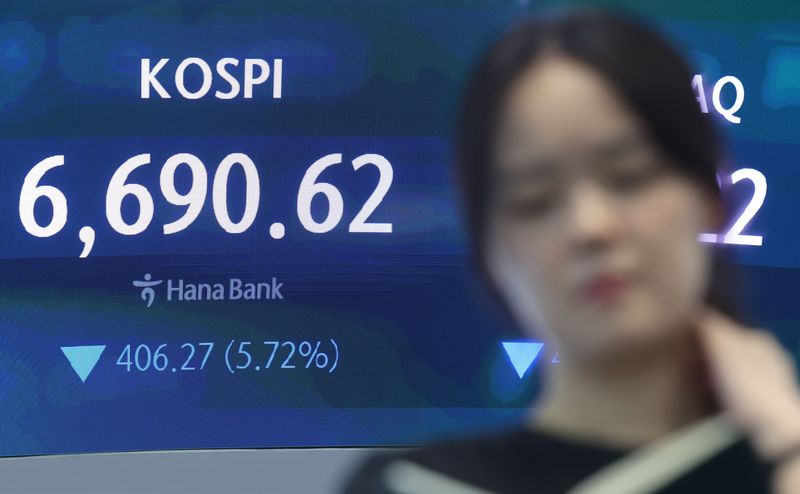
[Financial News] The KOSPI retreated to the 6,600 level amid concerns over AI investment costs and geopolitical risks in the Middle East.
According to the Korea Exchange, the KOSPI ended the day at 6,690.62, down 406.27 points, or 5.72%, from the previous trading day.
On the Korea Exchange Main Board, individual investors bought a net 625.88 billion won, while foreigners and institutions sold a net 4.204 trillion won and 210.96 billion won, respectively.
By sector, pharmaceuticals rose 5.99%, food and tobacco 1.49%, and transportation and warehousing 1.06%. In contrast, electrical and electronics fell 7.86%, manufacturing 6.64%, and medical and precision instruments 6.00%.
Among the largest-cap stocks, Samsung Biologics rose 7.83%, Celltrion 2.96%, and Hanwha Aerospace 1.57%. Kia fell 12.55%, SK Square 8.19%, and Hyundai Mobis Company Limited 8.11%.
The two major semiconductor stocks also fell sharply. Samsung Electronics closed at 252,500 won, down 6.48% from the previous day, while SK hynix ended at 1,789,000 won, down 6.77%.
As major large-cap stocks, including semiconductor names and Hyundai Motor Company and Kia, dropped sharply, a sell-side sidecar was triggered on the KOSPI during morning trading. The Korea Exchange activated the sell-side sidecar at 11:23:49 a.m.
The exchange suspends the effectiveness of program trading buy or sell orders for five minutes if the price of the most actively traded KOSPI 200 Index futures contract from the previous session rises or falls by at least 5% and remains there for one minute.
At the time the KOSPI sell-side sidecar was triggered, the KOSPI 200 Index was down 5.04%, or 56.88 points, from the previous close at 1,070.80.
The KOSDAQ (Korea Securities Dealers Automated Quotations) closed at 748.22, down 42.06 points, or 5.32%, from the previous session. Individual investors bought 550.1 billion won, while foreigners and institutions sold 180.8 billion won and 373.1 billion won, respectively.
Im Jeong-eun, a researcher at KB Securities, said, "Concerns over the profitability of AI investments resurfaced after Alphabet and Tesla, which reported second-quarter results the previous day, posted negative free cash flow amid expanding capital expenditures (CAPEX)." She added, "Middle East instability also weighed on the market, as U.S. President Donald Trump continued to make hard-line remarks toward Iran."
[email protected] Bae Han-geul Reporter