Government Freezes Oil Price Cap Again, Citing Burden on Household Economy
- Input
- 2026-07-24 19:00:00
- Updated
- 2026-07-24 19:00:00
[Financial News]
The government has decided to freeze the oil price cap for another four weeks, even as international oil prices have climbed back above $100 per barrel amid worsening tensions in the Middle East. It is placing more weight on stabilizing livelihoods than on raising prices, given the added burden on households from recent inflation and interest rate hikes.
The Ministry of Trade and Industry said on the 24th that the eighth oil price cap, which will apply for the next four weeks starting at midnight on the 25th, will remain unchanged from the seventh cap. Under the cap, gasoline will be priced at 1,784 won per liter, diesel at 1,773 won, and kerosene at 1,380 won.
Global crude markets have become unstable again as military tensions between the United States and Iran have escalated and Houthi rebels declared a blockade of the Red Sea. With traffic through the Strait of Hormuz also declining, Brent Crude Oil rose above $100 per barrel as of the 23rd, and international petroleum product prices also turned upward.
The government also took into account that, on a monthly average basis, international oil prices are still below the June average. July's average international oil prices stood at $82 for Brent Crude Oil, $77 for WTI, and $75 for Dubai crude, all below the June average.
At a briefing that day, Yang Ki-wook, Director-General for Industrial and Resource Security at the Ministry of Trade and Industry, said, "Given the uncertainty surrounding the situation in the Middle East and the difficulty of predicting price swings, we focused on making the price cap a buffer for the livelihood economy." He added, "The purpose of this decision is to minimize the burden on livelihood-dependent consumers, including truck drivers, delivery workers, and farmers and fishers."
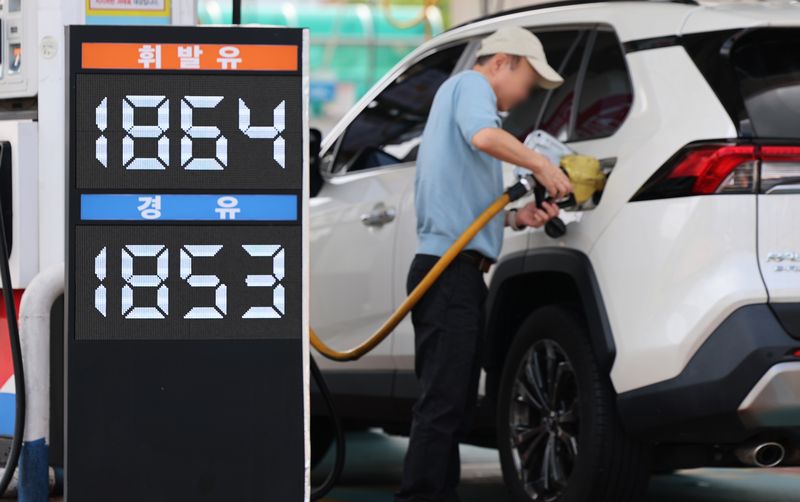
According to the ministry, retail fuel prices at domestic gas stations have continued to fall since the seventh price cap took effect. As of the 23rd, the national average retail prices were 1,871 won for gasoline and 1,856 won for diesel.
The government said it expects fuel prices to remain at current levels for the time being. However, it left open the possibility of adjusting the price cap during the four-week period if the situation in the Middle East deteriorates sharply.
Yang said, "I expect domestic fuel prices to remain at current levels for now," but added, "If the situation changes abruptly over the weekend or next week, we may have to adjust the price cap without waiting for the full four weeks."
The government also said crude oil supply and demand are still being managed stably. However, if the war drags on, it is considering gradually resuming measures to diversify supply.
Yang said, "We do not plan to introduce additional measures in August, but if necessary, we will restart crude oil swaps from September and review other supply diversification measures in sequence." He added, "There are no current plans to raise the resource security crisis alert level."
[email protected] Park Ji-young Reporter