A Large Portion of Chey Tae-won's Shares Are Deemed Subject to Property Division... 'Surging' Share Value Reflected in the Split Ratio [Full Text]
- Input
- 2026-07-24 15:00:08
- Updated
- 2026-07-24 15:00:08
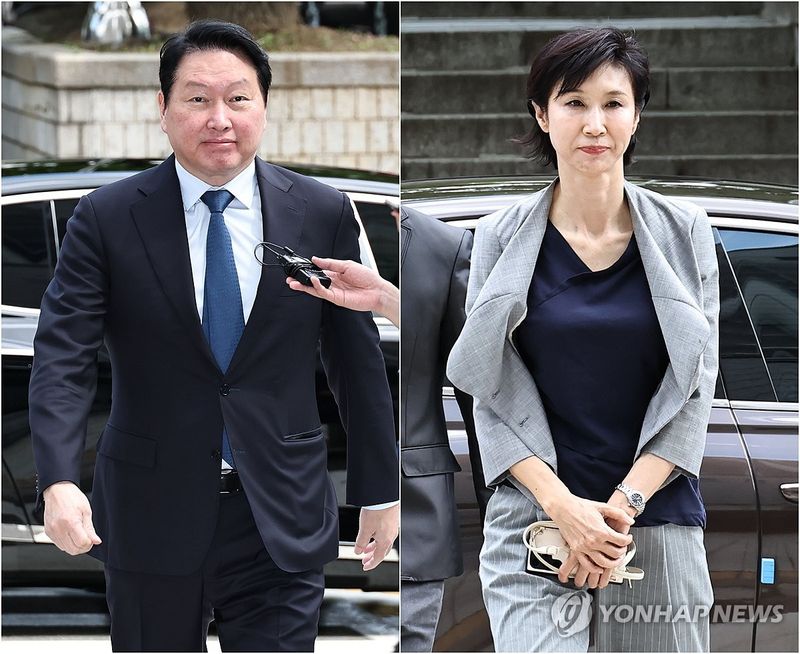
[Financial News] The key issue in the remanded appeal of the so-called 'property division of the century' between SK Group Chairman Chey Tae-won and Art Center Nabi Chair Noh So-young was whether the SK shares held by Chey should be regarded as subject to property division. Chey’s side has argued that the stake is separate property acquired through inheritance and gifts, and therefore not divisible. Noh’s side, meanwhile, has countered that it should be treated as marital property because she supported his business activities while handling household duties and child-rearing during the marriage. As Chey’s side said it would appeal after reviewing the ruling, the case is likely to return to the Supreme Court of Korea once again.
The Seoul High Court Family Division 1, presided over by Judge Lee Sang-joo, ruled on the 24th in the remanded property division case filed by Noh against Chey, ordering Chey to pay Noh 944 billion won.
The biggest issue was whether the SK and other shares held by Chey should be considered assets subject to division.
First, the court determined that the SK and other shares held by Chey were included in the assets subject to division. Because the shares were acquired in Chey’s name during the marriage, the court recognized that not only Chey but also Noh contributed to the acquisition and preservation of their value. In particular, it said the value of the shares rose sharply during the marriage due to Chey’s management activities, and that Noh’s household work, child-rearing, and external activities related to SK Group contributed to that increase. The court’s reasoning was that Noh’s domestic efforts enabled Chey to carry out external activities, including group-related duties, and that through those activities he was able to acquire the shares and significantly increase their value.
The court also set the valuation date for the SK and other shares as the closing date of arguments in the appeals trial before the remand, rather than the period after the remand when share prices surged. It applied a 2000 Supreme Court of Korea precedent stating that even if a property division claim is filed after a divorce is finalized, the assets and amount to be divided should be determined based on the date the factual hearings in the divorce case were closed. Although the SK and other shares have risen sharply since the closing date of arguments in the appeals trial before the remand, the court explained that this increase resulted from Chey’s management efforts and therefore could not be treated as property subject to division.
However, the court reflected the sharp fluctuation in share value in determining the division ratio. Chey will receive one-third of the shares he holds, while Noh will receive two-thirds of the shares held by Chey. The court noted that, given the highly volatile nature of share values, the total value of marital property could change significantly depending on when the closing date of arguments after remand is set. Even if the valuation date is fixed at the pre-remand closing date, the increase during that period must be shared by both spouses.
The court explained, "A substantial portion of the marital property was formed or acquired during the marriage," adding, "For an equitable division of marital property built through mutual cooperation, we took into account the sharp rise in the value of Chey’s shares after the closing date of arguments in the appeals trial before remand. We also considered that Chey’s shares account for a large portion of the marital property and that Chey’s management contributions helped increase the value of Noh’s shares."
The court ordered Chey to make the payment in cash. It said that, based on the arguments presented at hearings after the remand, the shares could serve as the basis for Chey’s management control and dominance over SK Group. It appears the court accepted Chey’s side’s argument that if Noh were to receive the shares themselves, the ownership structure could be overturned.
However, the court rejected all of the points previously addressed by the Supreme Court of Korea. Last year, the Supreme Court ruled that the 30 billion won in funds from Noh’s father, former President Roh Tae-woo, were slush funds and therefore illegal money that could not be considered subject to property division. The court said, "In accordance with the Supreme Court’s remand ruling, the 30 billion won in support from the former president will not be considered in assessing Noh’s contribution or in determining the property division ratio," adding, "Shares gifted by Chey for reasons such as maintaining management control before the breakdown of the marriage are also excluded from the assets subject to division."
Chey’s side expressed disappointment and said it would consider an appeal. Attorney Lee Dae-geun, Chey’s lawyer, told reporters after the ruling, "Above all, Chairman Chey feels deeply sorry for the concern this process has caused many people so far," adding, "After receiving the written judgment and reviewing it carefully, we will decide whether to appeal."
Noh’s side left the Seoul High Court building without answering the same question.
In the first trial, the court recognized 100 million won in alimony and 66.5 billion won in property division, but the appeals court sharply increased the amounts to 2 billion won in alimony and 1.3808 trillion won in property division. However, in October last year, the Supreme Court sent the case back to the Seoul High Court, saying that even if Roh Tae-woo’s slush funds were actually used in the growth of SK Group, they were illegal funds and could not be recognized as a contribution to asset formation. The 2 billion won in alimony was finalized.
[email protected] Jung Kyung-soo Kim Dong-kyu Choi Eun-sol Reporter