Can Non-Apartment Homes Become Places Worth Living In? Now It Is Up to the Government and the National Assembly to Answer [The 'Bottom Rung' of the Housing Ladder, Part 5 of 5]
- Input
- 2026-07-28 07:00:00
- Updated
- 2026-07-28 07:00:00
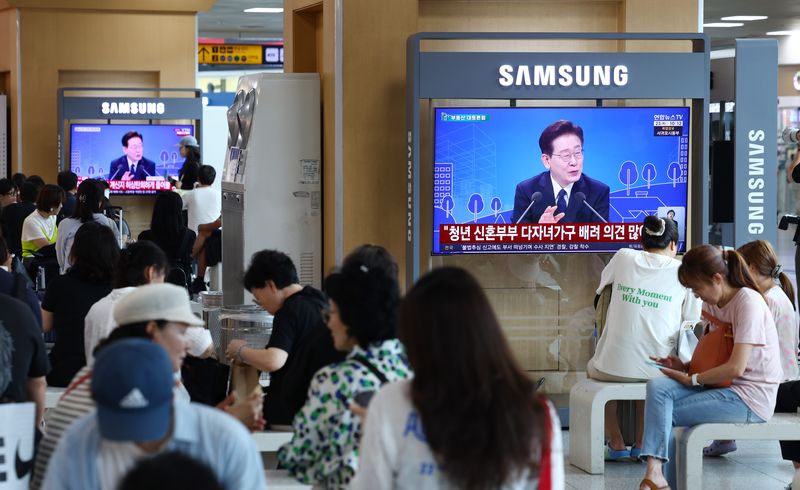
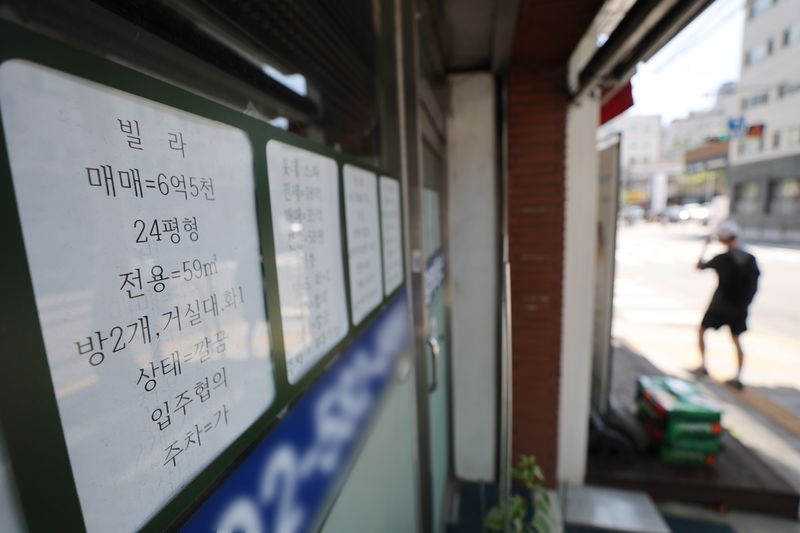
Non-apartment housing, often represented by villas, is not a type of home people want to live in. It is a type of housing people end up living in because they have no other choice.Non-apartment housing, often called the last rung of the housing ladder, has become a place where residents and experts alikehope it can becomea preferred place to live, and they have urged the government to share that goal.
[Financial News] The real estate market does not see just one reason behind the decline in demand for non-apartment housing.
The entry of small developers with unproven financial strength, along with business models that relied heavily on large jeonse deposits, led to mass refund failures and deepened fears of jeonse fraud.
Poorer living conditions also discouraged occupancy. On top of that, a system that classifies anyone who owns even one villa as a homeowner further intensified the dislike for non-apartment housing. Although these homes have lower price appreciation potential and weaker liquidity than apartments, they are still counted as a single home for taxes, subscriptions and loans.
That is why some analysts say, "It was not apartments that collapsed, but non-apartment housing."
Chae Sang-wook, CEO of ConnectedGround, who attended the Public Grand Forum on Real Estate Policy hosted by President Lee Jae Myung on the 23rd, made the same argument on social network service (SNS) after the forum.
He said, "Apartments are still being sold in the Seoul metropolitan area at 160,000 units this year, and cumulative presales reached 42,000 units by the end of May. But non-apartment housing came to just 7,000 units in the same period," adding, "The basic level of housing supply based on demand is 260,000 units in the Seoul metropolitan area, but from 2022 to 2025 only 160,000 units were supplied, leaving a shortfall of 100,000 units. Among them, non-apartment housing, including officetels, is down to one-tenth of that level."
He also urged the authorities to come up with measures, saying, "I wonder whether the presidential office has not yet fully recognized how serious the non-apartment housing problem is."
Proposal for 'supplier registration' to build trust in developers
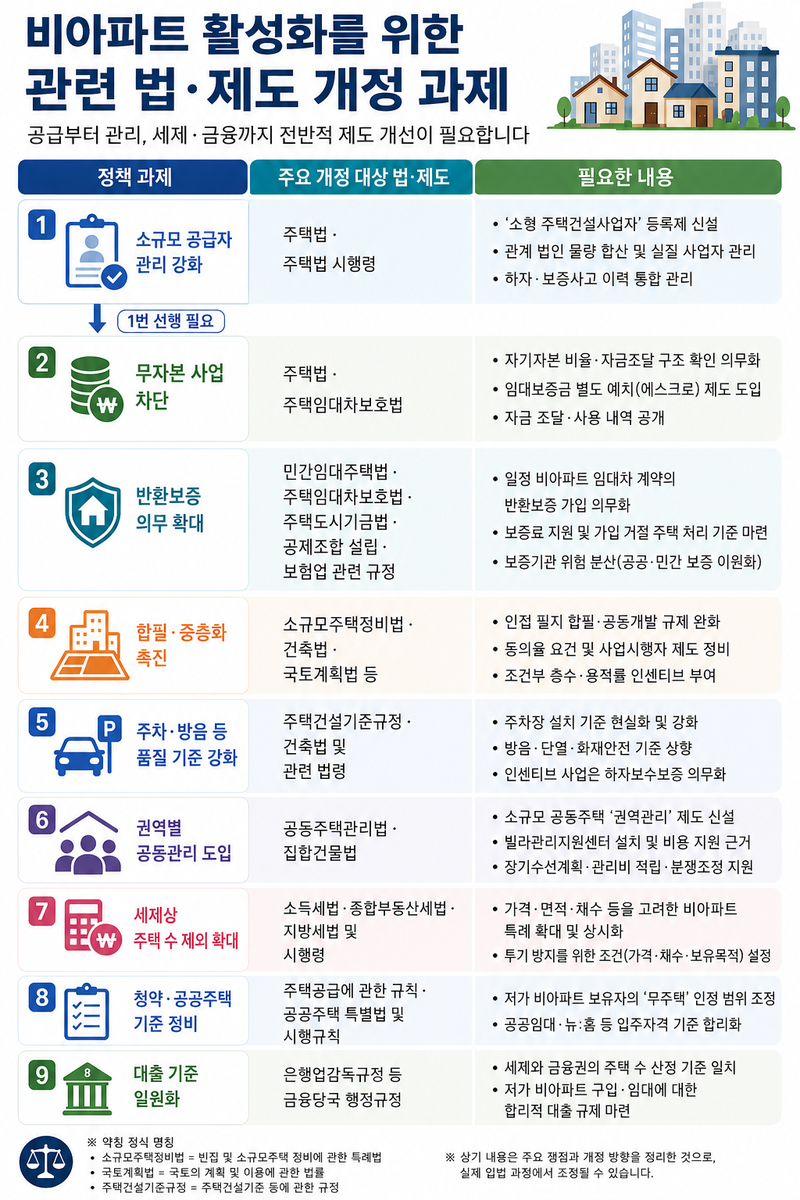
Because the causes are so intertwined, the solution to the weak demand for non-apartment housing is not simple. The first step toward restoring trust is stronger supplier management, including tighter standards for developer qualifications, construction quality and housing management.
Unlike apartments, which are built by registered housing developers and go through project approval, supervision and guarantee procedures, small multi-family and row houses can be built with only a construction permit under the Building Act. If the name of the corporation or builder changes from one project site to another, it becomes difficult to trace the actual supplier's past performance or any history of defects or deposit-related accidents.
At the same time, it is difficult to apply the same standards used for large construction companies to small operators. That could end up discouraging legitimate small-scale supply. Kim Deok-rye, a senior research fellow at the Housing Industry Research Institute, proposed creating a new registration system for "small housing construction operators" as a solution.
Under her proposal, the capital and staffing requirements for existing registered operators would be eased, but they would be required to register, disclose performance records, assume defect liability, join guarantee programs and disclose funding details. The goal is to manage the actual controlling party and supply history in an integrated way.
To do this, the Housing Act and its enforcement decree would need to be revised to create a new category for small housing construction operators and to establish a basis for combining the volumes handled by related corporations and actual project owners. A legal basis is also needed to link local governments' building permit data, the Ministry of Land, Infrastructure and Transport's operator registration information and guarantee accident records from Korea Housing & Urban Guarantee Corporation (HUG).
To prevent jeonse deposits from becoming construction funds... 'capital-free businesses' must be blocked
Experts also called for changes to financing structures that rely on loans and tenants' jeonse deposits without sufficient equity capital. One idea under discussion is a European-style escrow system, in which tenants' deposits are placed in a separate account or with a third-party institution and then released according to contract terms. This would prevent the deposits from being used immediately for construction costs or loan repayment.
To institutionalize this, the Housing Lease Protection Act would need new standards for deposit custody and management, or a separate law would need to be created. Another proposal is to expand the guarantee requirement under the Private Rental Housing Act to unregistered landlords above a certain size and to newly built non-apartment housing.
However, some argue that a phased introduction is necessary, since locking up the full amount of deposits could sharply weaken the rental business and housing finance structure.
Kim Deok-rye said, "Rather than locking up the entire deposit at once, we could consider partial escrow for high-risk newly built non-apartment homes or staggered payments based on construction progress."
She also pointed out that the more guarantees are expanded, the more risk becomes concentrated in one institution. At present, HUG handles return guarantees for jeonse deposits, presale guarantees and housing project finance (PF) guarantees. The problem is that there is no private guarantee market specialized in the risks of small housing developers and rental operators.
At the forum, Chae said, "Current project financing is structured so that land and construction costs are borrowed first and repaid through presale proceeds, but rental businesses have difficulty recovering initial capital." He added, "A financial system for private rental suppliers must be established institutionally."
In response, Kim suggested a dual guarantee system, saying, "Just as fire risk is spread through insurance, the risks arising in housing projects should also be shared not by one public institution alone, but by insurance, mutual aid and private guarantee providers."
Under such a system, HUG and the Housing and Urban Fund would focus on protecting low-income tenants and supporting policy projects, while business risks such as completion, defects, rent, deposit refunds and construction payments would be shared by private and mutual-aid guarantees from housing developer groups or insurers.
Land consolidation and mid-rise redevelopment could upgrade housing quality
There were also suggestions for improving housing quality. Instead of building one structure on each small lot, adjacent parcels could be combined for joint development. That would make it possible to integrate access roads, parking lots and stairways, secure underground parking and ground-level green space, and supply medium-sized homes suitable for families.
To make that possible, the project type and requirements would need to be made more flexible. Officials would also need to review a system for project implementers in land consolidation projects, consent ratios and buyout standards, special rules on floor-area ratio and building height, and legal grounds for local government support for infrastructure.
Simply increasing the number of floors and the floor-area ratio could create "high-rise villas" that add more households to a cramped site. That is why experts say parking capacity should reflect actual car ownership rates, and part of the incentives generated should be invested in underground parking, elevators, green space and shared facilities.
Management after completion is just as important as building well. Under the Act on the Management of Multi-Family Housing, mandatory management applies mainly to apartment complexes with 300 or more households, or 150 or more households if they have elevators. That makes it difficult for villas with 10 to 20 households to have a management office or professional staff. If there is no management body, repairs to exterior walls, pipes or elevators are delayed even when problems arise.
Possible solutions include linking these homes to small-scale housing improvement projects such as Moa Town, or creating a regional joint management system that groups multiple buildings together. Under such a system, several villa buildings in one area would be managed as a single zone, with a professional management company handling cleaning, fire safety checks, elevator inspections and repairs to shared facilities.
Calls for excluding certain homes from household-count rules
The most direct demand-side measure is still to exclude homes below a certain price and size from the household count. The government currently excludes some newly built small homes acquired through the end of 2027, with exclusive floor area of 60 square meters or less and prices of up to 600 million won in the Seoul metropolitan area or 300 million won outside the region, from certain tax-related household-count rules. In the field, however, there are calls to extend that period by at least three years, or even without a limit.
Professor Shin Bo-yeon of Sejong University's Department of Real Estate AI Convergence said, "For non-apartment housing, completely excluding them from the household count is also an option." She added, "Their price appreciation is so slow that it is less than half that of apartments, and newly built units do not need redevelopment anytime soon. They should be operated as corporate-style rental businesses that generate profit through landlord registration."
There are also side effects to consider. If the exclusion is allowed without a price cap, high-end row houses and officetels could be included, turning them into investment vehicles that bypass multi-home ownership regulations. If only redevelopment zones are exempted, speculative demand could shift to candidate sites before they are officially designated.
Accordingly, experts say rules should also be applied on price caps, the number of homes eligible for exclusion, holding period, actual occupancy, rental registration and guarantee enrollment, and whether redevelopment is being pursued.
On the public opinion website the government set up to gather views for real estate policy, one contributor argued, "Old villas under 100 million won and under 15 pyeong should be excluded from the household count." Another said, "The government has only given household-count exclusion benefits to some small newly built non-apartment homes, but that is a half-measure. Regardless of whether they are new or existing, all non-apartment homes under 84 square meters should be excluded entirely from household-count calculations."
Can non-apartment housing become a place worth living in?
The non-apartment housing problem is tied to a wide range of overlapping issues, including the Housing Act, the small-scale housing improvement law, the Building Act and the National Land Planning and Utilization Act, the Act on the Management of Multi-Family Housing and the Act on the Ownership and Management of Condominium Buildings, the Housing Lease Protection Act and the Private Rental Housing Act, as well as tax rules and regulations on subscriptions and finance. That is why the problem is unlikely to be solved by changing just one law or one system. More and more voices are saying that the government and the National Assembly must now treat non-apartment housing as a housing policy issue in its own right, not as a series of separate measures.
At the Public Grand Forum on Real Estate Policy on the 23rd, President Lee said, "The goal is not to force prices down. It is to prevent prices from being distorted by abnormal demand and supply."
Non-apartment housing can be supplied relatively quickly in urban areas and offers a place to live at an affordable cost. It is time for the government and the National Assembly to step in so that it can shed its negative image and become a place worth living in.
The government also held another Public Grand Forum on Real Estate Policy chaired by Prime Minister Han Seong-sook on the 27th.
At the event, participants proposed support measures to boost non-apartment housing supply and the creation of a one-stop system for use conversion. The government plans to reflect these ideas in next month's tax reform package and follow-up real estate policy measures.
[email protected] Kim Hee-sun, Seo Yoon-kyung Reporter