"If They Tell Us to Leave, We Have to Leave" ... The People of the Yongsan Station Tent Village [Recorder of the Low Places]
- Input
- 2026-07-26 06:00:00
- Updated
- 2026-07-26 06:00:00
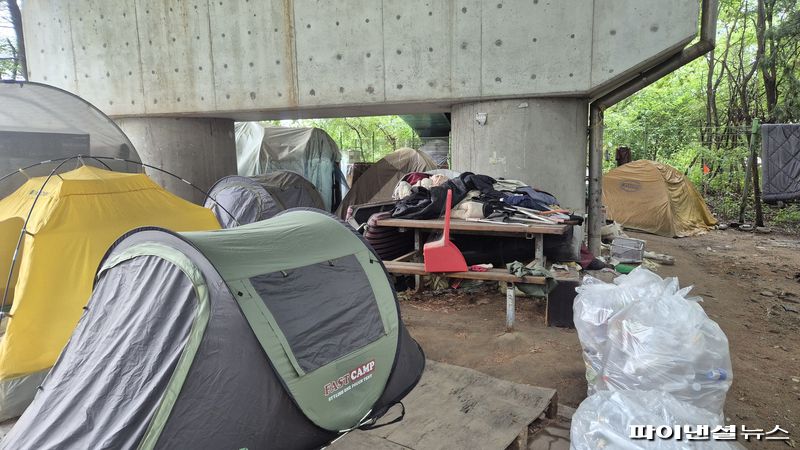
In the middle of the city, there are people who pitch tents in search of a place to spend the night. The tarps set up between the station, the overpass and the trees are temporary shelters, but they also serve as places to eat, do laundry and sleep. We looked at the daily lives of homeless people living in the tent village near Yongsan Station.
[Financial News]"If they tell us to leave, we have to leave. What else can we do?"A homeless man in his 50s, identified as A, said this on the afternoon of the 23rd under an overpass near Yongsan Station in Seoul. Around the tent where he was sitting were water bottles, pots, plastic boxes and empty bottles. Other tents were lined up between concrete pillars and trees, and blankets and mattresses were hung between the trees.
A complained, "No one is outside because they like it. We're here because this is where we can sleep tonight." He added that he is often encouraged to enter a shelter, but said, "I just don't feel like it."
Why the tents are gathered under the overpass near the station
The tent village around Yongsan Station is believed to have formed in the mid-2000s, when homeless people began settling in a small park inside the former railway maintenance yard site.
The area is not easily visible from the main road. If you go down the stairs next to the parking lot behind Yongsan Station and head into the trees, tents and daily necessities used by homeless residents begin to come into view. Cups, bowls, toiletries, water bottles and laundry were scattered around the tents. Some shelters had plastic sheets added on top to keep out the rain, and in some areas wooden boards and boxes were stacked up.
The reason the tent village remains near the station is not just about sleeping. Access to water, toilets and a place where people are constantly passing by also matters.
A homeless man in his 60s, identified as B, who stays there said, "The biggest thing is that the restroom is close." He added, "It is hard to wash, but if you go toward the station, there are restrooms. If you go somewhere completely isolated, it gets scarier at night and it is harder to get what you need."
Surveys also show why homeless people stay near stations or in downtown areas. According to the "2024 Survey on the Status of Homeless People," released by the Ministry of Health and Welfare (MOHW) in June last year, the reasons street homeless people gave for choosing where to sleep that night included "it is easier to use convenience facilities such as restrooms" at 22.7 percent and "there are other homeless people nearby" at 16.6 percent.
The same survey found that there were 12,725 homeless people nationwide in 2024. Of them, 1,349 were street homeless, 6,659 were in shelters and 4,717 lived in single-room housing. Of the street homeless, 1,022 people, or 75.7 percent, were in the Capital Region, including Seoul, Gyeonggi and Incheon.
"People live there?" Some citizens do not even know about the Yongsan Station tent village
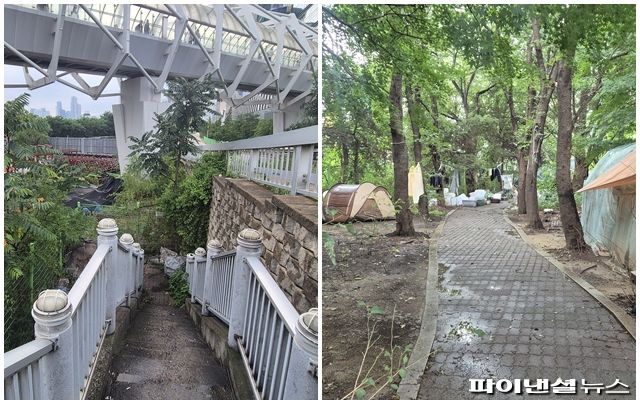
Public reactions were mixed. A office worker in his 30s, identified as C, who was passing by nearby, said, "At first I had no idea this kind of place existed." He added, "I am worried about smells and trash, but if you think about the fact that people are living inside those tents, it is hard to say they should just be cleared out."
A company employee in his 50s, identified as D, said, "Yongsan Station is a place with a lot of foot traffic, so it is true that it seems to need cleanup." He added, however, "If you just remove the tents without saying where people should go, aren't you just pushing them somewhere else?"
For the people living there, the tent village is a place to survive each day. But for citizens passing through the station area, it is a space that needs to be managed. As daily life continues under the overpass and among the trees, trash piles up, and hygiene and safety problems can worsen depending on the season.
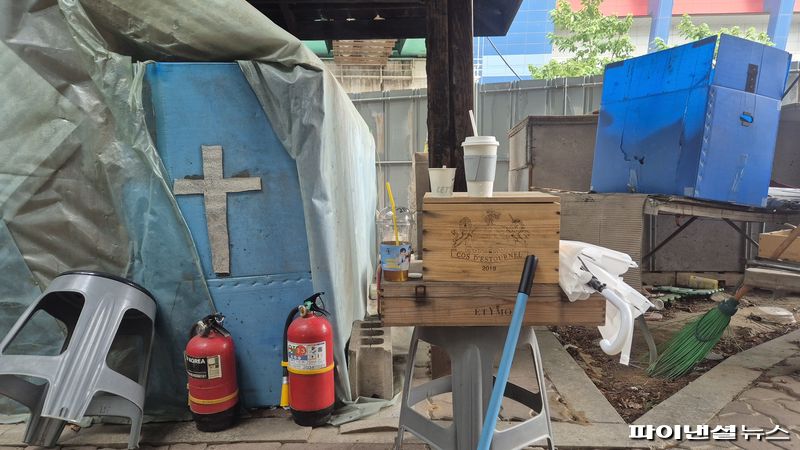
At the site, there were actually containers with standing water, empty bottles and various cooking utensils scattered around. In summer, health problems can become more serious, and in winter, the use of heating devices can create a fire risk. Fire extinguishers were also visible near some tents.
That does not mean moving people into facilities is simple. In the MOHW survey, the most common reason street homeless people gave for not using residential facilities was "because of group living and rules" at 36.8 percent. "The indoor space feels cramped" accounted for 16.6 percent, and "I do not know the facilities well" for 14.2 percent. This suggests that even when facilities exist, some people cannot easily leave the streets because of their way of life, belongings, relationships and rules.
The Yongsan redevelopment and the issue of relocating the tent village
The Yongsan Station area is also tied to a large-scale redevelopment project. Seoul is pushing ahead with the creation of the Yongsan International Business District (YIBD) centered on the former Yongsan railway maintenance yard site. According to the outline of the Yongsan Seoul Core project, the project area covers 456,099 square meters in Hangangno 3(sam)-ga, Yongsan-gu, Seoul.
As redevelopment moves forward, demands to improve the area around the station are likely to grow. The tent village is a space where inconvenience to the public, hygiene and safety issues are all raised together. But for the people living there, cleanup means a matter of survival. If the tents and belongings are removed, the place to lie down that night disappears as well.
This issue has come up before. During construction of a pedestrian bridge connecting Yongsan Station and a nearby hotel, part of the tent village was included in the demolition plan, and homeless groups at the time demanded housing measures. In 2024, there were also calls for relocation measures for the tent village in connection with the Yongsan maintenance yard redevelopment.
B said, "If they are doing construction, then yes, we will have to leave." He added, "But if they just tell us to go without saying where, where are we supposed to go? You need money to rent a room." He said, "I have been to shelters, but it was hard to stay long. There was nowhere where I could keep my belongings the way I wanted."
A day endured in the shadow of Yongsan Station
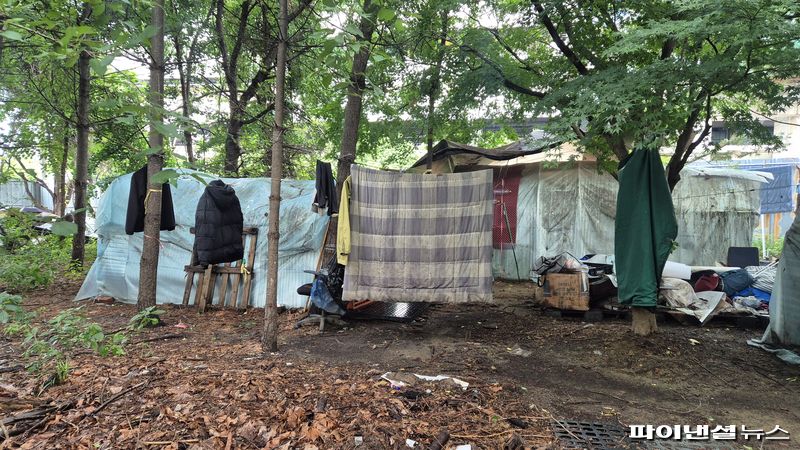
As the afternoon wore on, someone was seen gathering laundry inside the tent village. Another person was carrying water in a plastic container. The space under the overpass was a temporary shelter, but inside it, the routines of eating, doing laundry and preparing to sleep were repeated.
The problem is that this way of life can be cut off at any time. A tent may look like a home, but it is not legally stable housing, and it cannot fully protect people from rain, heat or cold. If they remain near the station, public inconvenience and hygiene problems arise. If they are pushed to the outskirts, they are farther from restrooms, water and people who can help.
One homeless man said, "It is not good to be here." He added, "But you need a place to lie down at night to make it through the next day." He then pleaded, "If you want us to leave, you need to give us somewhere to go first."
We record the stories of real lives in writing. Even if the language is rough, we capture the words gathered on the scene as they are. From alleys and markets to someone’s workplace, the record of an ordinary day that we have passed by comes to you, our readers. To receive [Recorder of the Low Places] more conveniently, please subscribe to the reporter page.
[email protected] Han Seung-gon Reporter