[Editorial] The Real Estate Forum Should Reflect On-the-Ground Demands, Not Be a Mere Formality
- Input
- 2026-07-23 18:25:52
- Updated
- 2026-07-23 18:25:52
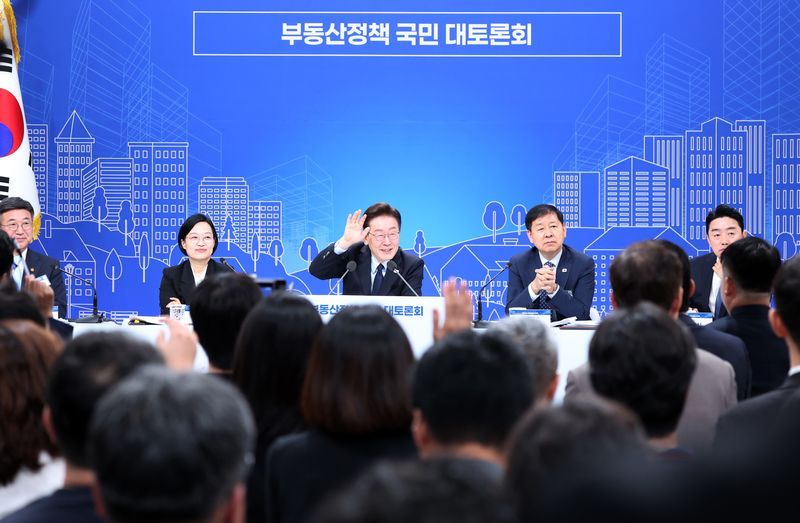
More than 140 people from the government, academia, and the public attended the forum held on the 23rd at the KBS annex in Yeouido, Seoul, and spent more than three hours presenting arguments for and against policies across the real estate spectrum, including supply, finance, and taxation. In expert presentations before the open discussion, speakers said that restoring the broken chain of housing supply would require financial and tax support, along with deregulation to revitalize private redevelopment projects. On taxation, they also pointed out the need to discuss what level of property tax burden would be appropriate compared with other major countries, and how to set the tax threshold for ultra-high-priced homes. They also proposed easing capital gains taxes to balance stronger property taxes.
This public forum was organized after a series of preliminary discussions hosted by the Ministry of Land, Infrastructure and Transport on the 14th for supply, the FSC on the 15th for finance, and the Ministry of Economy and Finance on the 16th for taxation. Public interest was intense, with more than 6,000 policy proposals submitted through the government’s online channel by the day of the forum. Even so, opinions remained sharply divided over designating regulated areas, loan restrictions, strengthening property taxes on ultra-high-priced single homes and on single-home owners who do not live in the property, and easing transaction taxes to offset higher property taxes. It showed just how difficult it is to build social consensus around real estate policy.
Although participants offered a wide range of views, the greatest attention was focused on the remarks of President Lee, the final decision-maker on policy. Lee said property taxes would need to rise by at least threefold to bring them up to advanced-country levels, but added that he would consider differentiating the burden according to whether the owner lives in the home, the home’s price, and the purpose of ownership, given the tax resistance that could follow a sharp increase. Some observers said that despite the many views raised at the forum, the president’s existing stance on the core policy direction was reaffirmed fairly clearly.
Regarding the recent surge in home prices, Lee said, "The limits of supply are clear," adding that market prices should be respected, but that corresponding social burdens would be imposed. He also said, "The greatest virtue of a public official is to accept criticism, conflict, and resistance and still take responsibility," reiterating his resolve to strengthen property taxes. He reaffirmed that even single-home owners would receive relief if they are actual residents, low-income households, middle-class households, or owners of homes in regional areas, while tax burdens would be increased on ultra-high-priced homes, multiple-home owners, and non-residential properties held for speculative purposes. However, he said the standards for ultra-high-priced homes and the level of tax burden would be set after gathering more public input.
The debate is over. What remains now is how much of the voices heard there will actually be reflected in policy. If the forum ends up merely reaffirming positions already set out, its significance will inevitably be diminished. That would be even more true if the purpose of the forum is to broadly gather public opinion and build national consensus on real estate policy. Only then will the forum’s slogan, "A blueprint for Korea’s real estate policy designed together with the sovereign people," avoid becoming just an empty slogan.