"Property tax relief for owner-occupied homes, heavier burden for ultra-expensive properties" [Real Estate Forum]
- Input
- 2026-07-23 18:22:17
- Updated
- 2026-07-23 18:22:17
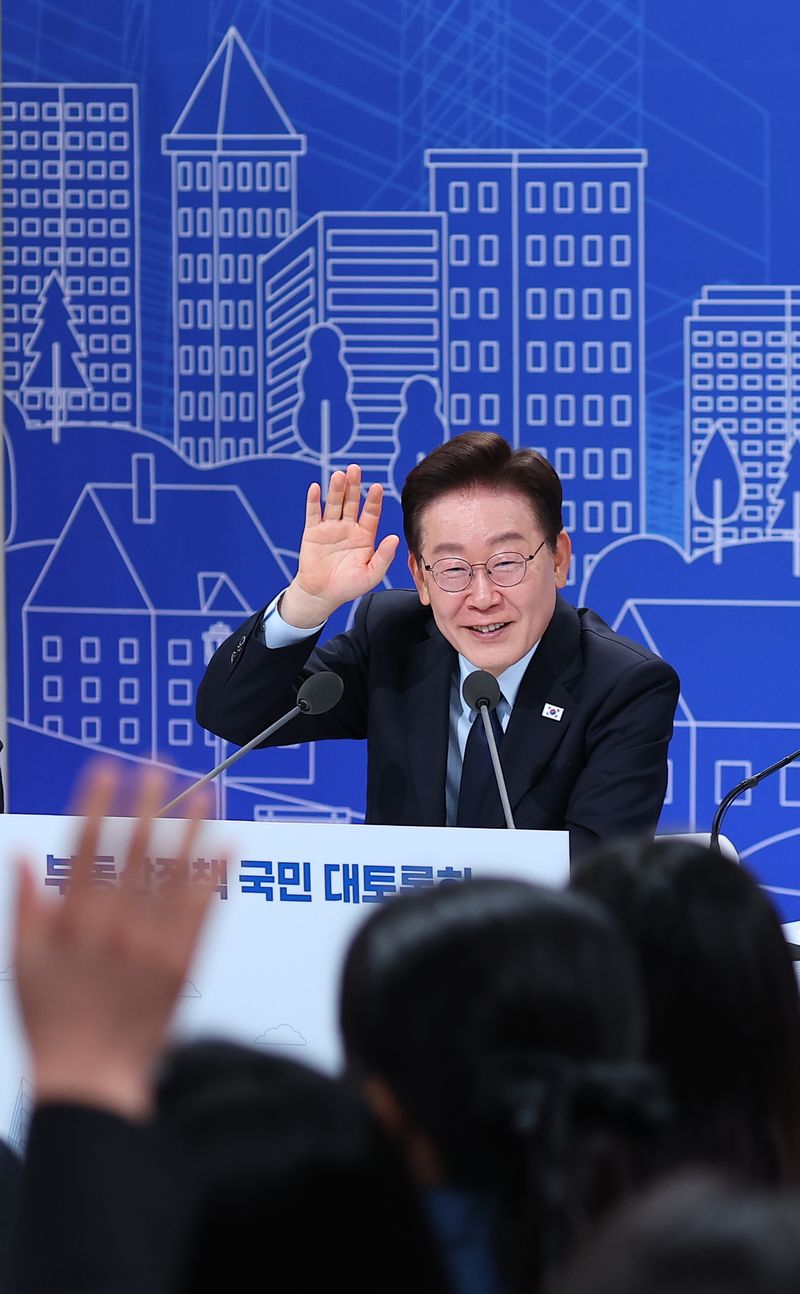
President Lee Jae Myung said on the 23rd that he generally agrees with the view that property holding taxes should be strengthened. He also said, "It is now very difficult to find land for development anywhere in Seoul." With housing supply constraints becoming increasingly clear and home prices surging in Seoul and other parts of the Seoul metropolitan area, Lee publicly raised the need to reform the tax system to normalize the real estate market. At the same time, he said that if property holding taxes were raised to the level of advanced economies, they would need to increase by about three times. "If we raise them threefold, there would probably be something close to a riot," he said, signaling support for a gradual and differentiated increase rather than a sharp hike.
At the forum held at the KBS Annex in Yeouido, Seoul, Lee said, "Historically and globally, taxes have had an enormous impact on politics, and some people use that to their advantage." He added, "For the future of South Korea, I think we have to be willing to endure some hardship." He stressed, "I am also worried about conflict, but for the sake of the entire public, our country's future, and a better long-term situation, we need to do what must be done."
In particular, Lee cited Japan's "The Lost Decades," which were triggered by a real estate bubble. He said, "Japan once went through difficult times because of real estate. People also talked about 'The Lost Decades.' In fact, quite a few people worry that we are racing toward that peak ourselves."
His reference to Japan is being interpreted as a strong sign that he intends to push ahead with real estate tax reform, even if it means political pressure and social conflict, in order to reduce the broader burden a bursting property bubble could place on the economy.
Regarding property holding taxes, Lee said the tax burden should vary depending on whether the home is owner-occupied, its price, and the purpose of ownership. He said, "Protection policies for assets bought to build wealth and for a home I actually live in should be different." He also suggested that the threshold for ultra-expensive homes and the level of taxation require careful discussion. Specifically, he explained, "If it is a single home used for actual residence, we can reduce the burden. If it is for ordinary people or the middle class, we can also reduce it a bit to provide protection. That is how it could be organized." He added, "We should take regional circumstances into account, while luxury homes, multiple-home owners, and clearly speculative properties are the cases where heavier weighting applies. We are considering a gradual and differentiated approach."
Lee also expressed concern about the so-called preference for a "single, high-quality home," saying, "It has created an opportunity for speculation in the most efficient way." He said, "Of course, that was not the policy makers' intention. The idea was to respect and protect one household owning one home." But he added that by treating expensive and inexpensive homes the same, people ended up buying one property efficiently and reaping investment gains. "On top of that, we did not distinguish between homes for living and homes for investment or speculation," he said.
He also pointed to jeonse loans as a major driver of rising home prices and hinted at tighter regulation. In particular, he said, "Jeonse loans were meant as a support policy to help ordinary people stabilize their housing, but at the same time they became a major cause of soaring home prices. I think it is time to adjust that now." He added, however, that targeted support should still be provided for young people, newlyweds, first-time buyers, and low-income housing needs.
Lee said the government's real estate policy is "not about forcing prices down," but about measures to normalize the market. He also made clear that expanding housing supply through redevelopment and reconstruction may not have a large effect. While urban renewal projects can improve living conditions and housing quality, he said, they have limits when it comes to increasing the total number of households.
[email protected] Choi Jong-geun, Seong Seok-woo Reporter