"A 'Smart' Single Home Is Fueling Speculation... Ultra-High-End Homes Defined as 3 Billion to 5 Billion Won" [Real Estate Grand Forum]
- Input
- 2026-07-23 18:21:14
- Updated
- 2026-07-23 18:21:14
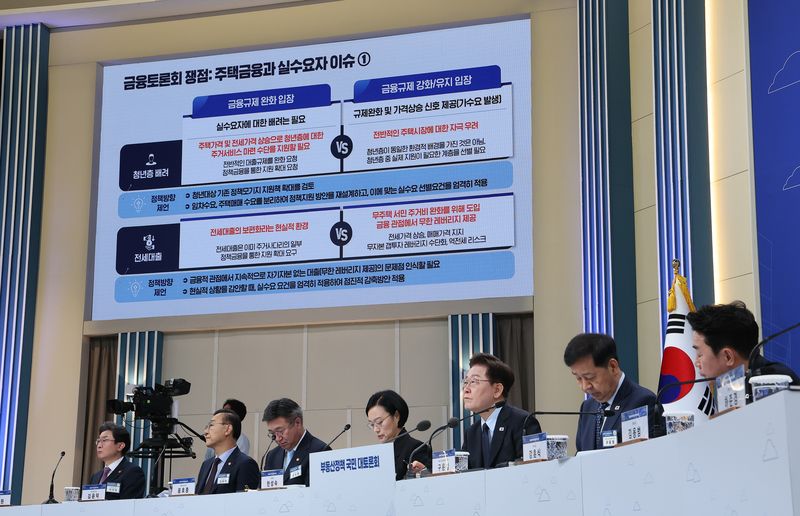
At the forum he chaired on the 23rd at the KBS annex in Yeouido, Seoul, Lee Jae Myung said, "There is generally broad agreement that property taxes need to be strengthened." He added, "The key question is how far to strengthen them, by how much, and what kind of differentiation to apply."
■From the number of homes to the value of homes
Under the current comprehensive real estate tax system, the basic deduction is 1.2 billion won in officially assessed value for one-home households and 900 million won in total officially assessed value for multi-home households. Tax is levied on the amount above those thresholds. The tax rate applied to the calculated base is also different: single-home owners face a progressive rate of 0.5% to 2.7%, while multi-home owners are subject to a heavier rate of up to 5.0%.
At the final tax calculation stage, one-home households can receive deductions of up to 80% by combining senior citizen and long-term ownership credits for those aged 60 and older. The actual tax burden gap with multi-home owners is therefore even wider.
Kang Seong-hoon, a professor in the Department of Public Policy at Hanyang University, said, "Under the current system, if you compare someone who owns one 3 billion won home with someone who owns three 1 billion won homes, the tax rate is lower for the person with one home." He added, "From the standpoint of tax fairness, we need to discuss applying tax rates based on home value rather than the number of homes owned."
Ultra-high-end homes are expected to become the key to strengthening property taxes. Even when asset sizes are similar, owning multiple homes leads to higher tax rates, while concentrating assets in a single home allows owners to benefit from various deductions and tax breaks. That, in turn, encourages demand for apartments in Gangnam, Seoul, drawing in overall assets and reinforcing the rise in Seoul home prices.
The main issue now is how to define ultra-high-end homes and where to set the threshold. At an earlier inter-ministerial listening forum, the benchmark was suggested at 3 billion to 5 billion won or higher. At Tuesday's forum, however, the range of 1 billion to 3 billion won was mentioned. Lee said, "The extent of the differential measures is actually very important. For example, the threshold for ultra-high-end homes matters greatly." He added, "It is difficult to judge, and there could be enormous tax resistance."
■Focusing long-term capital gains tax deductions on residence
Under the current capital gains tax system, one-home households pay tax only on the portion of the sale price exceeding 1.2 billion won. Through the long-term ownership special deduction, they can receive deductions of up to 40% each for ownership period and residence period, for a total of up to 80%.
Accordingly, the forum identified several key tasks: the appropriateness of the tax burden on non-resident homes, tax fairness for ultra-high-end homes, normalization of transactions, and links with property taxes. Professor Kang explained, "The key issue is whether the tax burden on non-resident homes is appropriate, and whether residence-based deductions in the long-term ownership special deduction should be expanded further."
However, if capital gains tax is tightened by reducing ownership-based deductions, a so-called "lock-in effect" could emerge, with homeowners choosing to keep their properties rather than sell them. For that reason, the implementation of any revised long-term capital gains tax deduction plan is expected to be delayed for a certain period.
The discussion also raised the number of times a single-home owner can receive capital gains tax relief as a major point of debate. Lee Gwang-su, head of Gwangsune Bokeodbang, proposed limiting the one-home capital gains tax break to once in a lifetime. In response, Lee Jae Myung said, "I am not sure whether the capital gains tax break should be limited to once in a lifetime," but added, "Limiting the number of exemptions, or giving a large break the first time and a smaller one the second time, seems like a very good idea."
There were also differing views on the relationship between stronger property taxes and capital gains taxes. Jeong Seeun, a professor at CNU, pointed out that lowering capital gains taxes as a countermeasure to stronger property taxes could create another institutional loophole. By contrast, JoongAng Ilbo reporter Ahn Jang-won suggested that if property taxes are raised, the increase in taxes already paid should be reflected in the capital gains tax calculation.
[email protected] Seo Young-joon, Choi Yong-joon, Kim Chan-mi Reporter