Rainy Season, the Worst Season for Diabetics... Heat and Humidity Make Blood Sugar Control Difficult [Weekend Health]
- Input
- 2026-07-24 04:00:00
- Updated
- 2026-07-24 04:00:00
This is because the continuous sweltering heat and high humidity suppress appetite, reduce physical activity, and increase the risk of dehydration, making blood sugar control difficult. In particular, since diabetes is a chronic disease where even small changes in lifestyle can lead to complications rather than simply managing blood sugar levels, more meticulous care is required than usual during the rainy season. According to statistics from the Health Insurance Review and Assessment Service on the 23rd, the number of diabetes patients in Korea was tallied at approximately 4,099,000 last year.
This figure represents an increase of about 560,000 compared to the 3,537,000 recorded in 2021. The number of patients is steadily rising every year due to factors such as an aging population, an increase in the obese population, and Westernized dietary habits. Experts unanimously agree that the rainy season is one of the most dangerous seasons for diabetes patients.
Professor Cho Yoon-kyung of the Department of Endocrinology at Asan Medical Center stated, "During the summer, blood sugar management can easily break down as people lose their appetite and reduce physical activity due to the heat," adding, "If this is compounded by dehydration, the risk of acute complications increases significantly. " ■ Blood Sugar Becomes More Unstable the Hotter and More Humid Many people believe that summer is more favorable for health management than winter, but this is not necessarily the case for diabetic patients. During the rainy season, high humidity makes it difficult to regulate body temperature and leads to increased sweating.
If the body becomes dehydrated during this process, the blood concentration thickens, causing blood sugar levels to rise as well. Diabetic patients are more vulnerable to dehydration than healthy individuals. This is because when blood sugar is high, water is lost along with sugar as it is excreted through urine.
If sweltering heat is added to this, dehydration can become even more severe. If dehydration persists, a vicious cycle of rising blood sugar repeats. In severe cases, it can lead to emergency conditions such as Hyperosmolar Hyperglycemia Syndrome (HHS) or Diabetic Ketoacidosis (DKA).
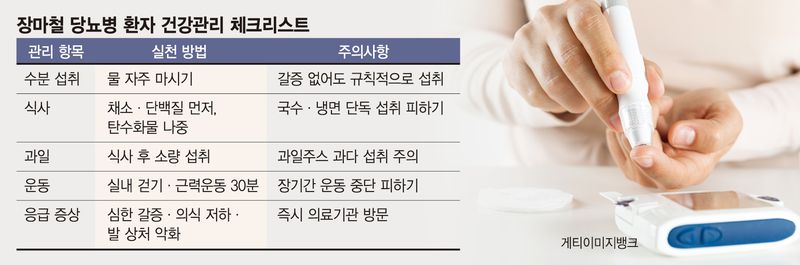
Professor Cho stated, "If you only drink water when you feel thirsty, dehydration has often already begun," adding, "It is important to develop the habit of replenishing fluids little by little and frequently, even when you are not thirsty. " During the rainy season, many people seek out refreshing cold noodles, bibim guksu, yeolmu guksu, and kongguksu. This is because they are convenient to eat when one has no appetite.
However, most of these foods have a very high proportion of refined carbohydrates. Eating a bowl of noodles alone leads to a lack of protein and dietary fiber intake, causing blood sugar levels to rise rapidly. In particular, bibim sauces contain a lot of sugar, and broth-based dishes have high sodium content, which is also detrimental to blood pressure management.
Experts recommend that you must consume vegetables and protein along with noodles. Adding plenty of bean sprouts, mung bean sprouts, radish sprouts, cucumbers, and lettuce, along with side dishes like boiled eggs or chicken breast, can slow down the rate of blood sugar spikes. The order of eating is also important.
Consuming vegetables first, followed by protein, and then carbohydrates last helps with blood sugar management. Watermelon, Korean melon, grapes, and peaches are representative summer fruits. Although fruit is often considered a healthy food due to its high water content, most varieties are also high in sugar.
In particular, eating only fruit on an empty stomach or consuming large amounts of fruit can cause blood sugar levels to rise rapidly. Professor Cho explained, "Fruit should not be eaten as a substitute for a meal, but rather consumed in small quantities as a dessert after a meal.
" ■ Sufficient Indoor Exercise During the Rainy Season Many people skip exercise when it rains. However, for diabetic patients, even a few days of skipping exercise can cause blood sugar levels to fluctuate significantly.
Walking indoors, using a stationary bike, climbing stairs, and bodyweight exercises can provide sufficient exercise benefits. Recently, with the diversification of online exercise programs and home training content, it has become easy to continue exercising at home.
Consistency is more important than intensity when it comes to exercise. Just walking or doing strength training for about 30 minutes a day helps with blood sugar control and weight management.
The complication that diabetic patients must be most wary of during the rainy season is diabetic foot. If blood sugar levels remain high for a long time, the nerves in the feet can be damaged, preventing the proper sensation of pain.
If blood circulation also deteriorates, wounds do not heal easily. Eventually, it can progress to ulcers, and in severe cases, lead to gangrene and potentially result in foot amputation.
In fact, it is known that a significant number of lower limb amputations in diabetic patients originate from minor wounds. People often wear sandals or slippers during the summer.
However, this habit can be dangerous for diabetic patients. Going barefoot can easily lead to injuries from small stones, glass shards, or hot surfaces.
Patients with dulled foot sensation often do not feel pain even when a wound occurs. Specialists emphasize that "for diabetic patients, the feet are more important than the face.
" Every evening, you should wash your feet, dry them completely, and thoroughly inspect the soles and between the toes. It is also helpful to examine the soles using a mirror or with the help of a family member.
If the color of your feet turns red or black, or if blisters or ulcers develop, you must visit a hospital immediately. It is also safer to seek medical help rather than attempting to remove corns or calluses yourself.
Furthermore, during the rainy season, symptoms that you might have dismissed as simple fatigue could actually be an emergency situation. If you experience extreme thirst, frequent urination, severe fatigue, vomiting, or a decrease in consciousness, you should suspect the possibility of a hyperglycemic emergency.
If a small wound on the foot swells, oozes fluid, or feels hot, it could be a sign that an infection is developing. For diabetes, consistent management is more important than specific treatment.
Regular meals and exercise, sufficient hydration, blood sugar monitoring, and foot care are fundamental. Professor Cho emphasized, "During the rainy season, you should pay more attention than usual to foot care as well as blood sugar management," adding, "Most complications can be sufficiently prevented simply by maintaining good lifestyle habits.
"
[email protected] Kang Jung-mo Reporter