"Honam Semiconductor Cluster Faces Power Grid Challenge; Need to Establish Jeonnam-Gwangju Power Corporation"
- Input
- 2026-07-23 18:20:47
- Updated
- 2026-07-23 18:20:47
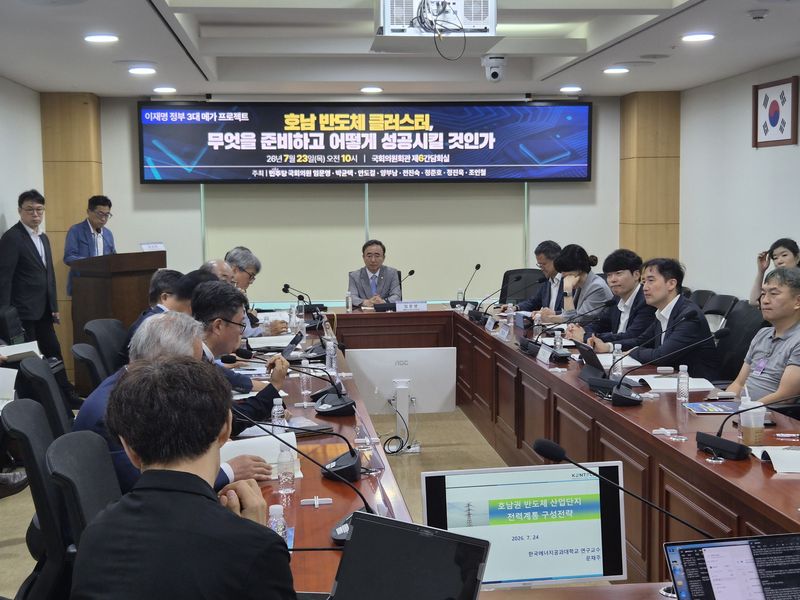
At the seminar held at the National Assembly on the 23rd, academic experts agreed that an integrated control tower involving the government, the National Assembly, local governments, public corporations, and companies is necessary.
In the power sector, the pace of building the transmission network was presented as the key issue, rather than the amount of electricity supply itself.
Moon Chae-ju, a research professor at Korea Institute of Energy Technology, said, "Public acceptance and permitting procedures during transmission line construction are the biggest variables," adding, "We need streamlined approvals through the Special Act on Semiconductors and the establishment of a dedicated body."
Moon also proposed that a regional power task force should be formed quickly by using existing local public corporations, with the goal of building the power grid by 2029. He added, "If Jeonnam Development Corporation and Gwangju Urban Corporation are merged, Jeonnam Development Corporation can simply change its articles of incorporation to become the Jeonnam-Gwangju Energy Corporation or the Jeonnam-Gwangju Power Corporation."
He also stressed the need to move forward in parallel with site selection for substations and transmission lines inside industrial complexes, consultations with residents, and permitting procedures. He further called for a support system that includes designation of a power quality management agency and a brokerage platform for renewable energy Power Purchase Agreement (PPA) contracts.
In the water sector, participants said a long-term integrated water management system is needed, moving beyond a supply model centered on dams. Professor Park Jun-hong of Yonsei University said, "We need a long-term water management system that takes regional water conflicts and treatment costs into account," and added, "Based on supply-demand simulations that reflect climate change and extreme droughts, we should review wastewater reuse and ways to secure multiple water sources."
Securing industrial land and supplying labor were also cited as major tasks. Professor Jeong Yoon-nam of CNU said, "Even if the former site of Gwangju Military Airport is the best industrial location, we should not wait for the relocation to be completed. Instead, we need to move ahead in parallel with environmental and ground surveys, land-use planning, power and water design, and efforts to attract companies and research institutes." He also said the state should share infrastructure costs and build a mixed financing system involving local public corporations and LH.
Professor Lee Min-seok of Kookmin University said, "If the mega-cluster is successfully established, it will also help reduce the outflow of local talent to the Seoul metropolitan area," adding, "We need to strengthen the talent pipeline by building an entrepreneurial ecosystem and a Living Lab, training talent that combines AI and semiconductors, and expanding specialized graduate schools."
The government also agreed on the need to expand production bases in the Honam region. Ahn Hong-sang, a semiconductor division official at MOTIE, said, "To respond to the expansion of production capacity in China and the United States, we will continue to improve support through the Special Act on Semiconductors and the Mega Special Zone Act."
[email protected] Lee Dong-hyeok Reporter