"Soared on HEVs" Hyundai Motor Company nears 50 trillion won in second-quarter sales, setting an all-time high
- Input
- 2026-07-23 18:20:39
- Updated
- 2026-07-23 18:20:39
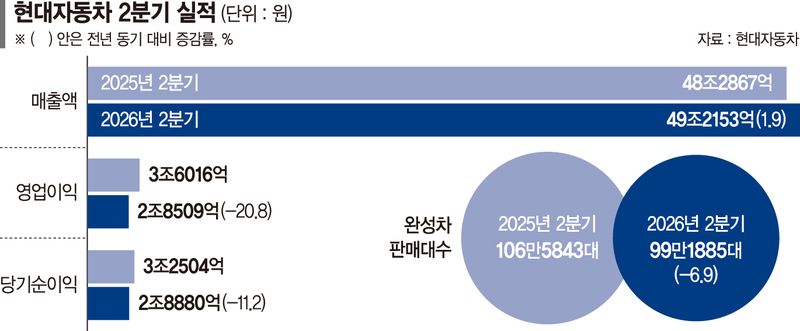
Hyundai Motor Company said on the 23rd that on a consolidated basis it recorded sales of 49.2153 trillion won, operating profit of 285.09 billion won, and net income of 288.8 billion won in the second quarter. Sales rose 1.9% from a year earlier, surpassing the previous record set in the second quarter of last year at 48.2867 trillion won. The average won–dollar exchange rate climbed 7.0% to 1,502 won, while HEV sales hit a record 187,661 units, driving top-line growth. However, profitability in the core automotive business slipped somewhat. Automotive sales fell 2.1% to 36.8324 trillion won, while financial and other businesses, with sales of 12.3829 trillion won, helped offset the decline and support overall results.
Global wholesale sales also fell 6.9% to 991,885 units, remaining below 1 million for a second straight quarter. Domestic sales dropped 16.4% to 157,647 units due to the fallout from the parts supplier fire, while overseas sales slipped 4.9% to 834,238 units. In the United States, however, sales rose 0.9% to 264,587 units, and market share stayed in the 6% range for a fifth consecutive quarter.
Operating profit also dropped 20.8% to 285.09 billion won. A fire in March at Safety Industry, a manufacturer of engine valves, disrupted production of high-value models such as Genesis and the Hyundai Palisade. That led not only to lower volumes but also to a weaker vehicle mix.
Lee Seung-jo, vice president and head of finance at Hyundai Motor Company, explained that "replacement parts were applied to all engine valves by mid-May, but most of the affected models were high-value products." A fire at Hyundai Mobis Company Limited's plant in India also affected some production.
With parts supply now normalized, Hyundai Motor Company plans to expand production in the second half to make up for the volume losses in the first half. The burden from raw material costs, which had weighed on profitability, is also expected to ease further in the latter half of the year.
Lee said, "As major raw material prices are turning downward in the second half, the negative impact on earnings will be further reduced."
[email protected] Kim Dong-chan Reporter