From parking and soundproofing to security deposit protection, a 'blind spot'... Why non-apartment housing is being shunned [The 'bottom' of the housing ladder · 3]
- Input
- 2026-07-24 07:00:00
- Updated
- 2026-07-24 07:00:00

/Photo=Newsis Non-apartment housing, represented by villas, is not a preferred residential area that people want to live in, but rather a residential area driven by demand where people have no choice but to live. Non-apartment housing, often called the very end of the housing ladder, is a place where residents and experts are contemplating how to make it a preferred residence.
They have raised their voices toward the government, urging them to share this concern. [Financial News] "New villas these days are just as well-made as apartments.They come with good amenities, and newlyweds who come to view rooms marvel at how nice they are, but they are reluctant to actually sign a contract. There is a higher preference for small 18-pyeong apartments than for newly built 28-pyeong villas." This is what a real estate agent in Gongneung-dong, Nowon-gu, Seoul, said. The point was that newly built villas, equipped with clean kitchens and bathrooms, as well as the latest windows and appliances, are more attractive than older apartments with outdated facilities and high prices, yet they are less preferred.Yoon Da-young (pseudonym, 38), who took out a loan to purchase an older apartment in Seongbuk-gu last year, cited the "living environment" as the reason. Yoon, who said she suffered a lot of stress due to parking space and maintenance issues while living in a villa on a lease for two years during the early days of her marriage, stated, "Although older apartments also lack parking space, it cannot be compared to a villa." Yoon added, "In my previous villa, 10 households lived there, but the pilotis parking space only accommodated 5 cars, and even then, we had to play 'parking Tetris,' which made commuting to work difficult every day. " She also mentioned, "I experienced many difficulties with garbage and recycling disposal, as well as issues regarding the surrounding environment.
/Photo=Newsis Non-apartment housing, represented by villas, is not a preferred residential area that people want to live in, but rather a residential area driven by demand where people have no choice but to live. Non-apartment housing, often called the very end of the housing ladder, is a place where residents and experts are contemplating how to make it a preferred residence." As such, the problems faced by most non-apartment housing, not just villas, cannot be solved solely by whether the individual homes are newly constructed. This is because the supply method of building single units on small plots makes it difficult to secure sufficient parking space, and green spaces and community facilities are woefully insufficient.Opinions stating that "the living conditions in villas are too poor" were also posted on the public policy suggestion website, which the government has operated since the 14th for the public real estate policy debate scheduled for the 23rd. One commenter emphasized the need for improvements in the living environment, stating, "If villas were allowed to be 5 to 6 stories instead of strictly 4, and if two buildings were demolished to create a taller and wider structure with gardens, young people and newlyweds would not choose to move to apartments." How to overcome the limitations of narrow plots Experts pointed to the size of the buildings as the cause of the poor living conditions in non-apartment housing. In reality, non-apartment housing, such as multi-family and multi-unit dwellings located in urban areas, is often built on small individual plots.
To accommodate the legally required number of parking spaces, stairs, corridors, and elevators on limited land while ensuring profitability, it is necessary to either reduce the exclusive floor area per household or utilize most of the first floor as a pilotis parking lot. However, increasing parking space in this manner reduces the rental and saleable area, while expanding the housing area lowers the number of units supplied and reduces business feasibility.
Consequently, space for children's play areas or green spaces disappears. Even newly built villas may see improvements in their internal environments, but they still suffer from the limitations of existing low-rise residential areas regarding parking and common spaces.
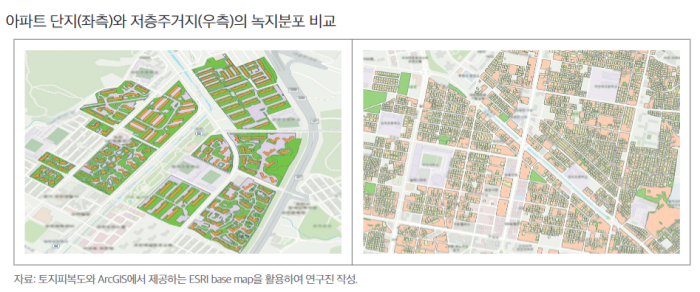
The Korea Institute for Human Settlements analyzed that non-apartment housing, built individually and haphazardly on small plots, is situated in a worse environment than apartments in terms of parking, sanitation, safety, green spaces, and facility management. According to an analysis of the 2023 Housing Survey, satisfaction with the residential environment in apartments was higher than in non-apartments across all categories.
The gap was particularly pronounced in cleaning and waste disposal, crime prevention, pedestrian safety, and accessibility to parks and green spaces. 4%.
/Photo=Newsis Non-apartment housing, represented by villas, is not a preferred residential area that people want to live in, but rather a residential area driven by demand where people have no choice but to live. Non-apartment housing, often called the very end of the housing ladder, is a place where residents and experts are contemplating how to make it a preferred residence.
/Graphic = Korea Institute of Land Research 'Land Policy Brief' Solutions Proposed by Experts: 'Plot Consolidation' and Joint Development Experts have also suggested 'plot consolidation,' which involves combining multiple small plots, and joint development as solutions to address residential environment issues. This implies that adjacent land should be combined for joint development of a certain scale, and mid-rise multi-family housing of around 5 to 6 stories should be supplied.
/Photo=Newsis Non-apartment housing, represented by villas, is not a preferred residential area that people want to live in, but rather a residential area driven by demand where people have no choice but to live. Non-apartment housing, often called the very end of the housing ladder, is a place where residents and experts are contemplating how to make it a preferred residence.
This is because if housing is built separately on each plot, access roads, stairs, and parking spaces are required for each building; however, if adjacent plots are grouped into a single development site, common spaces can be integrated, allowing for efficient land use. Piloti parking lots, which are typically installed for each building, can be converted into underground or integrated parking lots, and the above-ground space can be diverted to pedestrian walkways and green areas.
/Photo=Newsis Non-apartment housing, represented by villas, is not a preferred residential area that people want to live in, but rather a residential area driven by demand where people have no choice but to live. Non-apartment housing, often called the very end of the housing ladder, is a place where residents and experts are contemplating how to make it a preferred residence.By efficiently arranging common areas such as stairs, elevators, and corridors, the exclusive area inside the unit can also be expanded. If a certain scale is secured, lifestyle amenities found in apartment complexes, such as small libraries, shared childcare spaces, resident lounges, and unmanned parcel lockers, can also be installed.
Shin Bo-yeon, a professor in the Department of Real Estate AI Convergence at Sejong University, stated, "It is difficult to secure residential quality comparable to apartments by forcibly fitting the number of households and parking spaces into small plots," adding, "We must allow adjacent land to be combined to plan housing, parking, and common spaces together. " Kim Deok-rye, a senior research fellow at the Korea Housing & Industrial Research Institute, also said, "Just because it is urban housing supply does not mean we must build large-scale apartment complexes exceeding 20 stories," noting, "If adjacent plots are combined and developed to a scale of 5 to 6 stories, it is possible to supply housing equipped with elevators, parking, community spaces, and management facilities.
/Photo=Newsis Non-apartment housing, represented by villas, is not a preferred residential area that people want to live in, but rather a residential area driven by demand where people have no choice but to live. Non-apartment housing, often called the very end of the housing ladder, is a place where residents and experts are contemplating how to make it a preferred residence.
" **Allowing Mid-rise Development of Around 6 Stories from Current 4 Stories or Less Under Law** There is also an opinion suggesting that we consider a plan to allow mid-rise development of around 6 stories, limited only to projects that combine multiple plots for development. The intention is to utilize the profitability secured from additional floor area ratio or floor count for underground parking lots, elevators, management offices, and community spaces.
Under the current Building Act, row houses and multi-unit dwellings are multi-family housing units with four or fewer floors used for residential purposes. The difference lies in the fact that row houses must have a total residential floor area exceeding 660m2 per building, while multi-unit dwellings must be 660m2 or less.
/Photo=Newsis Non-apartment housing, represented by villas, is not a preferred residential area that people want to live in, but rather a residential area driven by demand where people have no choice but to live. Non-apartment housing, often called the very end of the housing ladder, is a place where residents and experts are contemplating how to make it a preferred residence.
/Photo=Newsis Non-apartment housing, represented by villas, is not a preferred residential area that people want to live in, but rather a residential area driven by demand where people have no choice but to live. Non-apartment housing, often called the very end of the housing ladder, is a place where residents and experts are contemplating how to make it a preferred residence.
Nevertheless, simply increasing the number of households while leaving parking standards and common spaces unchanged could further exacerbate the parking shortages and living inconveniences in existing villas.
/Photo=Newsis Non-apartment housing, represented by villas, is not a preferred residential area that people want to live in, but rather a residential area driven by demand where people have no choice but to live. Non-apartment housing, often called the very end of the housing ladder, is a place where residents and experts are contemplating how to make it a preferred residence.As conditions for allowing land consolidation and multi-story construction, sufficient parking spaces, elevators, soundproofing, insulation, and fire safety standards, as well as common facilities and a professional management system, are required together.
/Photo=Newsis Non-apartment housing, represented by villas, is not a preferred residential area that people want to live in, but rather a residential area driven by demand where people have no choice but to live. Non-apartment housing, often called the very end of the housing ladder, is a place where residents and experts are contemplating how to make it a preferred residence.
If separate management is difficult, a joint management system must be established.
There is also a need to overhaul the management systems of non-apartment buildings.
Under the Multi-Unit Housing Management Act, mandatory management targets are, in principle, multi-unit housing with 300 or more units, or multi-unit housing with 150 or more units equipped with elevators or central heating facilities.
These housing units are subject to obligations regarding the management entity, the residents' representative council, facility management, and accounting.
/Photo=Newsis Non-apartment housing, represented by villas, is not a preferred residential area that people want to live in, but rather a residential area driven by demand where people have no choice but to live. Non-apartment housing, often called the very end of the housing ladder, is a place where residents and experts are contemplating how to make it a preferred residence.
However, multi-family and row houses with around 10 to 20 units are mostly not included in the mandatory management targets.
/Photo=Newsis Non-apartment housing, represented by villas, is not a preferred residential area that people want to live in, but rather a residential area driven by demand where people have no choice but to live. Non-apartment housing, often called the very end of the housing ladder, is a place where residents and experts are contemplating how to make it a preferred residence.Due to the small number of units, it is difficult to hire professional management personnel or to manage common facilities such as exterior walls, rooftops, plumbing, and elevators when problems arise.
The same applies to long-term repair plans and the establishment of reserve funds.
Research Fellow Kim proposed a joint management system that groups several adjacent buildings into a single zone, stating, "If it is difficult to assign management personnel to every building with a small number of households, adjacent non-apartment buildings should be grouped into zones for joint management.
/Photo=Newsis Non-apartment housing, represented by villas, is not a preferred residential area that people want to live in, but rather a residential area driven by demand where people have no choice but to live. Non-apartment housing, often called the very end of the housing ladder, is a place where residents and experts are contemplating how to make it a preferred residence.
" This method involves a professional management company grouping multi-family and row houses in a specific area to handle cleaning, waste disposal, fire safety and elevator inspections, parking management, and repairs to common facilities.
/Photo=Newsis Non-apartment housing, represented by villas, is not a preferred residential area that people want to live in, but rather a residential area driven by demand where people have no choice but to live. Non-apartment housing, often called the very end of the housing ladder, is a place where residents and experts are contemplating how to make it a preferred residence.The advantages include lowering the burden of management fees per household by grouping multiple buildings and allowing for the employment of professional personnel.
A plan is also being discussed for local governments to establish 'Villa Management Offices' to support facility inspections, the formulation of repair plans, and the mediation of disputes among residents.
There is also an opinion that lease agreements should be included in the management of non-apartment buildings.
The proposal suggests supplying new managed non-apartment units equipped with lifestyle and contract management services, such as professional rental management, a defect reporting center, and verification of rental deposit return guarantee coverage.
Research Fellow Kim emphasized, "We need measures to remove not only newly constructed buildings through land consolidation but also existing villas from management blind spots.
/Photo=Newsis Non-apartment housing, represented by villas, is not a preferred residential area that people want to live in, but rather a residential area driven by demand where people have no choice but to live. Non-apartment housing, often called the very end of the housing ladder, is a place where residents and experts are contemplating how to make it a preferred residence.
"
/Photo=Newsis Non-apartment housing, represented by villas, is not a preferred residential area that people want to live in, but rather a residential area driven by demand where people have no choice but to live. Non-apartment housing, often called the very end of the housing ladder, is a place where residents and experts are contemplating how to make it a preferred residence.
[email protected] Kim Hee-sun Seo Yoon-kyung Reporter