Constitutional Court Rules Ban on Professors’ Union Political Activity Unconstitutional... Law Provision Loses Effect After 6 Years
- Input
- 2026-07-23 16:30:55
- Updated
- 2026-07-23 16:30:55
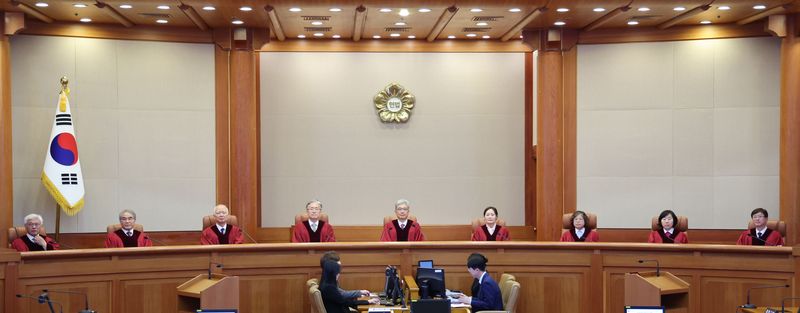
[Financial News] The Constitutional Court of Korea has ruled that a provision in the current teachers' union law banning political activity by university professors' labor unions is unconstitutional.
On the 23rd, the court consolidated two constitutional complaints filed by the Korea Private University Professors' Union and the National Professors' Union against Article 3 of the Act on the Establishment and Operation of Teachers' Labor Unions and ruled 7-2 that the provision was unconstitutional.
The court said that any act in which university faculty use their position to incite students to support or oppose a specific party or faction, or to conduct partisan propaganda education, fundamentally undermines the political neutrality of education and cannot be permitted, even for university faculty who enjoy political freedom. It added, however, that all other political activities should be guaranteed for both university faculty unions and university faculty associations.
The court also said that individual university faculty members are already allowed to engage in strong forms of political activity, including joining political parties, running for office, and campaigning. It noted that there is no separate blanket ban on university faculty associations made up of the same professors. "In that case, it is difficult to say that the risk to the political neutrality of education increases simply because the same professors form an association," the court said. "Nor can a stricter ban on political activity be justified merely because that association is a labor union rather than a general organization."
The court also explained that "the issue in this case concerns not elementary and secondary school teachers' unions, but university faculty unions." It added that university faculty teach adult college students and conduct academic research as their essential duties, and that the legal system reflects this by allowing them to join political parties and campaign, unlike elementary and secondary school teachers.
University professors were able to form unions under a June 2020 revision to the Act on the Establishment and Operation of Teachers' Labor Unions. Under the former Article 2 of the law, the term "teacher," which defines who may belong to a teachers' union, was limited to teachers under the Elementary and Secondary Education Act. But following a 2018 constitutional nonconformity ruling on that provision, the law was revised to include university faculty under the Higher Education Act. The problem arose when the revision also subjected university professors' unions to Article 3 of the law, which states that teachers' unions must not engage in any political activity. This created a contradiction: university faculty are broadly guaranteed freedom of political activity, including the right to run in public elections, yet their unions are barred from political activity as organizations under the teachers' union law.
In response, the National Professors' Union and others filed constitutional complaints in August and September 2020, arguing that their freedom of political expression and right to equality had been violated. After about six years of review, the court ruled on the day that extending the political activity ban to university faculty unions violates the Constitution.
Justices Kim Bok-hyeong and Cho Han-chang dissented. They said that allowing political activity by university faculty unions in full could have a much greater and more serious impact on universities and society than in the case of ordinary university faculty associations. On that basis, they concluded that the ban on political activity for professors' unions does not conflict with the Constitution.
[email protected] Kim Dong-gyu Reporter