More Than 3 Years Unemployed Even After Graduation: Share of Young People with Long-Term Joblessness Hits Record High
- Input
- 2026-07-23 12:00:00
- Updated
- 2026-07-23 12:00:00
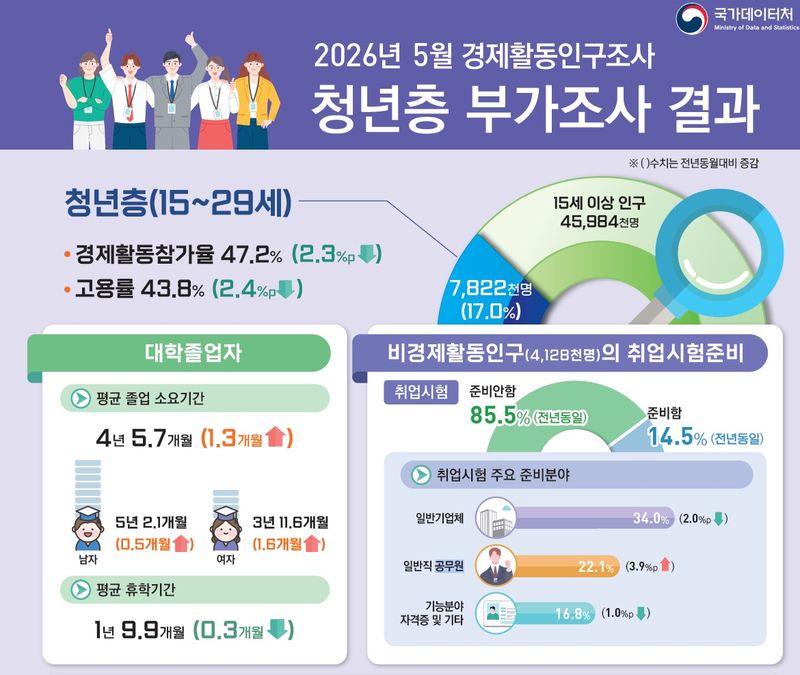
[Financial News] One in five young people who have been unable to find a job after graduation have remained unemployed for more than three years, according to data. This is the highest share ever recorded since the statistics began. The worsening youth job market reflects a shift in hiring practices, including a stronger preference for experienced workers and a move toward ongoing recruitment, as well as external headwinds such as the Middle East war and artificial intelligence (AI). As job searches have dragged on, the average time needed to graduate from college has also risen to a record 4 years and 5.7 months.
According to the National Data Office's "Results of the May 2026 Economically Active Population Survey on Youth" released on the 23rd, the youth population aged 15 to 29 stood at 7.822 million, down 152,000 from a year earlier. Of that total, 4.003 million were graduates, including 2.76 million employed and 1.243 million unemployed, while 3.819 million were enrolled in school or on leave, including 667,000 employed and 3.151 million unemployed. The number of employed young people fell by 255,000 year on year to 3.427 million, and the employment rate dropped 2.4 percentage points to 43.8%.
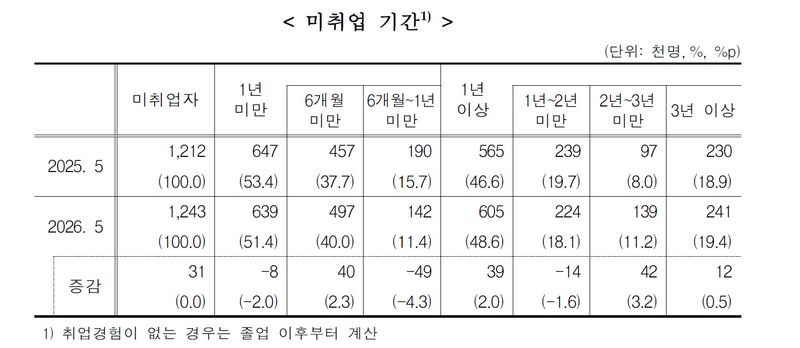
The long-term unemployment trend among graduates has become even more severe. The share of unemployed graduates who had been out of work for at least one year rose 2.0 percentage points from a year earlier to 48.6%. That is the second-highest level on record, behind 51.7% in 2009, just after the global financial crisis. The share unemployed for three years or more rose 0.5 percentage point to 19.4%, the highest since the statistic was first compiled in 2007. The main activities of unemployed young people were preparing for job-related exams and employment tests (39.3%), simply passing time (25.3%), and preparing for further education (12.5%). The share saying they were simply passing time was the highest since 2023.
Kim Rak-hyeon, head of employment statistics, said, "This reflects changes in hiring culture, such as a stronger preference for experienced workers and the rise of rolling recruitment, which create a particularly difficult job environment for young people." He added, "It also reflects the longer time needed to prepare for employment exams, certification tests and similar requirements while on leave from school."
As job opportunities narrowed, the time needed to graduate from university also increased. The average time to graduate for college graduates, including those from three-year programs or shorter, was 4 years and 5.7 months, up 1.3 months from a year earlier and the longest on record. For men, the average graduation period was 5 years and 2.1 months, up 0.5 month year on year. For women, it was 3 years and 11.6 months, up 1.6 months. The average leave-of-absence period reached 1 year and 9.9 months.
Meanwhile, the preference for civil service jobs, which had cooled for a while as hiring barriers at private companies rose, also showed signs of rebounding. Among young people preparing for employment exams, the share targeting general civil service positions rose 3.9 percentage points from a year earlier to 22.1%. By contrast, the shares preparing for jobs at general companies and at media or public enterprises fell by 2.0 percentage points and 3.9 percentage points, respectively. Industry observers say more young people are once again turning to stable public-sector jobs as AI adoption and economic uncertainty reduce employment opportunities.
[email protected] Choi Yong-jun Reporter