President Lee Jae Myung: "I Will Take Responsibility for the Real Estate Issue, Even If It Means Facing Conflict, Resistance and Criticism"
- Input
- 2026-07-23 10:57:18
- Updated
- 2026-07-23 10:57:18
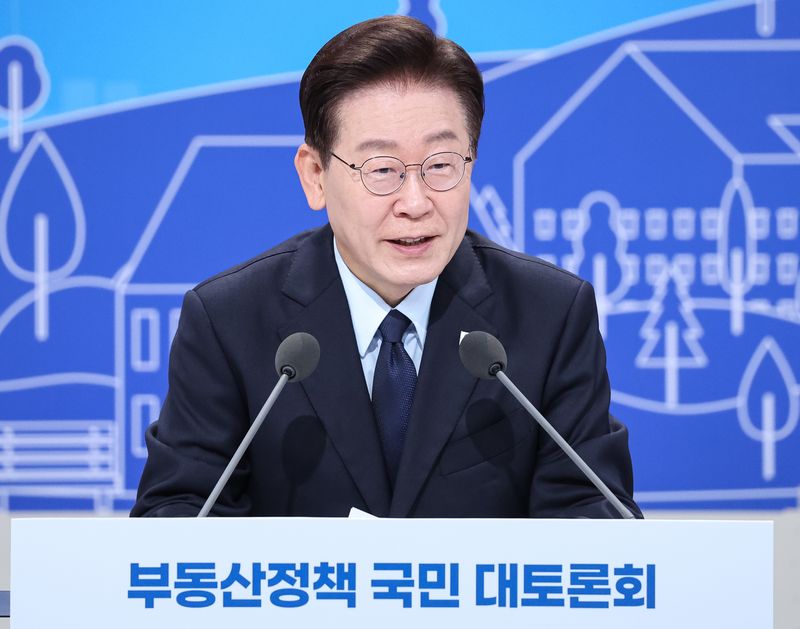
[Financial News] On the 23rd, President Lee Jae Myung said of the real estate issue, "I have always believed that the greatest virtue of a public official is taking responsibility. There are times when criticism must be accepted, and there are also times when a certain degree of conflict and resistance must be endured." He added, "Before that, however, I think we need to gather as many opinions as possible and work to coordinate them."
At the forum, which he chaired at the KBS annex building in Yeouido, Seoul, President Lee said, "If there is some conflict and resistance, isn't that exactly why someone like me was elected to do this?"
He also said he would actively gather public opinion at the event. "We are not going to decide this by simple majority vote," he said. "But listening to the views of many citizens is truly important. And if those views are reasonable, then of course we should follow the majority opinion."
He also stressed, "The real estate issue is difficult, of course, but the government will do its best. If we discuss this topic openly and listen to the other side, I believe we can reach a certain level of social consensus."
Citing Japan, he said, "People have talked about the 'lost 30 years.' Some people are worried that we may actually be running toward a similar peak." He added, "There is already a broad public consensus that some kind of countermeasure is now needed."
While agreeing on the need to expand housing supply, President Lee said there are clear practical limits.
"If we increase supply, that would solve the problem. The issue is where and how to do it," he said. "At this point, if we try to find land for development somewhere in Seoul, it is almost impossible to find any. In any case, the limits on supply are very clear."
On the demand side, he pointed out that investment and speculative demand, as well as artificial demand, are driving up housing prices beyond the needs of actual residents.
President Lee explained, "People buy a house, and it usually goes up. If it rises faster than inflation, that is a profit. Buying two homes is better than buying one. Buying a 3 billion won home is far less efficient than buying a 30 billion won home. Even if I do not have the money, I can borrow and buy it." He added, "So some people buy for investment, or, to put it more bluntly, for speculation. Others buy in advance as a kind of artificial demand, just in case they may need it later or to prepare for a worse situation."
On real estate tax policy, President Lee emphasized, "A tax system is a financial burden shared fairly by all members of the nation in order to secure state revenue. Using it to curb demand in a specific sector or to increase supply is somewhat of an exceptional situation."
He continued, "That actually moves slightly away from the original purpose of the tax system. It may be one of its purposes, but it is not the main one." He added, "So there may be debate over whether it is truly justified to intervene in supply and demand through taxes, and if so, how far such intervention should go."
President Lee said, "The lending capacity of financial institutions is, in fact, also the people's money. Finance is partly public." He added, "So who should use it, and who should be given the opportunity to access that financing, can ultimately be reduced to a policy issue."
He went on to say, "If finance is used for investment or speculation and home prices rise excessively, then the citizens who actually need those homes will suffer losses." He added, "If one member of society uses national capacity to gain at the expense of another, is that desirable? In the end, that too is a policy issue."
President Lee also introduced the results of a prior public opinion survey, saying, "The need for special consideration for young people, newlyweds and families with multiple children has increased significantly." He added, "Because people have pointed out that one of the main causes of the low birthrate is the housing problem, I think the public shares that view."
[email protected] Choi Jong-geun, Seong Seok-woo Reporter