Ultra-high-end homes are said to start at 3 billion to 5 billion won; opinions remain sharply divided over property and transaction taxes
- Input
- 2026-07-23 10:46:09
- Updated
- 2026-07-23 10:46:09
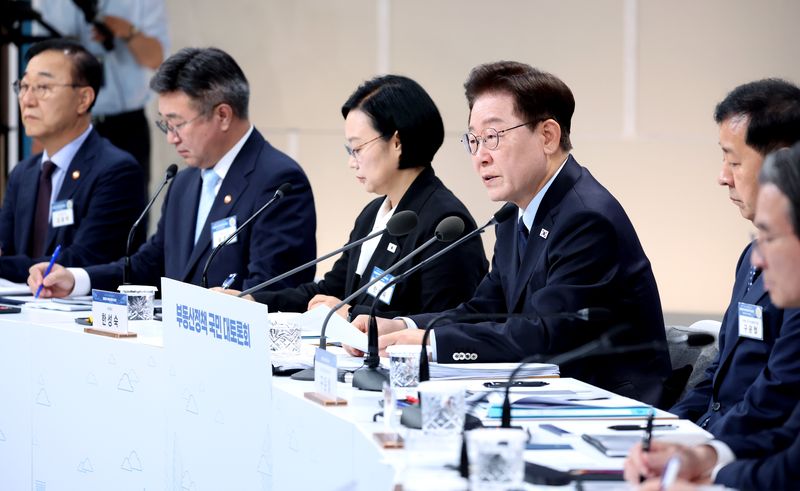
[Financial News] Ahead of a planned overhaul of real estate taxes, the government held a preliminary public consultation, where opinions were sharply split over the direction of reforms to property and transaction taxes. On the definition of ultra-high-end homes, suggestions ranged from 3 billion won to more than 5 billion won. There was also a proposal to tax the Comprehensive Real Estate Holding Tax based on the combined value of homes, rather than the number of homes owned.
First Vice Minister of Economy and Finance Lee Hyoung-il announced the results of the preliminary consultations on supply, finance and taxation at the National Grand Forum on Real Estate Policy held at the KBS Annex in Seoul on the 23rd. The results compiled public views gathered through sector-specific listening sessions hosted by the Ministry of Economy and Finance, the Ministry of Land, Infrastructure and Transport, and the Financial Services Commission, as well as through an online policy proposal channel.
In the tax sector, opinions were divided over property taxes on ultra-high-end single-home owners. Some argued that excessive tax benefits should be reduced to ease the preference for a 'one good home,' while others said caution was needed because the tax is levied on unrealized gains and could be passed on to tenants.
Lee said, "At the forum, there were views that excessive benefits for owners of ultra-high-end single homes should be limited," adding, "As for the threshold for ultra-high-end homes, suggestions ranged from 3 billion won to more than 5 billion won."
There was stronger support for shifting the tax base for the Comprehensive Real Estate Holding Tax from the current focus on the number of homes to the total combined value of homes. Lee said, "At the forum, there were views that it would be desirable to remove differentiation based on the number of homes and tax based on the total combined value of properties, and online responses were also generally in favor."
On non-owner-occupied single homes, opinions were split between those calling for stricter actual-residence requirements and higher tax burdens for non-residents, and those arguing that it is difficult to distinguish between genuine demand and speculation based only on residency, and that unavoidable circumstances such as work or education should also be considered.
Views also differed on the roles of property taxes and transaction taxes. Some argued that the tax system should be centered on holding taxes while transaction tax burdens should be lowered to avoid locking up supply. Others said appropriate taxation on capital gains should be maintained. Online, there were relatively more opinions in favor of lowering transaction taxes together with any increase in property taxes.
As for the long-term holding special deduction, opinions were divided between those who said benefits for non-owner-occupied homes should be reduced and a cap should be set, and those who warned that cutting the deduction could worsen supply lock-in because it serves as a mechanism to reflect inflation. On special tax treatment for elderly people relocating to provincial areas, some said tax burdens should be eased when retirees move out of the capital region, while others raised concerns that the measure could be abused as a way to avoid taxes.
Meanwhile, in the housing supply and finance sectors, calls for deregulation were relatively more common. In supply, proposals included using idle urban land, improving the profitability of redevelopment and reconstruction projects, and expanding the supply of non-apartment housing. In finance, suggestions included easing total loan management, expanding loan support for end-users such as young people and newlyweds, and relaxing regulations on moving expenses and jeonse loans.
[email protected] Kim Chan-mi Reporter