Public Opinion on Real Estate Surges Before Lee Jae Myung; Views Split on Redevelopment, Loans and Tax Policy
- Input
- 2026-07-23 11:08:30
- Updated
- 2026-07-23 11:08:30
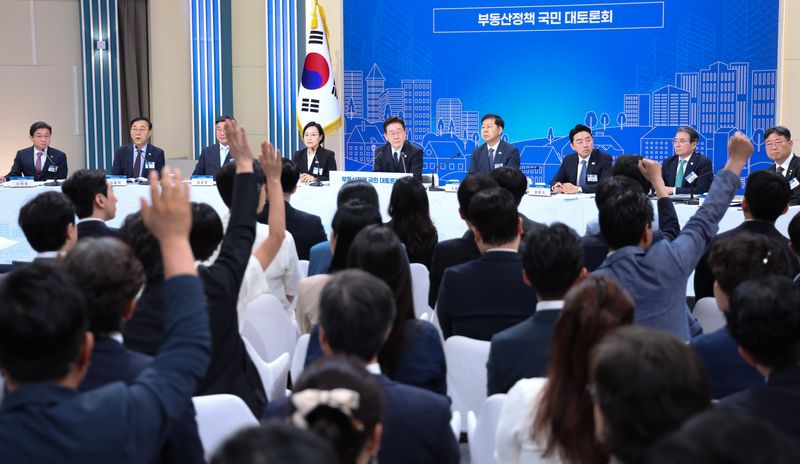
[Financial News] Diverging public views on housing supply, finance and taxation poured out before President Lee Jae Myung. On redevelopment and easing loan regulations, calls for relaxation clashed with arguments for keeping the rules in place, and opinions were also divided on tax measures other than a shift in the comprehensive real estate tax to a combined asset-value basis.
Lee Hyoung-il, first vice minister of the Ministry of Economy and Finance, reported the results of prior opinion gathering to President Lee at the National Forum on Real Estate Policy held on the 23rd at the KBS Annex in Yeouido, Seoul. The government had previously held listening sessions and online surveys by sector on supply, finance and taxation before bringing the findings together in a comprehensive discussion that day.
On the supply side, proposals were made to use idle urban land such as semi-industrial zones and to convert non-residential land for housing, provided public contributions are made. Suggestions to raise floor area ratios for redevelopment and reconstruction projects and to rationalize mandatory public contributions were raised both at the forum and online, as a way to improve project feasibility. Online respondents also called for lowering the consent threshold for forming associations and easing redevelopment charges.
For non-apartment housing supply, some proposed easing loan regulations for developers and excluding such units from housing-count calculations, while others called for looser rules on small officetels and urban living housing. Views on rental housing were also split, with some arguing for more high-quality public rental housing and others urging greater support for private rentals. On the ratio between public sale and public rental housing, one side said more units should be sold to strengthen the housing ladder, while the other argued for expanding rentals to improve housing welfare.
Opinions on regulated zones were also divided, with some saying they should be maintained to stabilize the market, while others argued they should be redesigned or differentiated by region to avoid constraining supply and freezing listings.
In the financial sector, many online comments called for easing total loan management, supporting young people and newlyweds in buying homes, relaxing moving-expense loans, and expanding jeonse loans. At the forum, however, some countered that total loan management should be maintained to stabilize the housing market and manage household debt. On lending rules for young people and jeonse loans, the need to support end users clashed with concerns over rising home prices.
In taxation, the forum raised the idea of imposing the comprehensive real estate tax based on the combined value of owned homes rather than the number of homes, and online responses were generally supportive. On strengthening holding taxes for owners of a single ultra-expensive home, one side argued that the preference for a "one good home" should be reduced, while the other warned about taxing unrealized gains and passing the burden on to tenants.
There were also calls to raise the tax burden on non-resident single-home owners to curb speculation, but others argued that unavoidable non-residency should not be taxed uniformly. Views also split on whether capital gains tax should be lowered to prevent listings from drying up, or whether gains should be taxed appropriately in light of fairness with earned income.
The report presented that day reflected prior opinion gathering, not a finalized government policy. President Lee said, "We will not decide by majority vote," adding that the government would examine both the reasonableness of public opinion and the effectiveness of policy.
[email protected] Sung Seok-woo Reporter