The New Formula in the AI Era: Big Tech Chooses Investment Over Cash
- Input
- 2026-07-23 09:25:11
- Updated
- 2026-07-23 09:25:11
Cash is shrinking as AI investment rises
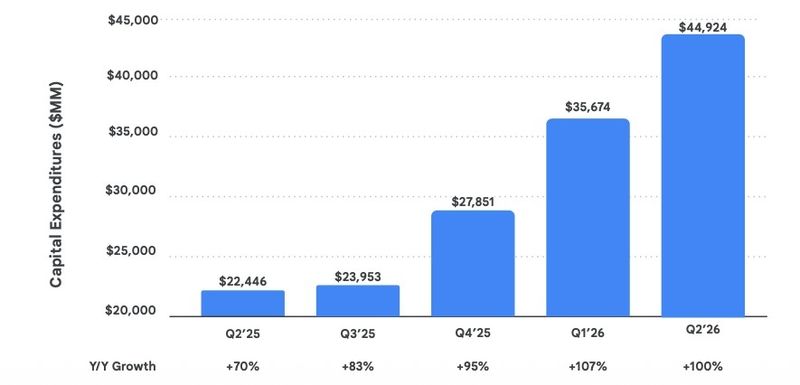
At its second-quarter earnings release on the 22nd (local time), Alphabet Inc. raised its full-year capital expenditures outlook from $180 billion to $190 billion to $195 billion to $205 billion. It was the company’s second increase in investment plans this year.
Anat Ashkenazi, Chief Financial Officer (CFO), said during the post-earnings conference call that the company is speeding up the supply of data centers and computing infrastructure to meet rising AI demand. She added that supply still is not keeping pace with demand. She also said the company will continue investing as long as returns remain attractive, signaling an aggressive spending stance.
Alphabet Inc. posted stronger-than-expected results, with revenue rising 24% from a year earlier to $119.8 billion and cloud revenue jumping 82% to $24.8 billion. Search advertising revenue also increased 17% to $63.3 billion.
However, the heavy burden of AI investment was reflected directly in cash flow. Alphabet Inc.'s free cash flow swung to a deficit of $5.9 billion. The expansion of data centers and AI hardware spending was cited as the main reason.
Ashkenazi said that free cash flow will remain under pressure because of technology infrastructure investment. Still, she emphasized that such spending will help the company seize AI opportunities and build a foundation for strong long-term returns.
From asset-light to capital-intensive
Tesla is following a similar path.
Tesla invested $5.8 billion in the second quarter to expand its AI and robotics businesses, pushing free cash flow into a $1.1 billion deficit. It was the first negative reading in two years.
Revenue rose 26% year on year to $28.2 billion, and automotive revenue increased 23%. But aggressive investment weakened cash generation. Net income fell 5%, and earnings per share (EPS) missed market expectations, sending the stock lower in after-hours trading.
Chief Executive Officer (CEO) Elon Musk said, "This year is a year of major capital spending." He added, "I am confident that everything we invest in will return enormous profits."
Tesla kept its $25 billion capital expenditure plan for this year. The company is pouring large sums into AI computing, its semiconductor production facility TeraFab, battery materials, solar equipment, the humanoid robot Tesla Optimus, and production lines for the autonomous Cybercab. Vaibhav Taneja, CFO, also said operating expenses will continue to rise, suggesting that AI infrastructure investment will continue for years to come.
Markets see Alphabet Inc. and Tesla as choosing to prioritize AI leadership over short-term profitability. Alphabet Inc. recently raised $85 billion to expand data centers and is also using about $100 billion in debt. Tesla, meanwhile, is concentrating investment on factory redesigns, semiconductor production facilities, robot development, and autonomous driving platforms.
Investor views are mixed. Some say aggressive spending is unavoidable if companies want to secure an early lead in the AI market. Others warn that a prolonged deterioration in free cash flow could increase financial strain.
[email protected] Lee Byung-chul Reporter