South Koreans Live Longer and Visit Hospitals More Than Anyone Else, Yet Doctors Remain Among the Fewest in the OECD
- Input
- 2026-07-23 12:00:00
- Updated
- 2026-07-23 12:00:00
[Financial News] South Korea's health indicators rank among the top tier of Organisation for Economic Co-operation and Development (OECD) member countries. Life expectancy was more than two years longer than the OECD average, and avoidable mortality, which refers to deaths that can be prevented through disease prevention and proper treatment, was also much lower. On the other hand, the number of clinical doctors remained the second lowest among OECD countries. While medical manpower is in short supply, outpatient visits are the highest among OECD members and medical equipment and hospital beds far exceed the average, once again highlighting the structural characteristics of South Korea's healthcare system.
The Ministry of Health and Welfare (MOHW) said on the 23rd that this was the result of its analysis of the OECD's recently released OECD Health Statistics 2026.
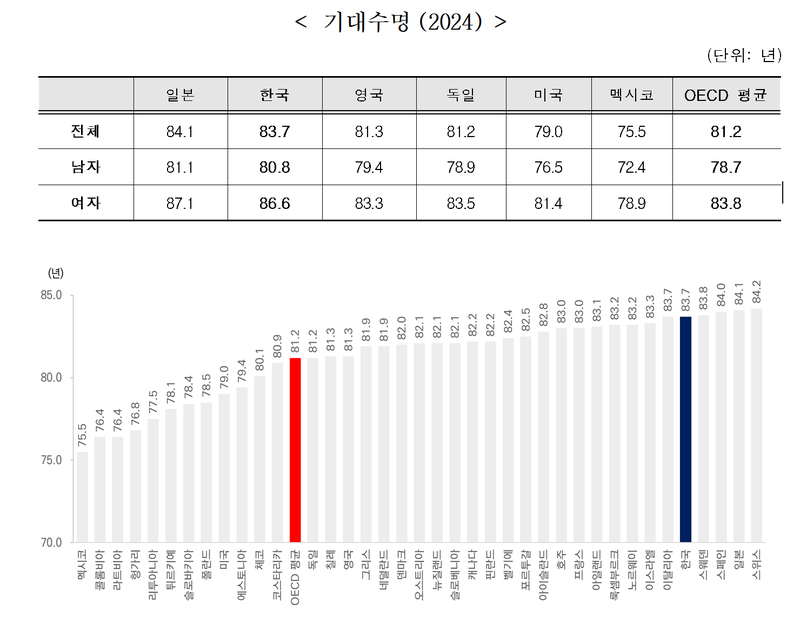
According to the data, South Korea's life expectancy was 83.7 years, 2.5 years longer than the OECD average of 81.2 years. That places the country near the top among member nations.
Avoidable mortality, a key indicator of healthcare quality, also showed strong results. It refers to deaths that can be prevented through disease prevention and appropriate medical services.
South Korea recorded 139.0 avoidable deaths per 100,000 people, far below the OECD average of 208.8, suggesting a relatively efficient healthcare system.
Health risk factors were also favorable. The smoking rate among people aged 15 and older stood at 13.2%, close to the OECD average of 12.7%, while annual alcohol consumption per capita was 7.6 liters, below the OECD average of 8.3 liters.
In particular, the share of overweight and obese people was 37.3%, far below the OECD average of 58.7%, making it the second-lowest among member countries.
Medical manpower, however, remained insufficient. South Korea had 2.6 clinical doctors per 1,000 people, including Korean medicine doctors, well below the OECD average of 4.0. That is the second-lowest level among OECD member countries.
The number of clinical nursing staff was 9.8 per 1,000 people, similar to the OECD average of 9.7, but the number of nurses actually working in clinical settings was slightly below average. As concerns over doctor shortages continue, the imbalance in healthcare staffing has also been confirmed in international comparisons.
Medical equipment, by contrast, far exceeded the OECD average. South Korea had 39.3 MRI units per 1 million people, about 1.8 times the OECD average of 21.5, while the number of CT scanners reached 46.7, well above the OECD average of 31.5.
The number of hospital beds also stood at 12.5 per 1,000 people, roughly three times the OECD average of 4.2. The figures once again underscored South Korea's healthcare system, which has a shortage of medical personnel but abundant infrastructure.
Healthcare use was the most active among OECD countries. South Koreans made 17.9 outpatient visits per person per year, the highest among OECD members.
Current health expenditure, however, accounted for 8.5% of Gross Domestic Product (GDP), below the OECD average of 9.3%. Still, healthcare spending has grown rapidly over the past decade.
Pharmaceutical consumption was also relatively high. Annual pharmaceutical sales per person came to $1,041.2 based on purchasing power parity (PPP), far above the OECD average of $708.5.
The use of long-term care services among people aged 65 and older remained below the OECD average. Home-based long-term care use stood at 9.1%, below the OECD average of 11.2%, while facility use was 2.7%, also below the OECD average of 3.6%. However, utilization has been rising rapidly over the past decade, driven by aging and expanded coverage under Long-Term Care Insurance.
Lee Yoon-shin, policy planning director at the Ministry of Health and Welfare, said, "OECD health statistics are representative data compiled using the same standards across countries and an important source for objectively assessing South Korea's healthcare level." She added, "We will continue to strengthen cooperation with international organizations and improve the quality of health and medical statistics so that the public can use them in various policy areas."
[email protected] Kang Jung-mo Reporter