U.S. Threatens to Push Ahead With Section 301 Forced-Labor Tariffs on the 23rd... 12.5% for South Korea?
- Input
- 2026-07-23 06:29:13
- Updated
- 2026-07-23 06:29:13
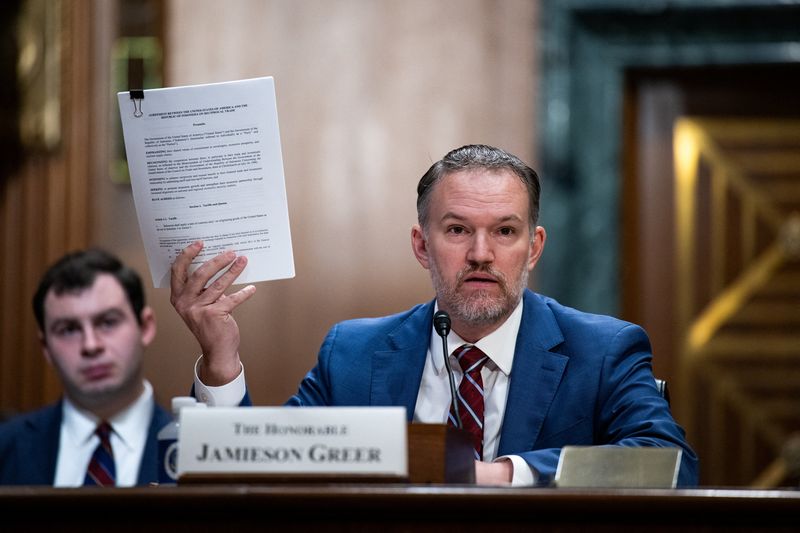
[Financial News] The U.S. government, which is pushing additional tariffs on South Korea and 59 other trade partners under Section 301 of the Trade Act of 1974, said it may impose final tariffs related to forced labor as early as the 23rd local time.
Jamieson Greer, head of the Office of the United States Trade Representative (USTR), made the claim while appearing before a hearing of the United States Senate Committee on Banking, Housing, and Urban Affairs on the 22nd. In prepared remarks, he said, "USTR will, as early as tomorrow, announce final measures against 60 trade partners for failing to respond to products made with forced labor." Greer added, "The United States is the only country in the world that has adopted and effectively enforced such rules." He also stressed, "This investigation is the result of years of effort to ensure our trade partners join us in our efforts and create a level playing field for American workers and businesses."
Greer also emphasized that the tariff policy of Donald Trump's administration has been successful and that the national emergency related to trade remains in effect. He said, "The specific authority used by the Trump administration has changed, but the trade strategy has not," and added, "We will continue to use tariffs."
Section 301 of the Trade Act of 1974, enacted in 1974, allows the United States to retaliate with measures such as import bans or tariffs when a trading partner harms U.S. companies through unfair practices or discrimination. To trigger retaliatory action, the USTR must investigate the unfair practice, and such investigations are generally completed within a year.
Last year, the Trump administration imposed additional tariffs worldwide, including on South Korea, under the International Emergency Economic Powers Act (IEEPA), calling them reciprocal tariffs. However, after the Supreme Court of the United States (SCOTUS) ruled in February that the reciprocal tariffs were unlawful, the Trump administration introduced a "10% global tariff" under Section 122 of the Trade Act of 1974. The global tariff can be imposed for up to 150 days and is set to expire on the 24th.
To collect new tariffs, the Trump administration turned to Section 301 of the Trade Act of 1974 and launched an investigation into unfair practices. On March 12, USTR announced that it had begun an investigation under Section 301 into acts, policies, and practices related to forced labor. On March 11, it also said it would investigate unfair trade practices tied to overproduction in manufacturing involving 15 countries, including South Korea, China, Japan, and the European Union (EU), under Section 301 of the Trade Act of 1974.
In a statement released on the 2nd of last month, USTR said the results of its Section 301 investigation showed problems with trade policies in 60 countries and economies, including South Korea. USTR argued that the affected regions "failed to effectively block imports of products made with forced labor," causing U.S. goods to "face burdens or restrictions" when competing in those markets.
USTR proposed an additional 10% tariff for six economies, including Canada, the EU, Mexico, and Indonesia, saying they had some related systems in place but were weak in enforcement. By contrast, the remaining 54 economies, including South Korea, China, Japan, the United Kingdom, Australia, and Taiwan, were classified as subject to a higher 12.5% tariff because they were judged to lack both the necessary legal framework and enforcement system. USTR has not yet released the results of its investigation into overproduction in manufacturing.
[email protected] Park Jong-won Reporter