Unusual: KOSPI Fails to Hold 7,000 Despite Buy-Side Sidecar
- Input
- 2026-07-23 06:00:00
- Updated
- 2026-07-23 06:00:00
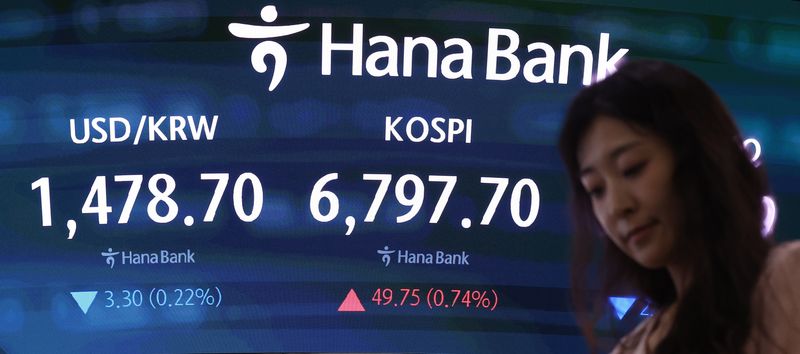
[Financial News] The KOSPI briefly climbed above the 7,100 level intraday, triggering a buy-side sidecar, but it failed to hold even the 6,800 level, let alone 7,000. Foreign investors bought more than 260 billion won net, but institutions and retail investors unloaded a similar amount, wiping out most of the early gains.
It is being described as unusual that the index fell more than 300 points from its intraday high on a day when a strong program-buying signal appeared. Market watchers also say the episode exposed both the heavy supply of shares stacked above the 7,000 level and the market's fragile underlying strength.
According to the Korea Exchange on the 23rd, the KOSPI closed the previous day at 6,797.70, up 49.75 points, or 0.74%. Overnight recovery in investor sentiment toward artificial intelligence (AI) investments on Wall Street pushed the index above 7,100 early in the session.
A buy-side sidecar was also triggered, temporarily suspending program buy orders as futures prices surged. It was the second straight day the mechanism was activated and the 20th buy-side sidecar this year. However, after reaching its intraday high, the index retreated and ended the day below 6,800. Kang Jin-hyuk, a senior researcher at Shinhan Investment Corp., said, "The KOSPI broke above 7,100 intraday on improved foreign spot demand and strength in semiconductors, but institutional selling emerged and the market finished strong in the morning and weak in the afternoon."
Large semiconductor stocks that had led the rally gave back most of their intraday gains. Samsung Electronics rose as much as 6.6% during the session, but closed up only 0.6%. SK hynix jumped 9.3% intraday before reversing to a 0.3% decline. In other words, profit-taking in the afternoon was stronger than the buying that had chased semiconductors early in the day.
By investor category, foreign investors were the only group supporting the market. They bought a net 2.6299 trillion won on the Korea Exchange Main Board. Institutions sold a net 1.3963 trillion won, while retail investors sold a net 1.2176 trillion won. Combined, institutions and retail investors posted net sales of 2.6139 trillion won, almost matching foreign investors' net buying.
Among institutions, the financial investment industry led the selling with net sales of 975.8 billion won. PEFs sold a net 257.4 billion won, investment trusts sold 109.6 billion won, and public pension funds also posted net selling of 70.6 billion won.
A securities industry official said, "What matters is not the sidecar trigger itself, but what happened afterward." The official added, "A buy-side sidecar signals strong upward pressure in the futures market. But on this day, even after the sidecar was triggered and the KOSPI moved above 7,100, the index could not hold onto its gains."
That suggests there were more investors waiting to take profits above the 7,000 level than buyers willing to enter at higher prices. Foreign investors' net buying of more than 260 billion won was only enough to absorb selling from institutions and retail investors; it was not enough to push the index higher.
Lim Jeong-eun, a researcher at KB Securities, said, "Earnings announcements are due from major companies such as Hyundai Motor Company and Samsung Biologics in Korea, and Alphabet Inc. and Tesla in the United States." She added, "Alphabet's results will be a key factor in shaping investor sentiment toward AI semiconductor stocks."
[email protected] Choi Du-seon Reporter