Lee says medical fees must be rationalized as AI-driven emergency room recommendations and other innovations are pushed
- Input
- 2026-07-22 14:05:00
- Updated
- 2026-07-22 14:05:00
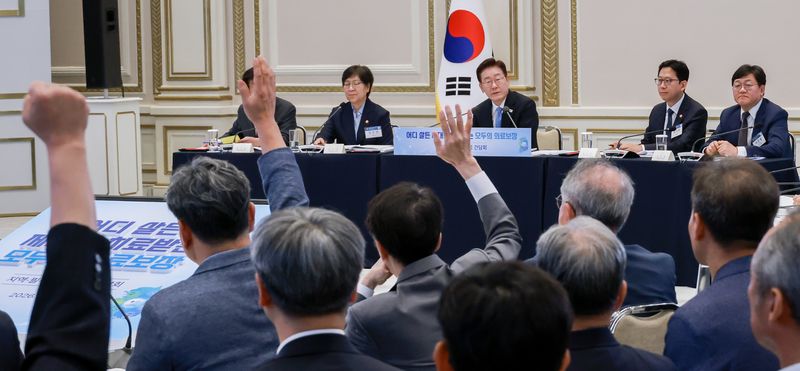
The Ministry of Health and Welfare (MOHW) and the Ministry of Science and ICT reported the implementation plan at a meeting on 'strengthening regional, essential and public healthcare and the AI basic medical care strategy' chaired by President Lee Jae Myung on the 22nd. The core of the plan is to use AI to improve the quality of care and expand access even in regions with shortages of medical personnel. The government will introduce AI packages with automatic medical record writing and clinical and administrative support functions at vulnerable-area medical institutions such as Public Health Centers. In mountainous and island areas, visiting nurses will be supported so they can work with remote specialists using AI for joint consultations.
At the meeting, Lee stressed the need to pursue fundamental institutional reforms that are both reasonable and feasible, including rationalizing the medical fee system. He said, "Because public healthcare and essential healthcare are strongly tied to economic factors, we are continuing to review policies in a direction that strengthens the government's responsibility a little more," adding, "Rationalizing the (medical) fee system is important first."
In response, the government will first reorganize the national healthcare system around five major regions and three special zones to narrow the medical gap between the Capital Region and the rest of the country. The framework centers on the Capital Region, the Southeast Region of Korea, the Daegyeong Region, the central region and the Honam region, along with the three special zones of Gangwon Province, Jeju and North Jeolla Province. To build a structure in which regional hub hospitals handle severe and emergency patients while local hospitals take care of essential medical services, the government will establish a special account worth 1.2 trillion won and expand regional and essential healthcare infrastructure.
AI has become the key tool in this healthcare overhaul. The government plans to expand an 'integrated emergency AI platform' that analyzes patient conditions, bed availability and medical staff status in real time during emergency transfers and recommends the most appropriate hospital. The goal is to spread nationwide the AI-based emergency patient management systems already operating at some medical institutions, reducing cases in which emergency rooms refuse patients and transfers are delayed.
The AI transition will also be extended to regional public hospitals. Starting in the second half of this year, the government plans to connect regional and local responsible medical institutions one by one to the 'public medical AI highway' platform so they can jointly use medical AI services, and then expand the system to all 72 responsible medical institutions nationwide by 2029. National university hospitals will build intelligent hospital information systems that apply AI throughout the entire process, from appointment booking to testing, admission and discharge, while pilot projects for region-specific AI-specialized hospitals will also be launched.
Investment in research and development at regional national university hospitals will also increase. The R&D budget for these hospitals rose from 43.7 billion won in 2021 to 100.4 billion won this year, more than doubling, and the government will also work to attract overseas researchers and train specialists in the AI and biohealth fields.
Jeong Eun-kyeong, minister of health and welfare, said, "AI is an important tool for filling gaps in regional, essential and public healthcare and protecting the lives of the public." She added, "We will push ahead with the AI basic medical care strategy without setbacks and create an environment where people in the regions can receive timely, high-quality medical services."
[email protected] Jung Sang-hee, Choi Jong-geun, Seong Seok-woo Reporter