[Editorial] Petrochemical Restructuring: No More Delays on Ulsan’s Third Project
- Input
- 2026-07-22 18:23:15
- Updated
- 2026-07-22 18:23:15
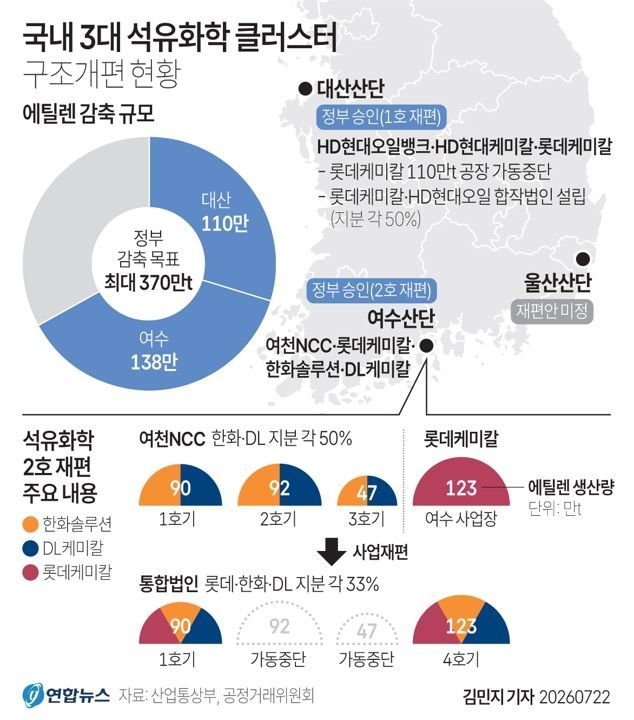
Petrochemical companies in the region have recently been enjoying a windfall from the conflict in the Middle East. Supply disruptions in the oil market have instead improved earnings across the petrochemical industry. In that situation, the urgency to push ahead with restructuring may have weakened. As business conditions briefly improved, differences among companies over restructuring have emerged, and the process appears to be stalling.
In particular, S-Oil's Shaheen Project, which involved an investment of about 9 trillion won, is the biggest variable holding back the restructuring talks. The facility, capable of producing 1.8 million tons of ethylene a year, is expected to begin full-scale operations next year. If that happens, it will add new production capacity equal to half of the government's overall target for output cuts.
Companies in Daesan and Yeosu have already agreed to join painful self-help efforts, so can it really be justified if only the Ulsan region brings large-scale new facilities online? The Shaheen Project cannot be excluded from the production-cut targets simply on the argument that it is an example of efficiency gains through preemptive investment. Allowing such claims to stand would amount to clear discrimination against companies that moved first on restructuring. In the broader picture, it is only reasonable to judge the project within the industry's overall reduction target.
If petrochemical companies deliberately delay restructuring or try to free-ride for their own reasons, that is no different from the domestic petrochemical industry harming itself. This restructuring is being pushed not because of domestic problems, but because the external environment has worsened. The global petrochemical market is now trapped in structural oversupply. Massive capacity expansions in China and aggressive low-price competition have pushed not only Korea but also other countries' petrochemical industries into a major crisis.
On top of that, the Middle East, which once only exported crude oil, has built its own production facilities and begun low-cost production. Combined with a fundamental oversupply structure driven by weakening global demand, the petrochemical industry has fallen into a true red ocean. The recent earnings rebound is only a temporary bounce caused by short-term factors such as instability in the Middle East. Thinking that the industry can simply settle for these short-term results would be a foolish calculation that would erode competitiveness on its own.
Delaying restructuring or trying to ride on the efforts of others under one excuse or another must not be tolerated. Petrochemical restructuring is not just about saving one industry. It is a matter of survival for a key national industry. We must not forget the original goal: reduce overlapping facilities, change the industry's structure, and restore global competitiveness by shifting toward high-value-added and eco-friendly products.