How Far Does Collective Bargaining Over 'Corporate Profit Distribution' Extend? Criteria and Cases to Be Clarified [Revising the Yellow Envelope Act]
- Input
- 2026-07-22 18:22:10
- Updated
- 2026-07-22 18:22:10
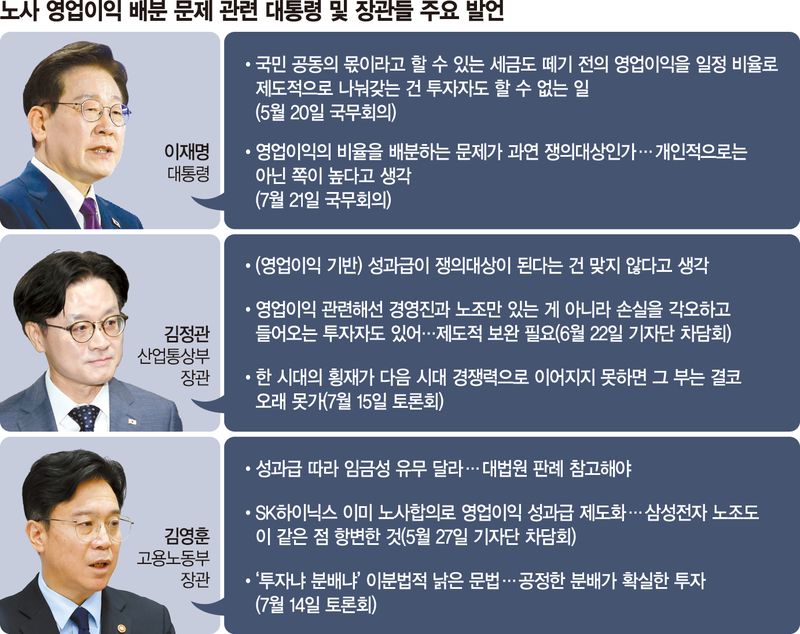
The current guidelines have drawn criticism for being difficult to apply in the field because they only state the principle that management decisions may become subject to labor disputes if they affect working conditions. In particular, as issues such as 'operating profit N% bonuses' have emerged without any clear benchmark in the existing guidelines, interpretation gaps among labor and management, ministries, and experts are widening.
■ Addressing gaps and ambiguities in interpretation guidelines
According to the government on the 22nd, MOEL is reviewing ways to supplement the interpretation guidelines for the revised Trade Union and Labor Relations Adjustment Act released in February. The key focus is to clarify the scope and timing of management decisions that may become subject to labor disputes, as well as whether profit-linked bonuses can be negotiated.
The current guidelines recognize management decisions themselves as an exercise of management rights, but state that if changes in working conditions occur during the implementation process, they may become subject to collective bargaining and labor disputes. However, they lack specific criteria for determining when such changes can be objectively expected.
That is why interpretations differ in the field over whether bargaining can be demanded at the stage when management decisions such as investment location choices, production facility relocations, mergers, spin-offs, sales, transfers, or workforce reassignments are announced, or only after layoffs or job transfers have been made concrete.
The current guidelines say that if layoffs or job transfers resulting from corporate restructuring are objectively expected, a union may demand bargaining over changes in workers' status and working conditions. But they do not provide specific examples of when such expectations become 'objective' or how to define 'most or a significant number of workers.' MOEL is therefore considering a more detailed classification of when bargaining and labor disputes are possible, depending on the type of management decision. It is also likely to strengthen the criteria for distinguishing decisions that fall under the authority of the board of directors or the General Meeting of Shareholders under the Commercial Act from matters directly linked to changes in working conditions.
■ Standards for 'operating profit N%' to be established
Another major target of the guideline revision is cases in which workers demand bonuses equal to a certain percentage of operating profit. The current guidelines cite court rulings and cases showing that bonuses can be included in bargaining agendas in negotiations between prime contractors and subcontractors. However, they do not separately explain whether a demand to pay a fixed percentage of operating profit as a bonus can be considered a legitimate subject of collective bargaining or labor disputes.
This lack of standards came into sharper focus during labor-management negotiations at semiconductor companies. The so-called 'operating profit N% bonus' demand became a key issue, but without an official benchmark, labor and management, relevant ministries, and academics and experts offered different interpretations.
The core issue is how far the distribution of operating profit can be decided through labor-management negotiations. If a certain percentage of operating profit is paid out as bonuses, it could affect a company's investment capacity, dividends, and financial structure, raising concerns that the issue could go beyond wage negotiations and encroach on the authority of the board of directors and shareholders.
MOEL is expected to outline the scope of possible bargaining and labor disputes by taking into account whether bonuses qualify as wages, existing payment practices and calculation methods, and the impact on a company's investment and financial structure. It is also likely to distinguish, case by case, how profit-linked bonuses differ from ordinary demands for wages and bonuses.
The Ministry of Trade, Industry and Energy is also reviewing related policy improvements, taking into account the impact of profit-linked bonuses on corporate investment and shareholder interests.
[email protected] Kim Jun-hyeok Reporter