Four SK hynix ADR-linked tokens surpass a combined market cap of 100 billion won
- Input
- 2026-07-22 18:12:01
- Updated
- 2026-07-22 18:12:01
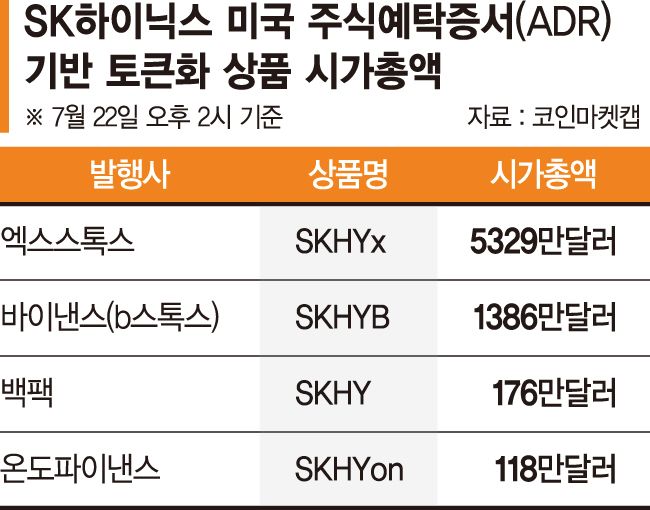
As of 2 p.m. on the 22nd, the combined market cap of SK hynix ADR-linked tokens stood at $70.09 million, or about 103.8 billion won, according to CoinMarketCap.
By token, SKHYx issued by Xstocks accounted for about 76% of the total, with a market cap of $53.29 million. SKHYB, distributed through Binance's tokenized stock service, bStocks, followed with $13.86 million. SKHY and SKHYon, issued by Backpack and Ondo Finance, respectively, recorded $1.76 million and $1.18 million.
SK hynix ADRs were listed on Nasdaq on the 10th. An ADR is a certificate that allows shares of a foreign company to be traded in U.S. dollars on the American market. Soon after the listing, Xstocks, Backpack and Ondo Finance launched tokens linked to the ADR price, and Binance also added an SK hynix token to bStocks.
The issuers say the tokens are created using ADRs as the underlying asset or collateral. Binance and Xstocks emphasize a structure backed one to one by the underlying security. Backpack said it designed its token so that one token can be redeemed for one actual ADR share.
But token holders do not have the same legal status as investors who directly own ADRs. Under contracts set by the issuer and intermediaries, investors receive price-linked gains or dividend-equivalent payments, as well as redemption rights. In effect, it is similar to buying a digital exchange voucher tied to the value of shares held by the issuer rather than the actual stock itself.
Investors therefore need to check not only for a decline in the ADR price, but also credit and operational risks at the issuer and custodian, whether the collateral assets are actually held, and whether assets can be segregated and redeemed if the issuer goes bankrupt. The handling of corporate actions such as dividends, voting rights and stock splits may also differ by product.
iM Securities classified these price-linked tokens as wrapper-style tokens, saying they are largely contractual claims against the issuer. By contrast, the tokenization service being pursued by DTCC is designed to preserve the legal and economic rights of existing securities held at a central depository, including ownership and dividends, while extending recordkeeping and transfer functions through blockchain.
[email protected] Kim Mi-hee Reporter