Semiconductor and Shipbuilding-Defense-Nuclear Stocks Have a Bright Outlook, but Share Prices Have Fallen to Half of Target Prices
- Input
- 2026-07-22 18:11:58
- Updated
- 2026-07-22 18:11:58
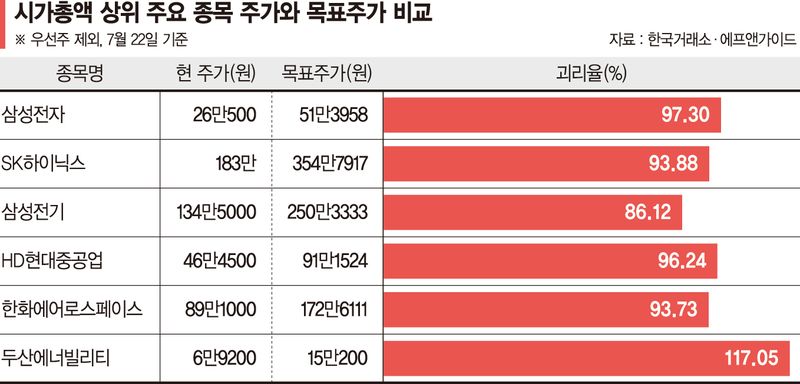
As the stock market took a breather, the gap between large-cap stocks' share prices and brokerage target prices widened to an average of more than 60%. While brokerages have been issuing target prices based on medium- to long-term earnings outlooks, share prices have swung sharply, pushing the gap much wider.
According to FnGuide on the 22nd, the average gap between current share prices and target prices for the top 20 stocks by market capitalization stood at 64.33% as of that day. That means brokerage target prices were 64.33% higher than actual share prices. Compared with the end of last year, when the figure was 25.04%, the gap has widened by about 2.5 times in just six months.
The widening gap appears to reflect the fact that brokerages are maintaining medium- to long-term earnings forecasts for large-cap stocks even as the KOSPI (Korea Composite Stock Price Index) has been swinging sharply in recent weeks. Among the top 20 stocks by market cap, five had target-price gaps of more than 90%. In some large-cap names, the gap even exceeded 100%. In effect, those stocks are trading in the market at roughly half of their target prices. This suggests that the gap between brokerage earnings estimates and the values assigned by the market is growing.
Samsung Electronics' target price was set at 513,958 won, putting its gap with the current share price of 260,500 won at 97.3%. SK hynix also posted a gap of 93.88%, with a target price of 3,547,917 won and a current share price of 1.83 million won. Samsung Electro-Mechanics, which is tied to the artificial intelligence supply chain, had a target price of 2.5 million won and a share price of 1.345 million won, resulting in a gap of 86%.
Stocks in the shipbuilding, defense, and nuclear power sector, which led last year's KOSPI rally, were no exception. HD Hyundai Heavy Industries had a target price of 911,524 won, compared with a current share price of 464,500 won, for a gap of 96.24%. Doosan Enerbility posted the widest gap among the top market-cap stocks at 117.05%, while Hanwha Aerospace also came close at 93.73%.
The widening gap between target prices and actual share prices is seen as a result of brokerages reflecting companies' medium- to long-term earnings and industry conditions. Although investor sentiment has weakened as the stock market has continued to swing sharply, fundamentals remain intact, including expectations for an improved semiconductor cycle driven by expanded artificial intelligence investment and order momentum for major export-oriented stocks such as shipbuilding and defense.
However, some say target prices do not fully reflect rapidly changing market conditions. Because target prices are usually calculated based on expected earnings and valuations over the next six months to a year, short-term shocks such as deteriorating investor sentiment, changes in supply and demand, and external variables are difficult to capture. Brokerages often keep target prices unchanged unless companies' earnings outlooks shift significantly. But the market itself reacts sensitively to concerns over an economic slowdown, interest rates, and geopolitical risks, repeatedly widening the gap between target prices and actual share prices.
A source in the financial investment industry said, "Rather than reacting to the target price number itself, investors should pay attention to why the target price was adjusted and how earnings forecasts have changed." The source added, "The more important investment point is how a company's fundamentals are changing."
[email protected] Park Ji-yeon Reporter