"Deposits Are Drying Up"...Retail Investors Rush Into Covered Call ETFs Amid Market Slump
- Input
- 2026-07-23 07:00:00
- Updated
- 2026-07-23 07:00:00
[Financial News] As the KOSPI (Korea Composite Stock Price Index) plunged and investor sentiment cooled, market analysts said individual investors are rapidly shifting their attention to covered call exchange-traded funds (covered call ETFs). The move appears to reflect a growing preference for monthly distributions and relatively stable cash flow over the pursuit of high returns in a rising market.
On the 21st, online stock communities were filled with posts from investors saying they had bought covered call ETFs, along with messages such as, "You should buy in a market like this." The mood suggested that many now see the downturn as a buying opportunity.
One investor wrote, "You should buy low-IQ covered calls in a market like this," while another user said, "Maybe I should start accumulating KOSDAQ covered calls. This really looks oversold."
Other reactions included, "I finished buying 30 shares of covered call ETFs. Now my deposits are drying up too," "KOSDAQ covered calls seem to have become a really attractive price," and "Unless the KOSPI crashes below 5,000 into hell, the current price looks tasty."
'Buying Only for Monthly Dividends Can Backfire'
A covered call ETF holds the underlying asset while simultaneously selling call options on that asset, using the option premium as a source of distributions. Because of the premium received from selling options, these products tend to offer stronger downside defense and more stable cash flow than ordinary index ETFs in sideways or gently falling markets, rather than aiming for large gains in a sharp rally.
That is why investors have recently been choosing covered call ETFs as a defensive investment tool as stock market volatility has increased.
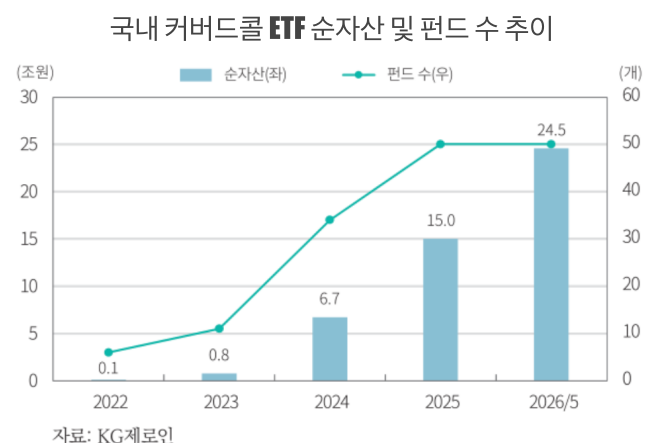
Capital flows also reflect this trend. So far this year, rising demand for monthly distributions, higher volatility, and new product launches by asset managers have driven rapid growth in the covered call ETF market, with a series of strategy-based products entering the market.
According to Koscom Corporation's ETF Check, KODEX 200 Covered Call Active ranked second in net individual buying over the past week, with retail net purchases totaling 146.1 billion won. TIGER Dividend Covered Call Active and covered call ETFs based on U.S. and Nasdaq-100 (NDX) assets also ranked among the top net buys by individuals.
Samsung Asset Management said on the 22nd that KODEX 200 Covered Call Active had surpassed 200 billion won in net individual buying just one week after its listing.
Listed on the 14th, the product is an evolved version of Samsung KODEX 200 Target Weekly Covered Call ETF, one of the flagship products in Korea's covered call market. Cumulative net individual buying has reached 245.1 billion won.
Song Ah-hyun, a manager at Samsung Asset Management, explained, "With the domestic stock market undervalued relative to earnings, a large amount of money from individual investors has flowed in as they try to turn the market's high volatility into an income opportunity." She added, "KODEX 200 Covered Call Active combines earnings momentum from leading domestic stocks with a flexible options strategy, aiming for both excess returns versus the benchmark and month-end distributions."
However, investors should not forget that a covered call ETF is not a product that protects principal. If the price of the underlying asset falls sharply, the ETF price will also fall. Even if distributions are paid, total returns can still turn negative if the decline in the share price exceeds those payouts.
The limitations of the covered call strategy also become clear in a strong bull market. Because call options are sold, gains above a certain level are given up to the option buyer, making returns likely to lag those of ordinary index ETFs. In both U.S. and Korean markets, there have been many cases in which standard index ETFs delivered higher total returns than covered call ETFs during prolonged bull runs.
Experts: "Look at Total Return, Not Distribution Yield"
Experts say it is natural for covered call ETFs to draw attention when market volatility rises, as it has recently. Still, they warn against investing based only on high distribution yields.
A report titled "Growth and Implications of Korea's Covered Call ETF Market," published in June by the Korea Capital Market Institute, explained that distributions from covered call ETFs are not "interest." They are paid from sources such as option premiums and capital gains, so a high distribution yield does not necessarily mean high returns. If the ETF price falls by a similar amount after the distribution is paid, investors may not actually see their assets grow.
The operating structure also varies widely by product. Some products are based on the KOSPI 200 Index, while others track the Nasdaq-100 (NDX). The share of options sold and the distribution policy differ as well. Some products give up a large portion of the underlying asset's upside in exchange for high payouts, while others leave room for some price appreciation.
A financial industry official said, "When a downtrend continues like this, covered call ETFs can look psychologically attractive." He added, "But rather than investing simply because money comes in every month, investors should consider total return, their investment horizon, and their own market outlook."
He also stressed that these are equity products that can incur losses depending on market direction. Rather than increasing exposure too aggressively just because they appear relatively defensive in a falling market, investors should distinguish their role from that of ordinary index ETFs and diversify according to their own risk preferences.
[email protected] Seo Yoon-kyung Reporter