Geopolitical Risks of a Simultaneous Blockade of the Strait of Hormuz and the Red Sea Hit, Raising Alarm Over a 'Logistics Cost Shock' for South Korean Exports
- Input
- 2026-07-23 06:29:00
- Updated
- 2026-07-23 06:29:00
[Financial News] With the Strait of Hormuz paralyzed by a full-scale war between the United States and Iran, and the Houthi rebels in Yemen imposing a 'full blockade of the Red Sea,' South Korea's export routes are facing an emergency. The global maritime supply chain, which had briefly entered a period of relief, is once again being pushed to the brink, reviving fears of a freight-rate explosion. Analysts say the unprecedented double geopolitical shock is tightening the noose around the export-driven South Korean economy, leaving domestic industries facing an unprecedented 'logistics perfect storm.'
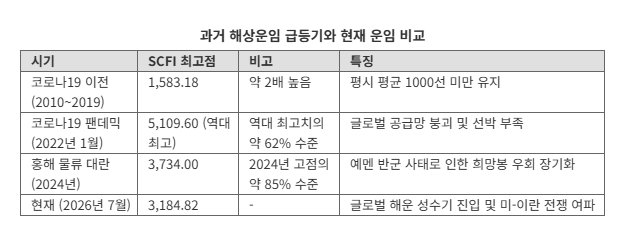
According to industry sources on the 23rd, the Shanghai Containerized Freight Index (SCFI), a key barometer of global shipping rates, stood at 3,184.82 in mid-July. That is close to the peak of 3,734 seen during the first Red Sea crisis in 2024, when logistics bottlenecks were at their worst. Compared with the pre-COVID norm of around 1,000, the index has already more than tripled. Market watchers are even warning that if the dual blockade drags on, it may only be a matter of time before rates surpass the pandemic-era high of 5,109 in 2022, when logistics networks were effectively paralyzed.
Shipping companies are also facing a complicated calculation. While higher freight rates may provide a short-term boost, the operational damage would be enormous. If vessels on Asia-Europe routes abandon the Red Sea and the Suez Canal and instead detour around the Cape Route off the Cape of Good Hope, round-trip sailing time would increase by at least two to three weeks.
That would directly translate into a massive increase in fuel costs. If vessel schedules are disrupted, the recovery rate for empty containers would also fall sharply. Korean carriers such as HMM can devise strategies to deploy substitute vessels, but capacity is limited, meaning the result would ultimately be weaker earnings.
The real problem lies with major South Korean companies in sectors such as automobiles, home appliances and batteries, where logistics costs account for a large share of expenses. If they fail to secure vessel space on time, export-bound goods will inevitably pile up at factory yards and ports.
An industry official said, "We are closely watching this because it comes at a time when year-end push shipments are concentrated ahead of peak global consumption seasons such as Black Friday in the fall." The official added, "If freight rates, which have been in a lull for the past two weeks, surge again, it could turn into a 'pretty shell with nothing inside' even if products are sold."
In fact, LG Electronics suffered deteriorating profitability from rising logistics costs despite posting record-high sales in 2024. At the time, an LG Electronics official explained, "In the second half of 2024, unexpected spikes in global maritime freight rates and one-off costs related to inventory normalization amid business uncertainty affected profitability."
In the first half of this year, Hyundai Motor Company also struggled with higher logistics costs caused by the Middle East war, disruptions in parts supply, the Hyundai Palisade recall, and slowing domestic sales. Hyundai Motor Company's domestic sales from January to May this year totaled 258,481 units, down 11.7% from 292,836 units in the same period last year.
A conglomerate official said, "As the Middle East powder keg drags on, operating profits at major export companies in the second half of the year could also continue to suffer." The official added, "It is more urgent than ever for the government to provide emergency vessel-space support and prepare measures to offset logistics costs for small and mid-sized companies."
[email protected] Kim Dong-ho Reporter