"Even if They Don't Want to, Villas Are the Only Option" ... Why Have Villas and Other Non-Apartment Homes Become Objects of Distrust? [The Bottom Rung of the Housing Ladder, 1]
- Input
- 2026-07-23 07:30:00
- Updated
- 2026-07-23 07:30:00
Non-apartment housing, represented by villas, is not a place people choose because they want to live there. It is a place they end up living in because they have no other option.Non-apartment housing, often described as the last rung of the housing ladder, has prompted residents and experts aliketo think about how it can become a more desirable place to liveand to call on the government to join that effort.
[Financial News] #1. During the summer monsoon of 2021, mold spread around the window frame. She also could not rest comfortably because she lived in a shared house.At the time, Lee Cheol-bin, then a 27-year-old office worker, decided to find a place of her own. Jeonse fraud and no-capital gap investment schemes were making headlines every day, but she was working in housing lease management at a real estate startup and was confident she knew better than anyone which documents and procedures had to be checked before signing a contract.
She personally reviewed the registry record and building register, and carefully examined ownership rights with a licensed real estate agent. But there was one fact no one told her at the time.
The landlord had more than 6 billion won in unpaid taxes and was a lessor who had bought more than 1,000 homes through no-capital gap investments worth hundreds of billions of won. Then one day, she learned that the tax office had placed a seizure on the house. She could no longer reach the landlord.
Lee immediately realized, "I was a victim of jeonse fraud."
Five years later, she now works in a new role at a new workplace. She is a co-chair of the National Countermeasure Committee for Victims of Jeonse Fraud and "Kangtong Jeonse."#2. Kim Jin-ju, 36, who had been living on jeonse in the so-called Nodogang area, recently became a homeowner unexpectedly. After her landlord told her that renewing the lease would be difficult, she looked for nearby apartment jeonse listings, but it was not easy.She weighed whether to buy a newly built villa in good condition, despite the cost burden, or an older apartment with outdated facilities. She chose the latter.
She was worried that when it came time to sell again, the villa might not be valued at its purchase price. She also feared she might not find a buyer when she wanted one.
Concerns about the lack of a secure main entrance, no security staff and other issues also played a role. Once she considered parking, the management office and on-site amenities, she concluded that it would be better to pay more and choose an apartment.
Advice from people around her also mattered: "Don't buy a villa, even if you plan to live there," and "If you want to sell later, it has to be a large apartment complex."
A house that is cheap but reluctant to own
The cases of Lee and Kim, interviewed by Financial News on the 22nd, show the contradiction of non-apartment housing. For households that cannot afford to buy or rent apartments, villas, multi-family homes, row houses and officetels are essential living spaces.
According to a March report by the Korea Research Institute for Human Settlements titled "The Avoidance of Non-Apartment Homeownership and Housing Policy Tasks," non-apartment homes, excluding luxury villas and high-end officetels, were less expensive than apartments. In Seoul, the price-to-income ratio for apartments was 15 times annual income, while non-apartment homes stood at 7.9 times. The rent-to-income ratio was also lower, at 39.5% for apartments and 20.8% for non-apartment homes.
For households without enough income or assets, or those that need to stay in a particular workplace or living area, non-apartment housing is a practical option. Even so, it has not been accepted as a place to live in long term or as a true home.
In a survey asking respondents what type of home they would most like to buy for the first time in their lives, 79.7% chose apartments. Non-apartment housing was widely seen as a temporary rental option for people short on assets.
Some analysts also say the recent rise in Seoul villa prices and transaction volume should not be seen as a recovery in preference.
According to the Korea Real Estate Board (KREB), the nationwide composite apartment price in Seoul rose 4.52% in the first half of this year, far above the 2.34% increase in the same period last year. Prices for row houses and multi-family homes rose 4.26%, up from 0.89% a year earlier. Apartment prices also climbed, from 3.41% to 5.07% over the same period.
Transaction volume also increased. According to Dabang, which analyzed Ministry of Land, Infrastructure and Transport transaction data, apartment-style row house and multi-family home sales in Seoul totaled 19,273 from January to May, up 45.8% from a year earlier.
Park Won-gap, chief real estate expert at KB Kookmin Bank, called this a "statistical illusion."
Park said, "The recent increase in villa transactions in Seoul cannot be seen as a recovery in preference for villas themselves," adding, "It is largely a form of parked investment, with buyers hoping to receive future apartment ownership rights through redevelopment or maintenance projects." In other words, demand is driven more by the possibility of acquiring an apartment later than by the residential value of the villa itself.
The structure that pushed people away from non-apartment housing
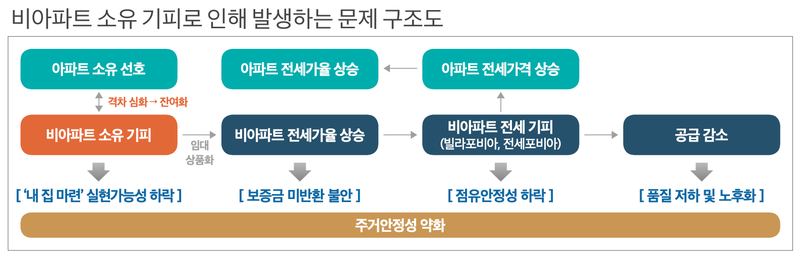
The avoidance of non-apartment housing cannot be explained simply by a preference for apartments. Tenants face the risk of not getting their deposits back, while owners bear the burden of falling prices and weak liquidity. During daily life, they also feel the gap with apartments in parking, security, cleaning, waste disposal and building repairs.
What most sharply deepened negative perceptions was jeonse fraud. The damage was concentrated in multi-family homes and officetels.
According to an analysis by the Korea Research Institute for Human Settlements, apartments accounted for 50% of all jeonse households, but only 13.6% of jeonse fraud victims lived in apartments. By contrast, 29.3% of victims lived in multi-family homes and 20.9% lived in officetels.
The average jeonse-to-sale price ratio for row houses and multi-family homes from 2014 to 2024 was 88.2%, higher than the 74.4% for apartments. In particular, from 2020 to 2022, the average ratio exceeded 90%, meaning many contracts were signed in which even a slight drop in housing prices could make it difficult to return the deposit.
Non-apartment housing is not an attractive asset for owners either. Prices can fall through depreciation, and low transaction volume makes it hard to sell when needed. There is also concern that owning even one non-apartment home could hurt eligibility for no-homeowner status or subscription opportunities.
The Korea Research Institute for Human Settlements said that although non-apartment homes are relatively affordable, they are not accepted as a path to homeownership because of fears of asset value decline and lost subscription opportunities. In other words, they do not function well as an asset that helps households move up to the next step on the housing ladder.
Same type of housing, but very different management
The difference in living conditions between apartments and non-apartment homes is also clear.
Apartment systems are designed from the supply stage to include access roads, parking lots, management offices and community facilities. For complexes above a certain size, systematic management rules such as professional staff and long-term repair plans are applied.
By contrast, many multi-family and row houses are built individually on small lots, making it difficult to have a management office or full-time staff. Because there are fewer households, it is also harder to secure elevators, parking spaces, security facilities and resident amenities.
The Korea Research Institute for Human Settlements said non-apartment homes supplied in an unplanned way on small lots are inferior in terms of parking, safety, sanitation, green space and facility management.
The 2023 housing survey also found that apartments scored higher than non-apartment homes in every category of housing condition and residential environment satisfaction. The gap was especially large in cleaning and waste disposal, security, pedestrian safety and access to parks and green space. The green coverage rate in apartment complexes in Seoul was 27.4%, compared with just 14.4% in low-rise residential areas.
Kim's choice of an older apartment over a newly built villa was also based on her view that the living environment and management system outside the home mattered more than the interior itself.
Non-apartment housing is a housing issue for everyone
Non-apartment housing is not just for young people and single-person households. Newlyweds and families with children who cannot easily enter the apartment market, middle-aged people who must live in a certain area because of work or caregiving, and older adults with reduced incomes also rely on the non-apartment market.
If non-apartment housing remains unstable and inconvenient, the damage will fall heavily on the groups that have no choice but to use it. There are growing calls to change a structure in which people who cannot secure apartments must accept lower housing quality, deposit risk and falling asset values.
Kim Deok-rye, a senior research fellow at the Housing Industry Research Institute, said, "The problem with non-apartment housing is not simply about supplying a few more villas," adding, "It is about restoring the bottom rung of the housing ladder used by people who cannot easily enter the apartment market."
She added, "Not every household can buy or rent an apartment," and emphasized, "We should not eliminate the multi-family, row house and officetel markets. Instead, we need to improve them so they have quality, safety and management systems closer to those of apartments."
The government is also reviewing ways to revitalize non-apartment housing as an alternative to supply shortages. At a town hall meeting with the housing construction industry in May, the Ministry of Land, Infrastructure and Transport was asked to promote new-build purchase rentals, ease financial regulations, exclude small officetels from housing counts and extend tax support for urban-type housing.
However, there are concerns that simply increasing supply through tax and financial incentives could repeat the same structure that has long pushed non-apartment housing out of favor. Attention is now on whether the issue will be placed on the table at the real estate policy forum to be held on the 23rd, chaired by President Lee Jae Myung.
[email protected] Seo Yoon-kyung Kim Hee-sun Reporter