[Exclusive] "Relocating the Gwacheon racetrack will take more than 16 years" ... 2029 housing start plan in doubt
- Input
- 2026-07-21 18:20:24
- Updated
- 2026-07-21 18:20:24
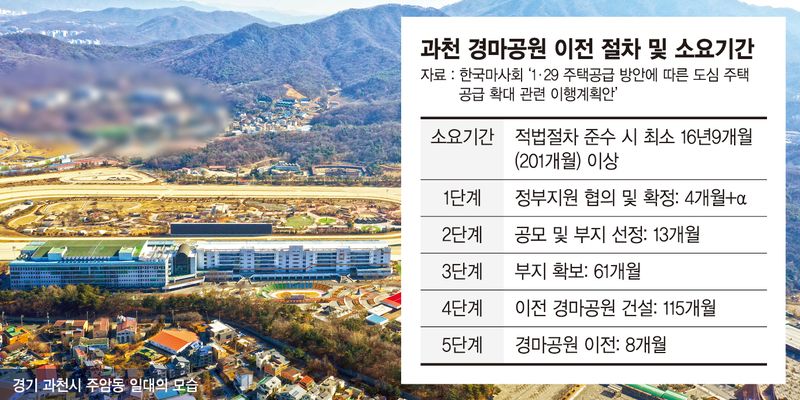
According to the "Implementation Plan for Expanding Urban Housing Supply Under the Jan. 29 Housing Supply Measures," obtained by Financial News on the 21st, KRA estimated that relocating Lets Run Park Seoul would take at least 16 years and nine months, or 201 months. It said securing a relocation site alone would take at least six years and six months, or 78 months, and that building a new racetrack would take more than 10 years.
KRA submitted the plan to the Ministry of Agriculture, Food and Rural Affairs (MAFRA) on the 7th. MAFRA is said to have sought review opinions from related agencies, including the Ministry of Land, Infrastructure and Transport, the Ministry of the Interior and Safety, and Gyeonggi Province.
If KRA's timeline is followed, the relocation site would not be secured until after 2032, more than three years later than the government's target of 2029. Even after the site is secured, the housing start date on the Gwacheon site could be pushed back further because the existing racetrack must still be shut down, facilities moved and the land prepared.
Earlier, the Ministry of Land, Infrastructure and Transport announced in its Jan. 29 housing supply package that a total of 9,800 homes would be supplied on the Defense Counterintelligence Command site adjacent to the Gwacheon racetrack. The original plan called for a relocation plan to be drawn up by the first half of this year and for construction to begin in 2030. In May, Deputy Prime Minister and Minister of Finance and Economy Koo Yun-cheol moved the target start date up to 2029.
Among the sites included in the Jan. 29 package, the Gwacheon racetrack area is the second-largest housing supply project after the Yongsan International Business District in Seoul, which is slated for 12,600 homes.
Project costs and support methods are also major points of contention. Excluding land purchase costs, KRA proposed a total relocation budget of 2.3879 trillion won, including 2.2907 trillion won in construction costs and 97.2 billion won in moving expenses. On compensation for the racetrack site, it said support should be based not on officially assessed land prices but on a level that would actually allow it to secure a new relocation site.
The plan also includes a lower leisure tax rate, a reduction in the leisure tax in Gyeonggi Province, the relocation of KRA headquarters, the creation of a horse culture and history park on the Gwacheon site, and eased limits on horse betting purchases. KRA said these measures are intended to reduce revenue losses and operational uncertainty during the relocation process.
Related ministries remain split.
MOLIT said the basic principle is to compensate relocation costs after an appraisal. A ministry official said, "When a public institution is designated for relocation, the institution sells its site and moves according to its own plan," adding, "Whether the government provides support is a matter for MAFRA to decide."
Gyeonggi Province says national projects should be backed by central government funding rather than local finances. It is also reported to have said it would be difficult to accept a leisure tax cut because it could reduce local tax revenue. MOIS is also said to have raised concerns that lowering the leisure tax rate could weaken local fiscal independence and create tax fairness issues with other industries. The Ministry of Planning and Budget is also reviewing the scale of government funding.
MAFRA says it will push ahead with the 2029 construction target through consultations with related ministries.
A MAFRA official said, "The timeline proposed by KRA is simply the sum of the procedures that need to be carried out in sequence," adding, "Since the relocation site has not yet been decided, costs and the time required can still be adjusted during consultations with related ministries." The official added, "We plan to flesh out support measures during the relocation and public offering stages."
The KRA union said support measures and a feasibility review should come before any relocation push.
Park Geun-mun, head of the KRA union, said, "Relocation is a matter that requires a board resolution," adding, "A financial plan must be prepared to cover the cost of developing a new site and the relocation expenses."
[email protected] Choi Yong-joon Kim Chan-mi Reporter