[Editorial] Why can’t we remove the regulatory nails blocking robot development and hydrogen vehicle charging?
- Input
- 2026-07-21 18:17:02
- Updated
- 2026-07-21 18:17:02
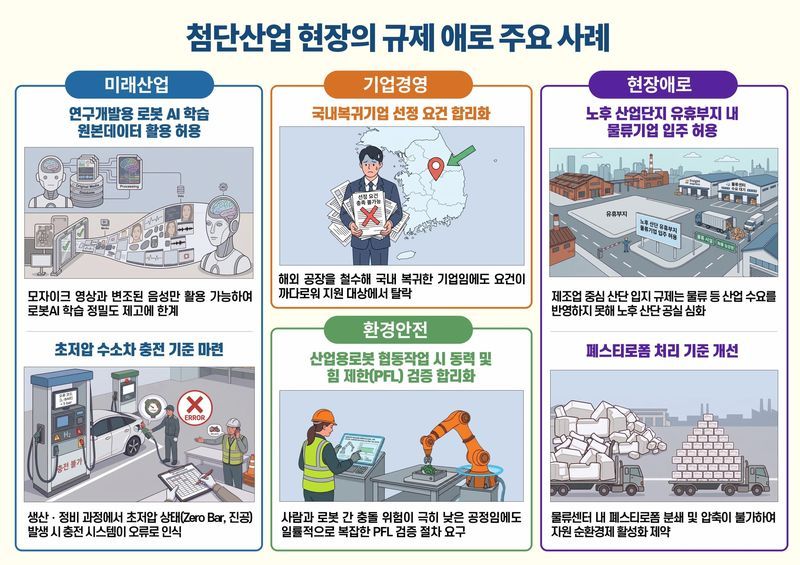
If robots rely on processed data, there is no choice but to face limits in accuracy. To overcome technical barriers, they must be able to learn subtle movements, unexpected behavior, and warning signs precisely from original data. If such rigid standards are maintained, technological development will inevitably fall behind.
It is understandable that regulations are justified in the name of protecting personal information and privacy. But a blanket ban on using original data at the research and development stage for robots is an overly simplistic and complacent way to manage things. Similar criticism was raised over self-driving cars. In the end, the government lifted restrictions on original video data on the condition that security and bans on use for other purposes were in place. Yet robots are still subject to strict standards. There is neither fairness nor flexibility.
The same applies to regulations related to hydrogen vehicles. Not only are charging standards for ultra-low-pressure FCEVs unclear, but the placement standards for mobile hydrogen refueling stations are also vague. Questions about duplicate safety performance assessments for new charging stations continue to be raised. Strict safety management is necessary because hydrogen is handled at high pressure. However, blocking production and maintenance while offering only vague standards in the name of risk is a textbook case of desk-bound administration.
Regulations that choke off industry are everywhere. According to KEF, there have been many cases in which companies seeking to shut down overseas plants and return to Korea were excluded from support because the requirements were excessively strict. Warehouses cannot be built on vacant land in aging industrial complexes, and transportation businesses face restrictions on entry. Logistics centers are also violating rules if they crush and compress discarded Styrofoam on site. As these regulations pile up, investment costs rise and business uncertainty grows, driving companies away.
Labor regulations also need to be revised to reflect reality. For years, critics have pointed out that companies struggle with workforce management because the standards and procedures for dismissing long-term low performers are unclear. Worker protection is necessary, but without flexibility, both diligent workers and companies suffer. The list of permitted dispatched work, which has not changed for nearly 20 years, should also be reviewed in line with changes in industrial structure.
Every time a new administration takes office, it announces a regulatory innovation roadmap and a regulatory sandbox. The principle of "allow first, regulate later" has also been emphasized countless times. But the reality on the ground has not changed. That is why the heads of major business groups gathered in Jeju Island last weekend and spoke with one voice about sweeping away outdated regulations.
This is an era of fierce competition for a lead in new industries. The United States and China are pouring massive amounts of capital and talent into AI and robot infrastructure. The outcome of technological competition depends on who can experiment and commercialize faster. If we fall behind not because of our technology, but because of regulations written decades ago and complacent administration, who will be responsible?
A system that restricts the use of technology under the banner of protection will only hold back industrial and economic progress. The right approach is to allow broad use at the research and development stage, while strengthening accountability standards at the commercialization stage. Above all, the regulatory nails blocking new industries must be pulled out quickly.