KOSDAQ Shrinks Further as Trading Value and Turnover Halve in a Month [Emergency Over Market Volatility Management]
- Input
- 2026-07-21 18:16:22
- Updated
- 2026-07-21 18:16:22
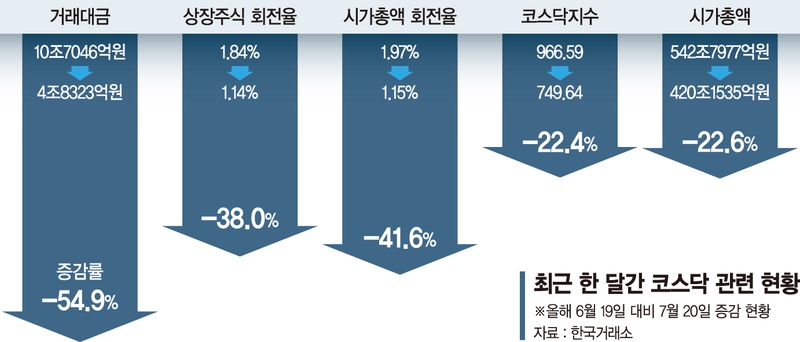
According to the Korea Exchange on the 21st, KOSDAQ trading value stood at 4.8323 trillion won as of the 20th. That followed 4.7204 trillion won on the previous trading day, the 16th, marking two straight days below the 5 trillion won level. When daily KOSDAQ trading value remains under 5 trillion won for consecutive sessions, it signals a sharp contraction in market participation.
The pace of the decline in trading over the past month has been much steeper than the drop in stock prices. Trading value fell 54.9% from 10.7046 trillion won on June 19 to 4.8323 trillion won a month later. Over the same period, the KOSDAQ Index dropped 22.4% from 966.59 to 749.64, while market capitalization fell 22.6% from 542.7977 trillion won to 420.1535 trillion won. With the index and market cap down only in the 20% range, trading value has plunged by more than half, showing that trading activity is cooling faster than prices.
The liquidity squeeze is even more evident when compared with May 27, when single-stock leveraged exchange-traded funds (ETFs) tied to Samsung Electronics and SK hynix were listed. At that time, KOSDAQ trading value reached 15.2784 trillion won, but it had fallen to 4.8323 trillion won on the 20th, a drop of 68.4% in less than two months. Trading value shrank by 10.4461 trillion won over that period, indicating a sharp reduction in the amount of money flowing into the market.
Trading volume is also falling sharply. Daily volume dropped 57.0% from about 1.229 million shares on May 27 to about 528,000 shares on the 20th. As investor participation in trading has declined significantly, turnover itself has slowed.
The deterioration in liquidity is also reflected in turnover ratios. Over the same period, the turnover ratio for listed shares fell from 2.51% to 1.14%. On a recent one-month basis, it also declined from 1.84% to 1.14%. Market cap turnover dropped from 2.41% to 1.15%, less than half its previous level. Looking at the past month alone, it fell from 1.97% to 1.15%. Turnover is a key liquidity indicator that shows how actively listed shares or market capitalization are traded over a given period. In general, the lower the turnover ratio, the weaker the market participation, and the greater the likelihood that even small trades will amplify price volatility.
Right after the launch of the single-stock leveraged ETF, KOSDAQ's five-day average trading value was 12.7416 trillion won. The recent five-day average, however, has dropped to 6.0201 trillion won, less than half that level. This suggests that the weakness is not temporary, but rather a sign that liquidity across the market is weakening structurally.
Market watchers say funds are concentrating on large semiconductor stocks in KOSPI, while retail investor participation in KOSDAQ is shrinking quickly. They add that recent declines in margin trading and a growing preference for lower-risk assets are hitting the KOSDAQ market, which is centered on small- and mid-cap growth stocks, particularly hard.
The liquidity squeeze does more than reduce trading volume. When trading thins out, the market's price-discovery function also weakens. If buy-side cash waiting on the sidelines diminishes, even a small amount of selling can move stock prices sharply. Rising volatility can then further dampen investor sentiment, creating a vicious cycle. That is why there are concerns that corporate fundraising conditions will also worsen.
Jae-hong Yoon, a researcher at Mirae Asset Securities, said, "KOSDAQ has suffered the biggest neglect since the market was launched, compared with KOSPI, due to earnings improvements centered on large semiconductor stocks and concentrated liquidity flows, and the sharp decline in average daily trading value is creating a structure in which even small shocks can lead to larger drops."
He added, "This downturn differs from past episodes in that retail investors are continuing to leave the market." He said, "If regulations on single-stock leveraged ETFs are implemented, the concentration of funds may ease somewhat, so additional policies to revitalize the KOSDAQ market should also be pursued."
[email protected] Choi Du-seon Reporter