Global oil prices surge again as government signals higher ceiling for fuel prices
- Input
- 2026-07-21 18:14:23
- Updated
- 2026-07-21 18:14:23
On June 21, President Lee Jae-myung presided over the 31st State Council of South Korea meeting at Cheong Wa Dae and said, "Under the original plan, we would have lowered the ceiling further or abolished it by now." He added, "It seems we should strengthen it instead."
The government had initially planned to lower the ceiling price for petroleum products and phase it out gradually as the Middle East war moved toward an endgame. However, renewed attacks on commercial vessels by Iran, fresh U.S. airstrikes, and Iran's scrapping of a memorandum of understanding (MOU) led to another blockade of the Strait of Hormuz, pushing global oil prices back into the high $80s per barrel. Deputy Prime Minister Koo explained, "Since oil prices are rising, we will decide the ceiling price while taking market trends into account."
The government is currently managing the seventh ceiling price, which was lowered by 150 won per liter, to ensure the reduction is quickly reflected in petroleum product prices.
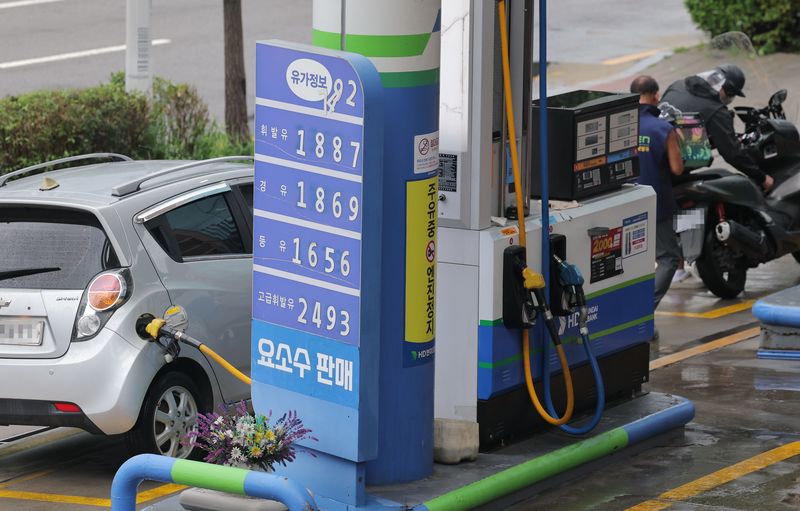
Deputy Prime Minister Koo said, "For petroleum products, gasoline prices exceeded 2,000 won per liter on June 26, and diesel was 1,996 won, but now gasoline is at 1,872 won per liter and diesel at 1,857 won, down by more than 130 won."
The government also plans to expand imports of eggs and mackerel to supply them at lower prices and to make all-out efforts to stabilize food prices through discount events and other measures. Deputy Prime Minister Koo emphasized, "In particular, retail prices of eggs, mackerel and chicken, which are of great interest to the public, are down 3% from the end of June," adding, "We are expanding imports and holding discount events to stabilize prices as much as possible."
The supply chain is monitoring trends in the supply and demand of key items based on a traffic-light system. Deputy Prime Minister Koo said, "There are about 40 priority items, and we reviewed them overall in response to the recent rise in petroleum product prices." He added, "There are currently no red or orange lights, only yellow or green, but the government will not be complacent and will closely monitor the supply chain with vigilance."
In employment policy, the K-New Deal Academy, which uses training facilities and other resources from large conglomerates to educate young people, began at eight companies in July. The number of participating companies is set to rise to 30 in August. Boot camps that provide advanced semiconductor and Artificial Intelligence (AI) training at universities are currently operating at 95 universities, and the government plans to expand that number to 108 by September.
Deputy Prime Minister Koo said, "The government will continue to make every effort to help young people build expertise, train 200,000 specialists in semiconductors, AI and other fields, and create more than 300,000 jobs, while continuously preparing and reviewing measures."
In foreign exchange policy, the government is drawing up a roadmap for the internationalization of the Korean won and is pushing ahead with both the global use of the currency and risk management.
[email protected] Seo Young-joon Reporter