“Korean Youth Flocked to 2x ETFs” Amid Government Policy Failure ... Foreign Media’s Diagnosis and Criticism
- Input
- 2026-07-21 16:43:22
- Updated
- 2026-07-21 16:43:22
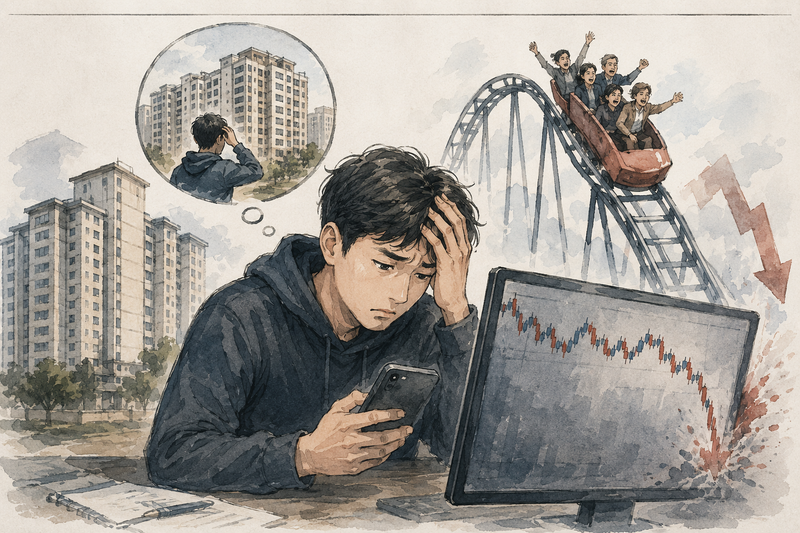
[Financial News] A foreign media report has said that young people who feel they cannot build assets normally because of soaring home prices in Seoul are being pushed into high-risk leveraged investing. The government allowed single-stock leveraged exchange-traded funds (ETFs) tied to Samsung Electronics and SK hynix in an effort to boost the stock market, but critics say the move only increased volatility and widened losses for individual investors.
On the 21st, a foreign outlet highlighted South Korea's high-risk investment culture by introducing the case of a 24-year-old investor who lost about 300 million won in just four weeks during the recent swings in the South Korean stock market.
The investor, identified as Lee, began investing with 20 million won saved during military service and at one point grew his holdings to 300 million won. But a sharp drop in semiconductor stocks, combined with the volatility of single-stock leveraged ETFs, wiped out most of his gains and even much of his principal.
Lee said, "I felt a sense of loss, and I feel pressure that I may never be able to live the way I did before," adding, "It is literally so hard that I can barely breathe."
The foreign outlet pointed to surging home prices as the background to this investment frenzy. With the average price of an apartment in Seoul reaching about 14 years of an office worker's annual salary, young people are feeling that saving and wage income alone cannot get them onto the housing ladder.
For some young people who have concluded that buying a home is effectively impossible, stock and cryptocurrency investing has come to be seen not as a choice but as the only way to grow wealth. Expectations of large gains in a short period also helped drive a rapid spread of investing with loans and leverage.
Lee also said, "I felt like I was living in an era where I could not buy real estate," and added, "Stock investing seemed like the only path to salvation."

A blocked asset ladder ... young people look to stocks for a way to turn their lives around
The foreign outlet analyzed that South Korea's real estate market and financial policies have fueled speculative demand among young people. It argued that as rising home prices blocked the traditional path to asset accumulation, the government further increased risk by lowering the barrier to high-risk investment products.
It paid particular attention to the end of May, when a large number of single-stock leveraged and inverse ETFs based on Samsung Electronics and SK hynix were listed. As expectations for semiconductor stocks peaked, products that track twice the daily return were launched, and individual investors quickly poured in money.
But once the underlying stock prices fell sharply, losses in leveraged ETFs snowballed. Single-stock leveraged ETFs can deliver high returns in a rising market, but if prices fluctuate, losses can grow through compounding effects. The longer they are held, the wider the gap becomes between the return on the underlying asset and the actual investment performance.
Margin loan balances also surged to dangerous levels. Outstanding margin loans in the domestic stock market hit a record 38.63 trillion won on the 24th of last month. Total securities-related lending, including stock-backed loans, exceeded 60 trillion won as of the end of May.
That is why critics say price volatility became even greater as high-risk products were approved one after another in an already overheated market.

When launched, it was about "boosting the stock market" ... but action came only after the damage grew
As losses among individual investors spread, the financial authorities on the 16th temporarily suspended new listings of single-stock leveraged ETFs and introduced follow-up measures restricting advertising and promotional activities.
However, the market says the fact that measures were introduced less than two months after the products were launched suggests the review and approval process was not sufficiently thorough. Critics say high-risk products were put on the market before investor protection measures were in place, and regulators only reacted after losses had already grown.
One market expert said, "The authorities are effectively acknowledging that the product launch was far too rushed," adding, "This measure can be seen as a belated attempt to correct an already exposed policy mistake."
The single-stock leveraged ETF controversy is once again raising the question of what the financial authorities' policy priority really is: boosting the stock market or protecting investors. Debate is also expected to intensify over whether opening high-risk financial products to young people who feel shut out of asset building by rising home prices expands opportunity or creates a trap that leads to even greater losses.
[email protected] Kim Kyung-min Reporter