President Lee orders improvements to leveraged ETFs, says government will take bold action where needed
- Input
- 2026-07-21 14:54:39
- Updated
- 2026-07-21 14:54:39
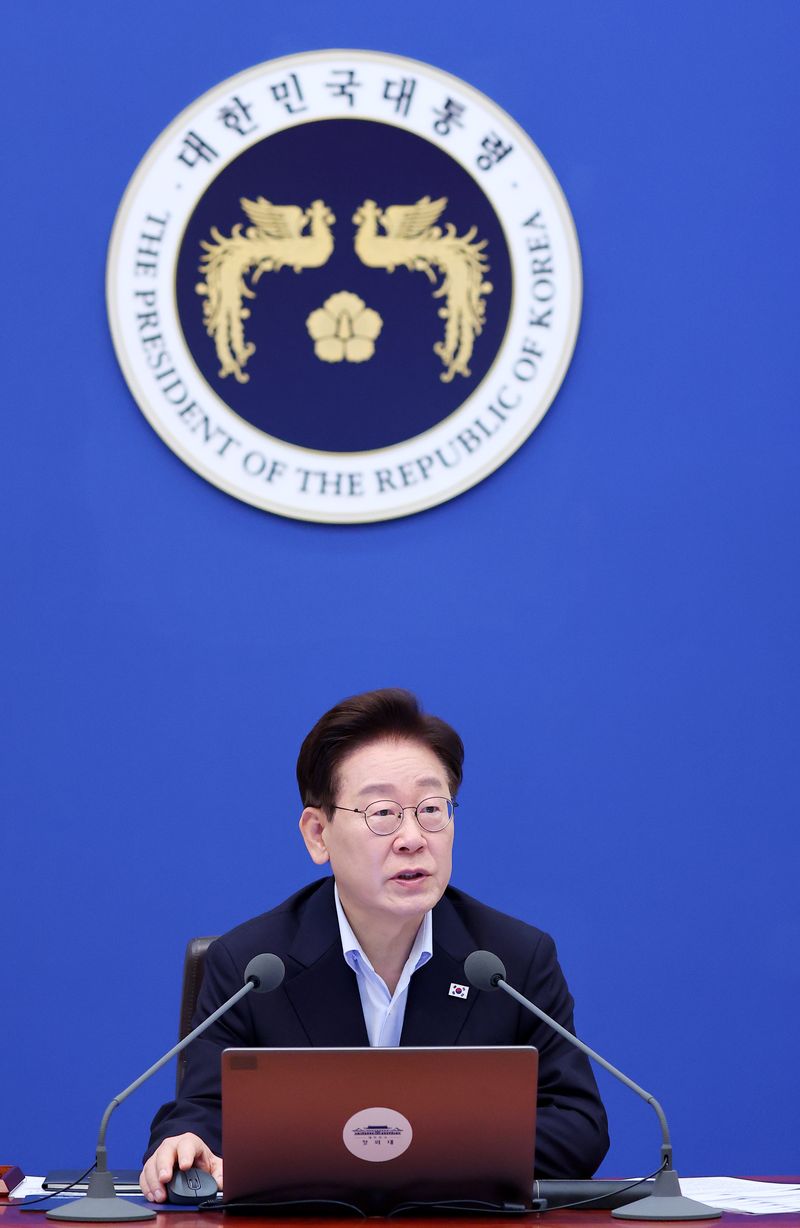
[Financial News] President Lee Jae Myung said on the 21st that the government should "respond quickly and take even bolder action where necessary" regarding the issue of single-stock leveraged exchange-traded funds (leveraged ETFs), which are seen as a major cause of sharp stock price swings. He added that "it seems to be taking too long." He also addressed the widening real estate divide, saying, "Along with supply measures that move at a faster pace, we will carefully prepare support measures for actual homebuyers that fit reality." On real estate taxation, he said it would be rationally reworked to meet public expectations.
At the Cabinet meeting he chaired at Cheong Wa Dae, Lee said, "Because there are leveraged products that are two or three times larger overseas, domestic investors have been putting money there. So Samsung and Hynix developed a two-times leveraged product to absorb that demand at home, but there are criticisms that it deepened a kind of correction amid the stock rally." He added, "There are differing views on this. Some say it worsened instability in the stock market, while others say it had the intended effect of reducing foreign exchange outflows."
Lee told Lee Eok-won, chairperson of the Financial Services Commission, that "it seems clear that this became one source of complaints from domestic investors." He added, "In an uptrend, doesn't it intensify the rise, and in a downtrend, doesn't it deepen the fall?"
He continued, "The authorities may have been aiming for policy effects in terms of stabilizing the exchange rate, but the public is not in a position to consider all of that." He stressed that, from the perspective of stock market participants, "the policy inefficiency or problem is much greater, so supplementary measures must be prepared quickly and thoroughly."
Lee also called for follow-up measures on the government's recent plan to improve leveraged products, saying, "There are also criticisms that this alone will not be enough." He noted that the policy may have created the impression that the problem was more serious than it actually was because it was introduced at the peak of a sharp rally. Still, he repeated that market participants felt the volatility and losses had worsened because of it, adding, "It is our responsibility to come up with supplementary measures."
The meeting also included criticism of real estate windfall gains. Lee said, "Above all, real estate windfall gains driven by illegal and expedient practices have destroyed the common sense of fairness in our society and become the biggest culprit undermining national unity."
He added, "Stabilizing the real estate market is one of the most important prerequisites for easing polarization. Our current real estate market is a major cause of asset inequality, household debt, and the deepening pain and alienation of young people." He said that extreme speculative demand and anxiety have become intertwined, locking a significant amount of social capital into unproductive real estate and holding back economic development.
Lee also said that normalizing the real estate market would make it possible to reinvest resources productively, restore social dynamism, and find a path to resolving conflicts caused by polarization. He pledged to introduce supply measures that move quickly. He added that the tax system would also be reworked fairly and rationally based on public common sense and expectations.
Lee plans to hold a public forum on real estate on the 23rd to gather opinions. He emphasized, "To move beyond the ruinous real estate republic and toward stable housing and productive economic growth, I will humbly listen to the voices of our people and use them to develop feasible alternatives and measures."
Lee also took a negative stance on whether a certain share of operating profit should be distributed to workers at major companies such as Samsung Electronics and SK hynix, saying the view that it should be treated as a labor dispute is "more likely not the case." In response to the Samsung Electronics labor union's claim that the issue should be part of labor-management negotiations over the planned semiconductor plant at the Gwangju Military Airport site, he said the exercise of management rights in general cannot be subject to labor disputes and instructed MOEL to establish clear standards.
On the growing uncertainty in the Middle East, he said, "The situation in the Middle East is worsening again, and there is no clear sign of an early end to the war or a ceasefire, so we need to pay close attention to its impact on domestic prices." Regarding the oil price cap system, he added, "According to the original plan, we should have lowered it further or abolished it by now, but it seems we may need to strengthen it instead."
[email protected] Choi Jong-geun, Seong Seok-woo Reporter